

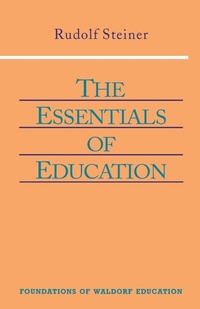
The Essentials of Education
(Cw 308) Volume 18
4th Edition
Published on 1. February 1998
Book
Paperback/Softback
104 pages
978-0-88010-412-8 (ISBN)
Description
These five talks were given during an educational conference in 1924. They are the last public lectures given by Rudolf Steiner in Germany. According to one member of his audience, "Seventeen hundred people listened to him; the prolonged applause from this great crowd at the end of every lecture was deeply moving, while at the end of the last lecture the applause became an ovation that seemed as if it would never end." This kind of adoration was the result not only of who Steiner was as an individual but of what he accomplished as well. People had already begun to realize the potential and the promise for the future that Waldorf education held out to the children of the world.
The Essentials of Education, together with its companion book, The Roots of Education, present a remarkable synthesis of what Waldorf education is and what it can become. The Waldorf "experiment" had matured for five years since 1919, when Steiner helped to establish the first Waldorf school. He had guided that school from its beginning, observing very closely all that happened. As a result, he was able to distill and present the essentials of Waldorf education with elegance as well as with the urgency he felt for the coming times.
More details
Series
Edition
4th Revised edition
Language
English
Place of publication
New York
United States
Publishing group
Anthroposophic Press Inc
Target group
Professional and scholarly
Edition type
Revised edition
Product notice
Paperback (UK-trade)
Illustrations
black & white illustrations
Dimensions
Height: 212 mm
Width: 137 mm
Thickness: 9 mm
Weight
163 gr
ISBN-13
978-0-88010-412-8 (9780880104128)
Copyright in bibliographic data and cover images is held by Nielsen Book Services Limited or by the publishers or by their respective licensors: all rights reserved.
Schweitzer Classification
Persons
Rudolf Steiner (1861-1925) was born in the small village of Kraljevec, Austro-Hungarian Empire (now in Croatia), where he grew up. As a young man, he lived in Weimar and Berlin, where he became a well-published scientific, literary, and philosophical scholar, known especially for his work with Goethe's scientific writings. At the beginning of the twentieth century, he began to develop his early philosophical principles into an approach to systematic research into psychological and spiritual phenomena. Formally beginning his spiritual teaching career under the auspices of the Theosophical Society, Steiner came to use the term Anthroposophy (and spiritual science) for his philosophy, spiritual research, and findings. The influence of Steiner's multifaceted genius has led to innovative and holistic approaches in medicine, various therapies, philosophy, religious renewal, Waldorf education, education for special needs, threefold economics, biodynamic agriculture, Goethean science, architecture, and the arts of drama, speech, and eurythmy. In 1924, Rudolf Steiner founded the General Anthroposophical Society, which today has branches throughout the world. He died in Dornach, Switzerland.