

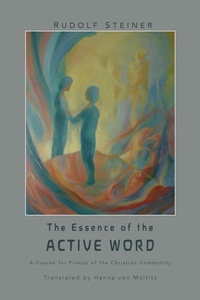
The Essence of the Active Word
Lectures and Courses on Christian-religious Work IV
Published on 31. May 2024
Book
Paperback/Softback
168 pages
978-1-948302-63-0 (ISBN)
Description
A course of 4 lectures for Priests of the Christian Community, with questions and answers. Held in Stuttgart, Germany on July 11-14, 1923, these lectures and documentary additions, encompass Part IV of Steiner's works entitled, Lectures and Courses on Christian-religious Work. Also included are several of Rudolf Steiner's original manuscripts in his own handwriting, a speech given by Steiner at the cremation of Hermann Linde, and a special note from GA# 342. This lecture series is the entirety of GA# 345. Translated by Hanna von Maltitz and edited by James D. Stewart.
More details
Language
English
Product notice
Paperback (trade)
Unsewn / adhesive bound
Dimensions
Height: 229 mm
Width: 152 mm
Thickness: 9 mm
Weight
254 gr
ISBN-13
978-1-948302-63-0 (9781948302630)
Copyright in bibliographic data and cover images is held by Nielsen Book Services Limited or by the publishers or by their respective licensors: all rights reserved.
Schweitzer Classification
Persons
Rudolf Joseph Lorenz Steiner was born in 1861 to Johann Steiner and Franziska Blie. He emerged as a prominent figure in philosophy, spirituality, and cultural renewal during the late 19th and early 20th centuries. Initially recognized for his scholarly work on GOETHE, Steiner s intellectual journey gradually shifted toward metaphysical and esoteric inquiries. His early education at the Vienna University of Technology and later studies at the University of Rostock provided a strong foundation in science and philosophy, which he later integrated into his spiritual explorations. He claimed the existence of clairvoyant abilities and developed a system of knowledge he called spiritual science, aiming to bridge the material and spiritual worlds. Steiner s teachings influenced a range of fields, including education, medicine, agriculture, and architecture. He founded the anthroposophical movement, which sought to apply spiritual understanding to practical life. His architectural legacy includes the Goetheanum, a center for cultural and spiritual activities. Although he attracted both admiration and criticism, his commitment to fostering human development through inner knowledge and social responsibility left a lasting impact. Steiner died in 1925 in Switzerland, leaving behind a substantial body of work that continues to inspire alternative approaches to learning, healing, and spiritual inquiry.