

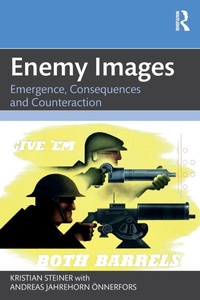
Enemy Images
Emergence, Consequences and Counteraction
1st Edition
Published on 14. October 2024
Book
Paperback/Softback
276 pages
978-1-032-24635-2 (ISBN)
Description
This book offers a detailed understanding of 'enemy images', which are used in political rhetoric to dehumanize adversaries for various purposes, such as to legitimate violent conflicts.
Applying theoretical models to a strong catalogue of historical and recent examples - from blood libel narratives in medieval manuscripts, to state-sponsored children's board games in Nazi Germany and social media posts about the wars in Gaza and Ukraine - the book identifies how 'enemy images' have led to the development of dominant socio-political paradigms by providing justifications for and reinforcements of violent conflicts both within and between societies. In doing so, the work offers an up-to-date, accessible and authoritative overview of how to identify, analyse, and counteract energy images - which will be key to fostering social environments of reconciliation and peacebuilding for the future.
This book will be of much interest to students and scholars of peace and conflict studies, International Relations, history, political sociology, and communication studies.
Applying theoretical models to a strong catalogue of historical and recent examples - from blood libel narratives in medieval manuscripts, to state-sponsored children's board games in Nazi Germany and social media posts about the wars in Gaza and Ukraine - the book identifies how 'enemy images' have led to the development of dominant socio-political paradigms by providing justifications for and reinforcements of violent conflicts both within and between societies. In doing so, the work offers an up-to-date, accessible and authoritative overview of how to identify, analyse, and counteract energy images - which will be key to fostering social environments of reconciliation and peacebuilding for the future.
This book will be of much interest to students and scholars of peace and conflict studies, International Relations, history, political sociology, and communication studies.
Reviews / Votes
'Enemy Images provides a comprehensive overview of our history of socially constructing an enemy Other, documenting how and why we marshal racist stereotypes and scapegoating rhetoric to inflame emotions and spur aggression. A much-needed primer to help make sense of the dehumanizing propaganda so prevalent in contemporary geo-political conflicts.'Erin Steuter, Mount Allison University, author of At War with Metaphor: Media, Propaganda, and Racism in the War on Terror
'A must-read for anyone who wishes to understand and analyse enemy images. This impressively multidisciplinary book is a treasure trove and great source of inspiration for all students and scholars of peace and conflict in all their forms.'
Leena Malkki, University of Helsinki, director of the Centre for European Studies at the University of Helsinki and co-editor of The Routledge Handbook on Radicalisation and Countering Radicalisation
'Enemy Images: Emergence, Consequences, and Counteraction is a thought-provoking and timely book that offers both a deep analysis of how adversarial perceptions shape societies and practical solutions to counteract them. Steiner and OEnnerfors present a compelling argument for addressing enemy images as a crucial step toward conflict resolution and social cohesion in an increasingly polarized world.'
Jan Erola, Nordic Defence Review
More details
Language
English
Place of publication
London
United Kingdom
Publishing group
Taylor & Francis Ltd
Target group
College/higher education
Professional and scholarly
Postgraduate, Professional, and Undergraduate Advanced
Illustrations
8 s/w Tabellen, 18 s/w Abbildungen, 12 s/w Photographien bzw. Rasterbilder, 6 s/w Zeichnungen
8 Tables, black and white; 6 Line drawings, black and white; 12 Halftones, black and white; 18 Illustrations, black and white
Dimensions
Height: 234 mm
Width: 156 mm
Thickness: 16 mm
Weight
450 gr
ISBN-13
978-1-032-24635-2 (9781032246352)
Copyright in bibliographic data and cover images is held by Nielsen Book Services Limited or by the publishers or by their respective licensors: all rights reserved.
Schweitzer Classification
Other editions
Additional editions
E-Book
10/2024
1st Edition
Routledge
€52.49
Available for download
E-Book
10/2024
1st Edition
Routledge
€52.49
Available for download

Book
10/2024
1st Edition
Routledge
€176.30
Shipment within 10-20 days
Persons
Kristian Steiner is Associate Professor in Peace and Conflict Studies at Malmoe University, Sweden. He has authored numerous articles in peace and conflict studies and political science. His research revolves around the usage of religious language to justify violence. He co-edited Expressions of Radicalization: Global Politics, Processes and Practices (with Andreas OEnnerfors, 2018).
Andreas Jahrehorn OEnnerfors is Full Professor in Intellectual History and works as a project manager at Fojo Media Institute at Linnaeus University, Sweden. He has specialized in contemporary radicalization, populist mobilization, and conspiratorial meaning-making. In 2021, he co-edited Europe: Continent of Conspiracies. Conspiracy Theories in and about Europe (with Andre Krouwel).
Andreas Jahrehorn OEnnerfors is Full Professor in Intellectual History and works as a project manager at Fojo Media Institute at Linnaeus University, Sweden. He has specialized in contemporary radicalization, populist mobilization, and conspiratorial meaning-making. In 2021, he co-edited Europe: Continent of Conspiracies. Conspiracy Theories in and about Europe (with Andre Krouwel).
Content
1. Why study enemy images?: An introduction
2. What is an enemy image?: Concepts and ideal types
3. How to make enemy images persuasive: Senders, messages and discursive consistency
4. Why are enemy images accepted?: Individual and structural factors
5. Who is targeted by enemy images?:Socio-psychological and cognitive drivers
6. How to counteract enemy images: Interventions and measures
7 . Expressions of enemy images: Media and manipulation
Index
2. What is an enemy image?: Concepts and ideal types
3. How to make enemy images persuasive: Senders, messages and discursive consistency
4. Why are enemy images accepted?: Individual and structural factors
5. Who is targeted by enemy images?:Socio-psychological and cognitive drivers
6. How to counteract enemy images: Interventions and measures
7 . Expressions of enemy images: Media and manipulation
Index