

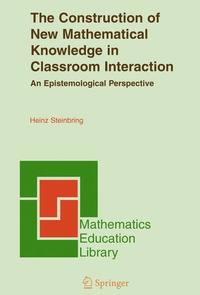
The Construction of New Mathematical Knowledge in Classroom Interaction
An Epistemological Perspective
Published on 22. March 2005
Book
Hardback
XIV, 236 pages
978-0-387-24251-4 (ISBN)
Description
Mathematics is generally considered as the only science where knowledge is uni form, universal, and free from contradictions. "Mathematics is a social product - a 'net of norms', as Wittgenstein writes. In contrast to other institutions - traffic rules, legal systems or table manners -, which are often internally contradictory and are hardly ever unrestrictedly accepted, mathematics is distinguished by coherence and consensus. Although mathematics is presumably the discipline, which is the most differentiated internally, the corpus of mathematical knowledge constitutes a coher ent whole. The consistency of mathematics cannot be proved, yet, so far, no contra dictions were found that would question the uniformity of mathematics" (Heintz, 2000, p. 11). The coherence of mathematical knowledge is closely related to the kind of pro fessional communication that research mathematicians hold about mathematical knowledge. In an extensive study, Bettina Heintz (Heintz 2000) proposed that the historical development of formal mathematical proof was, in fact, a means of estab lishing a communicable "code of conduct" which helped mathematicians make themselves understood in relation to the truth of mathematical statements in a co ordinated and unequivocal way.
More details
Series
Edition
2005 ed.
Language
English
Place of publication
New York
United States
Target group
Professional and scholarly
Research
Illustrations
XIV, 236 p.
Dimensions
Height: 241 mm
Width: 160 mm
Thickness: 19 mm
Weight
547 gr
ISBN-13
978-0-387-24251-4 (9780387242514)
DOI
10.1007/b104944
Schweitzer Classification
Other editions
Additional editions
Heinz Steinbring
The Construction of New Mathematical Knowledge in Classroom Interaction
An Epistemological Perspective
E-Book
03/2006
Springer
€96.29
Available for download
Content
General Overview Of The Book.- Overview of the First Chapter.- Theoretical Background and Starting Point.- Overview of the Second Chapter.- The Theoretical Research Question.- Overview of the Third Chapter.- Overview of the Fourth Chapter.- Epistemology-Oriented Analyses of Mathematical Interactions.- Epistemological and Communicational Conditions of Interactive Mathematical Knowledge Constructions.