

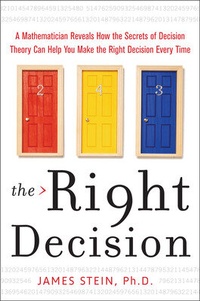
The Right Decision
A Mathematician Reveals How the Secrets of Decision Theory
Will be published approx. on 16. January 2010
Book
Hardback
256 pages
978-0-07-161419-1 (ISBN)
Description
CAN YOU EVER BE SURE YOU'RE MAKINGTHE RIGHT DECISION?Should you stay in a comfy job with little chance of advancement-or take a riskier one in which you could make lots of money but also wind up on the street?Should you listen to a doctor who advises surgery-or trust another who tells you to wait and see if your condition improves?Should you remain in a cozy relationship without much spark-or cut your losses and search for your soul mate?Is there ever a "right" decision? Professor James Stein would argue yes, and in this provocative new book, he shows you how to apply the mathematical principles of Decision Theory to every aspect of your life. Ingeniously blending statistics, probability, game theory, economics, and even philosophy, this dynamic new approach to decision making can help you choose a new career path, buy a better home, even pick the perfect mate. With The Right Decision, you can't go wrong.INCLUDES ENTERTAINING INTERACTIVE QUIZZESTO HELP YOU MAKE THE RIGHT DECISION EVERY TIME!
More details
Language
English
Place of publication
London
United States
Publishing group
McGraw-Hill Education - Europe
Target group
Professional and scholarly
Illustrations
0 Illustrations
Dimensions
Height: 221 mm
Width: 152 mm
Thickness: 20 mm
Weight
445 gr
ISBN-13
978-0-07-161419-1 (9780071614191)
Copyright in bibliographic data and cover images is held by Nielsen Book Services Limited or by the publishers or by their respective licensors: all rights reserved.
Schweitzer Classification
Other editions
Additional editions
E-Book
12/2009
1st Edition
McGraw-Hill Education
€66.69
Available for download
Person
James Stein is a Yale graduate who received both his M.A. and Ph.D at U.C. Berkeley, is Professor of Mathematics at California State University, past member of the enormously prestigious Institute of Advanced Studies at Princeton (where Oppenheimer held the physics chair formerly held by Einstein and became the head of the Institute) and co-author of two other books. He is also the author of the soon-to-be-published book, How Math Explains the World (Harper-Collins 2008) which is scheduled for an initial print run of 50,000; translation rights have already been sold in a number of countries.
Content
Table of Contents
1.Decisions
2.Actions
3.Payoffs
4.Relevance of Payoffs
5.States
6.Criteria for Decions
7.Admissibility
8.The Minimax Criterion
9.The Maximax Criterion
10.Baye's Criterion
11.Preferences and Utilities
12.Value and Cost of Information
13.Choosing a Criterion
14.Game Theory
15.Competitive Solution
16.Cooperative Solution
17.Vindictive Solution
18.Encore Performance
1.Decisions
2.Actions
3.Payoffs
4.Relevance of Payoffs
5.States
6.Criteria for Decions
7.Admissibility
8.The Minimax Criterion
9.The Maximax Criterion
10.Baye's Criterion
11.Preferences and Utilities
12.Value and Cost of Information
13.Choosing a Criterion
14.Game Theory
15.Competitive Solution
16.Cooperative Solution
17.Vindictive Solution
18.Encore Performance