

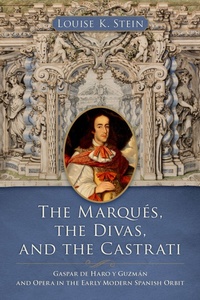
The Marques, the Divas, and the Castrati
Gaspar de Haro y Guzman and Opera in the Early Modern Spanish Orbit
Published on 29. August 2024
Book
Hardback
792 pages
978-0-19-768184-8 (ISBN)
Description
This is an open access title available under the terms of a CC BY-NC-ND 4.0 International licence. It is free to read on the Oxford Academic platform and offered as a free PDF download from OUP and selected open access locations.
During a crucial period in opera's development as a genre and as a business, the flamboyantly libertine Spanish aristocrat Gaspar de Haro y Guzman (1629-87), Marques de Heliche and del Carpio, influenced operatic practices and productions for both Italian and Hispanic operas. A voracious collector of books and antiquities and famed connoisseur of visual art, the marques financed operas in both Spain and Italy and further shaped them through his ideas, energy, and politics. His legacy also brought forth the first operas of the Americas, as posthumous revivals of the operatic genres he nurtured appeared in the Americas less than fifteen years after his death. In this book, author Louise K. Stein follows the trajectory of this first operatic producer to have shaped opera in two different worlds-Europe and the Americas-and in doing so, advances our musical and historical understanding of seventeenth- and early eighteenth-century opera and cultural encounter.
Each chapter focuses on different productions spearheaded by the Marques in Madrid, Rome, and Naples during his lifetime, with the final chapter considering how his influence continued in operatic productions in Lima, Mexico City, and other regions of New Spain after his death. Alongside this portrait of the distinguish patron of the arts, Stein shows how conventions of musical dramaturgy for both private and commercial opera were developed within a consistent politics of production across the far-flung administrative centers of the Spanish empire in the years 1650-1730. She reveals the place of opera within the siglo de oro (Golden Age) of Hispanic theatre and delves deeply into how the Marques became the principal patron of Alessandro Scarlatti in Italy after his time in Rome, sparking a reliable production system for Italian opera in Naples. Stein also addresses gendered performance-how beliefs about female fertility conditioned listeners and shaped the operatic genre-and advances the concept of the "womanly voice" in the first extant Hispanic operas, the Italian operas produced in Naples between 1683 and 1687, and the first operas of the Americas from 1701 to 1730.
During a crucial period in opera's development as a genre and as a business, the flamboyantly libertine Spanish aristocrat Gaspar de Haro y Guzman (1629-87), Marques de Heliche and del Carpio, influenced operatic practices and productions for both Italian and Hispanic operas. A voracious collector of books and antiquities and famed connoisseur of visual art, the marques financed operas in both Spain and Italy and further shaped them through his ideas, energy, and politics. His legacy also brought forth the first operas of the Americas, as posthumous revivals of the operatic genres he nurtured appeared in the Americas less than fifteen years after his death. In this book, author Louise K. Stein follows the trajectory of this first operatic producer to have shaped opera in two different worlds-Europe and the Americas-and in doing so, advances our musical and historical understanding of seventeenth- and early eighteenth-century opera and cultural encounter.
Each chapter focuses on different productions spearheaded by the Marques in Madrid, Rome, and Naples during his lifetime, with the final chapter considering how his influence continued in operatic productions in Lima, Mexico City, and other regions of New Spain after his death. Alongside this portrait of the distinguish patron of the arts, Stein shows how conventions of musical dramaturgy for both private and commercial opera were developed within a consistent politics of production across the far-flung administrative centers of the Spanish empire in the years 1650-1730. She reveals the place of opera within the siglo de oro (Golden Age) of Hispanic theatre and delves deeply into how the Marques became the principal patron of Alessandro Scarlatti in Italy after his time in Rome, sparking a reliable production system for Italian opera in Naples. Stein also addresses gendered performance-how beliefs about female fertility conditioned listeners and shaped the operatic genre-and advances the concept of the "womanly voice" in the first extant Hispanic operas, the Italian operas produced in Naples between 1683 and 1687, and the first operas of the Americas from 1701 to 1730.
Reviews / Votes
In her book on diplomat and entrepreneur Marquis del Carpio, Louise Stein presents in detail the career of a man who deeply influenced the development of opera in seventeenth-century Madrid, Rome, Naples, Peru, and Mexico. With meticulous research, brilliant cultural insights, deft musical analysis, and lively prose, our foremost scholar of Hispanic Baroque music sets the stage for dozens of new projects. * Susan McClary, Case Western Reserve University; MacArthur Fellow, 1995 * Because music was so central to politics in the Baroque era, musicology is the crucial tool for unveiling new perspectives on theatre and opera as diplomacy across Europe and the Americas in the seventeenth century. Within a clear and beautiful narrative, musicologist Louise Stein combines a deep knowledge of sources and a vast historiography spanning modern history, book history, visual arts, and theatre studies from the three very different traditions of Spanish, Italian, and Anglo-American scholarship. This book presents a renewed vision of a polymath patron whose mastery of music and voices illuminates an entire age and several closely-linked worlds. * Jose Maria Dominguez, Complutense University of Madrid *More details
Language
English
Place of publication
New York
United States
Product notice
sewn/stitched
Cloth over boards
Illustrations
83 music examples, 46 figures, 13 tables
Dimensions
Height: 229 mm
Width: 155 mm
Thickness: 36 mm
Weight
1111 gr
ISBN-13
978-0-19-768184-8 (9780197681848)
Copyright in bibliographic data and cover images is held by Nielsen Book Services Limited or by the publishers or by their respective licensors: all rights reserved.
Schweitzer Classification
Other editions
Additional editions
Louise K. Stein
The Marqués, the Divas, and the Castrati
Gaspar de Haro y Guzmán and Opera in the Early Modern Spanish Orbit
E-Book
06/2024
OUP eBook
€85.99
Available for download
Louise K. Stein
The Marqués, the Divas, and the Castrati
Gaspar de Haro y Guzmán and Opera in the Early Modern Spanish Orbit
E-Book
06/2024
OUP eBook
€85.99
Available for download
Person
Louise K. Stein is Professor of Musicology, Medieval and Early Modern Studies, and Latin American Studies at the University of Michigan. She has contributed critical editions of the first opera of the Americas, La purpura de la rosa (1999) and the first extant Spanish opera, Celos aun del aire matan (2014). Her first book Songs of Mortals, Dialogues of the Gods: Music and Theatre in Seventeenth-Century Spain (OUP 1993) received the First Book Prize from the Society for Spanish and Portuguese Historical Studies. In 1996, she was awarded the Noah Greenberg Award by the American Musicological Society for distinguished contributions to the study and performance of early music.
Content
- Introduction: An Extraordinary Patron
- Chapter 1. Inventing Hispanic Opera: Opera as Epithalamium
- Material Traces of an Interest in Music
- Heliche's Temperament
- Heliche, Mariana, and Theatrical Production in Madrid
- Heliche and the Renovation of the Coliseo del Buen Retiro
- Artistic Collaboration
- Performers
- Women Singing Onstage
- Opera Production in Madrid; The Context for the "Lost" La púrpura de la rosa
- The Music of Celos aun del aire matan
- Conclusion
- Epilogue: Exile and Subsequent Travel
- Chapter 2. Negotiating Operatic Culture in Rome 1677-82
- A First Experience of Italian Opera
- Italian Opera as Heard by Spanish Compatriots
- Amidst the Vicissitudes of Opera Production in Rome
- Entertainments With a Spanish Flavor
- The 1681 Serenata in Piazza di Spagna
- Patron and Protector in Rome
- Spanish Productions at Palazzo di Spagna
- Conclusion: "el buen gusto romano"?
- Chapter 3. Naples, Opera, and Spanish Viceroys to 1683
- The Count of Oñate and the First Operas in Naples
- Spaces for Opera in Oñate's Naples
- Viceroys and Inconsistent Levels of Support
- Operas at the Teatro di San Bartolomeo After the Fire
- Operas for Special Occasions
- Spanish Operas for Dynastic Celebrations
- Conclusions
- Chapter 4. Carpio and the Integration of Opera in Public Life, Naples 1683-87
- Practical Considerations
- --Theaters and Finances for Opera in Naples
- -- A Palace Theater
- --A Public Commercial Theater
- --Libretti and the Schedule of Productions
- --Opera Finances in Naples
- --Musicians and Singers
- The 1683-84 Naples Opera Season
- --L'Aldimiro o vero Favor per favore
- --La Psiche, ovvero Amore innamorato
- --Giulia Francesca Zuffi and the donnesca voce
- --Giovanni Francesco Grossi and Amore
- --Il Pompeo
- --La Tessalonica in 1684
- The 1684-85 Naples Opera Season
- --Il Giustino
- --L'Epaminonda
- --Il Galieno
- --Summer Festivities
- The 1685-86 Naples Opera Season
- --Il Fetonte
- --Olimpia vendicata
- --L'Etio
- Carpio's Final Season 1686-87
- --L'Olimpo in Mergellina (serenata)
- --Il Nerone
- --Clearco in Negroponte
- --Il Roderico
- Tutto il mal: a private opera in 1686 or 1687
- Carpio in Naples, Some Conclusions
- Chapter 5. An Operatic Legacy in the Americas
- The Context for Opera in the American Viceroyalties
- La púrpura de la rosa in Lima 1701
- --Legitimizing Public Secular Music and the Emerging Criollo Culture
- --The Extant Lima Score
- --Torrejón as Composer or Compiler?
- --Hidalgo's Music Inside Torrejón's Opera
- --Hidalgo's Music Reaching Lima
- --Torrejón y Velasco and the Loa
- --Coplas, estribillos, bailes, freely declamatory song
- Opera in New Spain
- --Celos aun del aire matan?
- --The Italian paradigm in New Spain
- --La Partenope, El Zelueco, and Neapolitan models
- --The Sumaya Question
- An Appreciable Contemporaneity
- Epilogue: Lima 1943
- Appendices
- --Appendix 1: Plot Synopses, Celos aun del aire matan and La púrpura de la rosa
- --Appendix 2: Theaters in the Carpio Inventories
- --Appendix 3: Singers in Carpio's Naples Productions
- Bibliography
- Printed Sources Before 1800
- Printed Sources After 1800
- Index