

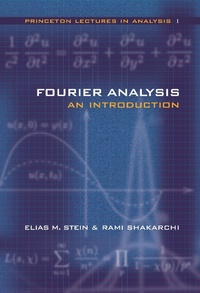
Fourier Analysis
An Introduction
Published on 6. April 2003
Book
Hardback
328 pages
978-0-691-11384-5 (ISBN)
Description
This first volume, a three-part introduction to the subject, is intended for students with a beginning knowledge of mathematical analysis who are motivated to discover the ideas that shape Fourier analysis. It begins with the simple conviction that Fourier arrived at in the early nineteenth century when studying problems in the physical sciences--that an arbitrary function can be written as an infinite sum of the most basic trigonometric functions. The first part implements this idea in terms of notions of convergence and summability of Fourier series, while highlighting applications such as the isoperimetric inequality and equidistribution. The second part deals with the Fourier transform and its applications to classical partial differential equations and the Radon transform; a clear introduction to the subject serves to avoid technical difficulties. The book closes with Fourier theory for finite abelian groups, which is applied to prime numbers in arithmetic progression. In organizing their exposition, the authors have carefully balanced an emphasis on key conceptual insights against the need to provide the technical underpinnings of rigorous analysis.
Students of mathematics, physics, engineering and other sciences will find the theory and applications covered in this volume to be of real interest. The Princeton Lectures in Analysis represents a sustained effort to introduce the core areas of mathematical analysis while also illustrating the organic unity between them. Numerous examples and applications throughout its four planned volumes, of which Fourier Analysis is the first, highlight the far-reaching consequences of certain ideas in analysis to other fields of mathematics and a variety of sciences. Stein and Shakarchi move from an introduction addressing Fourier series and integrals to in-depth considerations of complex analysis; measure and integration theory, and Hilbert spaces; and, finally, further topics such as functional analysis, distributions and elements of probability theory.
Students of mathematics, physics, engineering and other sciences will find the theory and applications covered in this volume to be of real interest. The Princeton Lectures in Analysis represents a sustained effort to introduce the core areas of mathematical analysis while also illustrating the organic unity between them. Numerous examples and applications throughout its four planned volumes, of which Fourier Analysis is the first, highlight the far-reaching consequences of certain ideas in analysis to other fields of mathematics and a variety of sciences. Stein and Shakarchi move from an introduction addressing Fourier series and integrals to in-depth considerations of complex analysis; measure and integration theory, and Hilbert spaces; and, finally, further topics such as functional analysis, distributions and elements of probability theory.
More details
Language
English
Place of publication
New Jersey
United States
Target group
Professional and scholarly
College/higher education
Product notice
Trade binding
Illustrations
40 line illus.
Dimensions
Height: 245 mm
Width: 161 mm
Thickness: 25 mm
Weight
612 gr
ISBN-13
978-0-691-11384-5 (9780691113845)
Copyright in bibliographic data and cover images is held by Nielsen Book Services Limited or by the publishers or by their respective licensors: all rights reserved.
Schweitzer Classification
Other editions
Additional editions
E-Book
02/2011
1st Edition
Princeton University Press
€96.49
Available for download
Persons
Elias M. Stein is Professor of Mathematics at Princeton University. Rami Shakarchi received his Ph.D. in Mathematics from Princeton University in 2002.
Content
Foreword vii Preface xi Chapter 1. The Genesis of Fourier Analysis 1 Chapter 2. Basic Properties of Fourier Series 29 Chapter 3. Convergence of Fourier Series 69 Chapter 4. Some Applications of Fourier Series 100 Chapter 5. The Fourier Transform on R 129 Chapter 6. The Fourier Transform on R d 175 Chapter 7. Finite Fourier Analysis 218 Chapter 8. Dirichlet's Theorem 241 Appendix: Integration 281 Notes and References 299 Bibliography 301 Symbol Glossary 305