

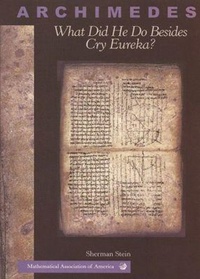
Archimedes
What Did He Do Besides Cry Eureka?
Published on 30. December 1999
Book
Paperback/Softback
155 pages
978-0-88385-718-2 (ISBN)
Description
Many people have heard two things about Archimedes: he was the greatest mathematician of antiquity, and he ran naked from his bath crying ``Eureka!''. However, few people are familiar with the actual accomplishments upon which his enduring reputation rests, and it is the aim of this book to shed light upon this matter. Archimedes' ability to achieve so much with the few mathematical tools at his disposal was astonishing. He made fundamental advances in the fields of geometry, mechanics, and hydrostatics. No great mathematical expertise is required of the reader, and the book is well illustrated with over 100 diagrams. It will prove fascinating to students and professional mathematicians alike.
Reviews / Votes
The author's writing style is elegant yet logical... In short, the book is eminently readable... Highly recommended for all teachers of mathematics."" - The Australian Mathematics Teacher""Highly recommended to anyone interested in mathematics and its history, as it is an eye-opening and a great read."" - Choice Magazine, March 2000
""The topics in this volume are treated carefully clearly, and with many illustrations."" - AAAS, Science Books and Films May-June 2000
More details
Series
Language
English
Place of publication
Washington DC
United States
Target group
Professional and scholarly
College/higher education
Product notice
Paperback (trade)
Unsewn / adhesive bound
Dimensions
Height: 228 mm
Width: 151 mm
Thickness: 9 mm
Weight
236 gr
ISBN-13
978-0-88385-718-2 (9780883857182)
Copyright in bibliographic data and cover images is held by Nielsen Book Services Limited or by the publishers or by their respective licensors: all rights reserved.
Schweitzer Classification
Content
1. The life of Archimedes; 2. The lever; 3. The centre of gravity; 4. Big literary find in Constantinople; 5. The mechanical method; 6. Two sums; 7. The parabola; 8. Floating bodies; 9. The spiral; 10. The ball; 11. Archimedes traps p.