

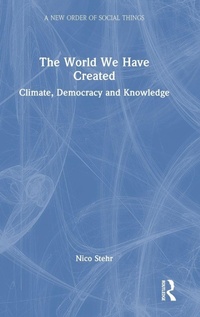
The World We Have Created
Climate, Democracy and Knowledge
1st Edition
Will be published approx. on 30. January 2026
Book
Hardback
288 pages
978-1-041-15961-2 (ISBN)
Description
Addressing the complex interplay between climate change, democratic governance, and scientific knowledge in the Anthropocene era, this book focuses on how political systems respond to the global ecological crisis and to what extent they are structurally capable of doing so.
The World We Have Created: Climate, Democracy, and Knowledge details how the de-democratization of ecological decision-making favors models of authoritarian governance, as democratic values such as transparency, participation, and accountability are continually undermined. Offering a robust account of the responses to the climate crisis and the necessary social and political changes posed by the scientific consensus, this book analyses the growing discrepancy between scientific knowledge about the causes and consequences of climate change and the lack of political and social willingness to implement necessary measures. Comprehensive social change is needed that focuses on social justice, intergenerational responsibility, and political participation, and it is only by strengthening democratic structures and integrating knowledge into responsible governance can we open paths to a resilient, just, and liveable future.
This sharp, interdisciplinary intervention bridges sociological, political, and philosophical thinking to underline the necessity of hope and utopian social imagination together with concrete changes to the constitution that guarantees a safe environment for future generations.
The World We Have Created: Climate, Democracy, and Knowledge details how the de-democratization of ecological decision-making favors models of authoritarian governance, as democratic values such as transparency, participation, and accountability are continually undermined. Offering a robust account of the responses to the climate crisis and the necessary social and political changes posed by the scientific consensus, this book analyses the growing discrepancy between scientific knowledge about the causes and consequences of climate change and the lack of political and social willingness to implement necessary measures. Comprehensive social change is needed that focuses on social justice, intergenerational responsibility, and political participation, and it is only by strengthening democratic structures and integrating knowledge into responsible governance can we open paths to a resilient, just, and liveable future.
This sharp, interdisciplinary intervention bridges sociological, political, and philosophical thinking to underline the necessity of hope and utopian social imagination together with concrete changes to the constitution that guarantees a safe environment for future generations.
Reviews / Votes
"Nico Stehr is one of the foremost expert thinkers on the intersection of science, politics, and society. This will be one of the foundational resources for navigating the political and economic orders in responding to climate change."Charles Lemert, University Professor and John C. Andrus Professor of Social Theory Emeritus at Wesleyan University, and author of Americans Thinking America (2025)
"Nico Stehr's insights on science and policy are important and highly respected. In this book he builds on his well-established analyses but moves them in a new direction by focusing on risk, climate and democracy."
Tom Dietz, Distinguished Professor Emeritus, Michigan State University, and author of Decisions for Sustainability (2023)
"What matters more-finding ways of settling the convulsions of the global climate or preserving the political freedoms of the western democratic tradition? In The World We Have Created, veteran sociologist Nico Stehr answers this question: it is not that democracy is failing, but that we-the defenders of democracy-are failing to be democratic enough."
Mike Hulme, Professor of Human Geography, University of Cambridge, and author of Why We Disagree About Climate Change (2009)
"Nico Stehr, one of the co-authors of the influential Hartwell Paper, provides a well-documented account of climate change, including the challenge to democratic governance."
Stephen Turner, Distinguished University Professor, University of South Florida
More details
Series
Language
English
Place of publication
London
United Kingdom
Publishing group
Taylor & Francis Ltd
Target group
College/higher education
Professional and scholarly
Academic and Undergraduate Advanced
Illustrations
1 s/w Tabelle, 17 s/w Abbildungen, 17 s/w Zeichnungen
1 Tables, black and white; 17 Line drawings, black and white; 17 Illustrations, black and white
Dimensions
Height: 240 mm
Width: 161 mm
Thickness: 22 mm
Weight
640 gr
ISBN-13
978-1-041-15961-2 (9781041159612)
Copyright in bibliographic data and cover images is held by Nielsen Book Services Limited or by the publishers or by their respective licensors: all rights reserved.
Schweitzer Classification
Other editions
Additional editions
Book
approx. 01/2026
1st Edition
Routledge
€65.20
Not yet published
E-Book
01/2026
1st Edition
Routledge
€55.49
Available for download
E-Book
01/2026
1st Edition
Routledge
€55.49
Available for download
Person
Nico Stehr is Karl Mannheim Professor of Cultural Studies Emeritus at the Zeppelin University, Friedrichshafen, Germany. He is a fellow of the Royal Society (Canada). He is one of the authors of the Hartwell Paper on climate policy. His recent books include Knowledge Capitalism (Routledge, 2022), Money: A Theory of Modern Society (Routledge, 2020), and Knowledge: Is Knowledge Power? (with Marion Adolf, Routledge, 2017).
Content
Introduction, 1. The climate clock is ticking, 2. Momentum of the authoritarians or the oligarchic temptation, 3. Social science and the environmental dilemma, 4. Climate politics: Overburdened democracy?, Excursus: Climate change and weather extremes: Anchor in an uncertain world?, 5. Science as the solution - policy follows science, 6. Knowledge politics, 7. Climate change as a wicked problem, 8. Democracy and the Anthropocene, Conclusions - or bringing nature back into politics