

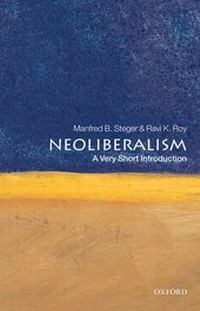
Neoliberalism: A Very Short Introduction
A Very Short Introduction
Published on 21. January 2010
Book
Paperback/Softback
168 pages
978-0-19-956051-6 (ISBN)
Description
Anchored in the principles of the free-market economics, 'neoliberalism' has been associated with such different political leaders as Ronald Reagan, Margaret Thatcher, Bill Clinton, Tony Blair, Augusto Pinochet, and Junichiro Koizumi.
In its heyday during the late 1990s, neoliberalism emerged as the world's dominant economic paradigm stretching from the Anglo-American heartlands of capitalism to the former communist bloc all the way to the developing regions of the global South. At the dawn of the new century, however, neoliberalism has been discredited as the global economy, built on its principles, has been shaken to its core by a financial calamity not seen since the dark years of the 1930s.
So is neoliberalism doomed or will it regain its former glory? Will reform-minded G-20 leaders embark on a genuine new course or try to claw their way back to the neoliberal glory days of the Roaring Nineties? Is there a viable alternative to neoliberalism?
Exploring the origins, core claims, and considerable variations of neoliberalism, this Very Short Introduction offers a concise and accessible introduction to one of the most debated 'isms' of our time.
ABOUT THE SERIES: The Very Short Introductions series from Oxford University Press contains hundreds of titles in almost every subject area. These pocket-sized books are the perfect way to get ahead in a new subject quickly. Our expert authors combine facts, analysis, perspective, new ideas, and enthusiasm to make interesting and challenging topics highly readable.
In its heyday during the late 1990s, neoliberalism emerged as the world's dominant economic paradigm stretching from the Anglo-American heartlands of capitalism to the former communist bloc all the way to the developing regions of the global South. At the dawn of the new century, however, neoliberalism has been discredited as the global economy, built on its principles, has been shaken to its core by a financial calamity not seen since the dark years of the 1930s.
So is neoliberalism doomed or will it regain its former glory? Will reform-minded G-20 leaders embark on a genuine new course or try to claw their way back to the neoliberal glory days of the Roaring Nineties? Is there a viable alternative to neoliberalism?
Exploring the origins, core claims, and considerable variations of neoliberalism, this Very Short Introduction offers a concise and accessible introduction to one of the most debated 'isms' of our time.
ABOUT THE SERIES: The Very Short Introductions series from Oxford University Press contains hundreds of titles in almost every subject area. These pocket-sized books are the perfect way to get ahead in a new subject quickly. Our expert authors combine facts, analysis, perspective, new ideas, and enthusiasm to make interesting and challenging topics highly readable.
Reviews / Votes
This book is a timely and relevant contribution to this urgent contemporary topic. * I. K. Gujral, Former Prime Minister of India *More details
Series
Language
English
Place of publication
Oxford
United Kingdom
Target group
College/higher education
Illustrations
15 black and white halftones
Dimensions
Height: 174 mm
Width: 112 mm
Thickness: 10 mm
Weight
138 gr
ISBN-13
978-0-19-956051-6 (9780199560516)
Copyright in bibliographic data and cover images is held by Nielsen Book Services Limited or by the publishers or by their respective licensors: all rights reserved.
Schweitzer Classification
Other editions
New editions
Book
01/2021
2nd Edition
Oxford University Press
€13.00
Shipment within 15-20 days
Persons
Manfred B. Steger's academic fields of expertise include global studies, political and social theory, peace studies, and international politics. His most recent publications include Globalism: Market Ideology Meets Terrorism (Rowman & Littlefield, 2005) and Globalization: A Very Short Introduction (2003).
Ravi K. Roy is Lecturer of Global Studies and teaches International Development and Global Studies at the Royal Melbourne Institute of Technology, Australia. His research expertise is in Economic Policy and Public Policy. He is the co-editor of Neoliberalism: National and regional experiments with global ideas (Routledge, 2007) and the co-author of Fiscal Policy Convergence from Reagan to Blair: The Left Veers Right (Routledge, 2004).
Ravi K. Roy is Lecturer of Global Studies and teaches International Development and Global Studies at the Royal Melbourne Institute of Technology, Australia. His research expertise is in Economic Policy and Public Policy. He is the co-editor of Neoliberalism: National and regional experiments with global ideas (Routledge, 2007) and the co-author of Fiscal Policy Convergence from Reagan to Blair: The Left Veers Right (Routledge, 2004).
Content
Preface ; 1. What's 'Neo' about Liberalism? ; 2. First-Wave Neoliberalism in the 1980s: Reaganomics and Thatcherism ; 3. Second-Wave Neoliberalism in the 1990s: Clinton's Market Globalism and Blair's Third Way ; 4. Neoliberalism and Asian Development ; 5. Neoliberalism in Latin America and Africa ; 6. Crises of Neoliberalism: The 2000s and Beyond ; References