

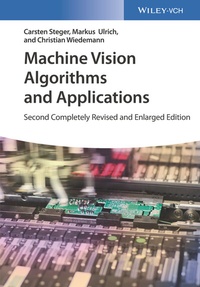
Machine Vision Algorithms and Applications
2nd Edition
Published on 24. January 2018
Book
Paperback/Softback
516 pages
978-3-527-41365-2 (ISBN)
Description
The second edition of this successful machine vision textbook is completely updated, revised and expanded by 35% to reflect the developments of recent years in the fields of image acquisition, machine vision algorithms and applications. The new content includes, but is not limited to, a discussion of new camera and image acquisition interfaces, 3D sensors and technologies, 3D reconstruction, 3D object recognition and state-of-the-art classification algorithms. The authors retain their balanced approach with sufficient coverage of the theory and a strong focus on applications. All examples are based on the latest version of the machine vision software HALCON 13.
More details
Edition
2. vollst. überarb. u. erw. Auflage
Language
English
Place of publication
Berlin
Germany
Target group
Professional and scholarly
Illustrations
340
4 s/w Tabellen, 336 s/w Abbildungen
Dimensions
Height: 24.4 cm
Width: 17 cm
Thickness: 2.4 cm
Weight
948 gr
ISBN-13
978-3-527-41365-2 (9783527413652)
Schweitzer Classification
Other editions
Additional editions

Carsten Steger | Markus Ulrich | Christian Wiedemann
Machine Vision Algorithms and Applications
E-Book
11/2017
2nd Edition
Wiley-VCH
€70.99
Available for download

Carsten Steger | Markus Ulrich | Christian Wiedemann
Machine Vision Algorithms and Applications
E-Book
11/2017
2nd Edition
Wiley-VCH
€70.99
Available for download
Previous edition
Carsten Steger | Markus Ulrich | Christian Wiedemann
Machine Vision Algorithms and Applications
Book
11/2007
Wiley-VCH
€62.90
Article exhausted; check for reprint
Persons
Carsten Steger studied computer science at the Technical University of Munich (TUM) and received his PhD degree from TUM in 1998. In 1996, he co-founded the company MVTec, where he heads the Research department. He has authored and co-authored more than 80 scientific publications in the field of computer and machine vision. In 2011, he was appointed a TUM honorary professor for the field of computer vision.
Markus Ulrich studied Geodesy and Remote Sensing at the Technical University of Munich (TUM) and received his PhD degree from TUM in 2003. In 2003, he joined MVTec?s Research and Development department as a software engineer and became head of the research team in 2008. He has authored and co-authored scientific publications in the fields of photogrammetry and machine vision. Markus Ulrich is also a guest lecturer at TUM, where he teaches close-range photogrammetry. In 2017, he was appointed a Privatdozent (lecturer) at the Karlsruhe Institute of Technology (KIT) for the field of machine vision.
Christian Wiedemann studied Geodesy and Remote Sensing at the Technical University of Munich (TUM) and received his PhD degree from TUM in 2001. He has authored and co-authored more than 40 scientific publications in the fields of photogrammetry, remote sensing, and machine vision. In 2003, he joined MVTec's Research and Development department as a software engineer. Since 2008, he has held different leading positions at MVTec.
Markus Ulrich studied Geodesy and Remote Sensing at the Technical University of Munich (TUM) and received his PhD degree from TUM in 2003. In 2003, he joined MVTec?s Research and Development department as a software engineer and became head of the research team in 2008. He has authored and co-authored scientific publications in the fields of photogrammetry and machine vision. Markus Ulrich is also a guest lecturer at TUM, where he teaches close-range photogrammetry. In 2017, he was appointed a Privatdozent (lecturer) at the Karlsruhe Institute of Technology (KIT) for the field of machine vision.
Christian Wiedemann studied Geodesy and Remote Sensing at the Technical University of Munich (TUM) and received his PhD degree from TUM in 2001. He has authored and co-authored more than 40 scientific publications in the fields of photogrammetry, remote sensing, and machine vision. In 2003, he joined MVTec's Research and Development department as a software engineer. Since 2008, he has held different leading positions at MVTec.
Content
INTRODUCTION
IMAGE ACQUISITION
Illumination
Lenses
Cameras
Camera-Computer Interfaces
MACHINE VISION ALGORITHMS
Fundamental Data Structures
Image Enhancement
Geometric Transformations
Image Segmentation
Feature Extraction
Morphology
Edge Extraction
Segmentation and Fitting of Geometric Primitives
Camera Calibration
Stereo Reconstruction
Template Matching
Optical Character Recognition
MACHINE VISION APPLICATIONS
Wafer Dicing
Reading of Serial Numbers
Inspection of Saw Blades
Print Inspection
Inspection of Ball Grid Arrays
Surface Inspection
Measuring of Spark Plugs
Molding Flash Detection
Inspection of Punched Sheets
3D Plane Reconstruction with Stereo
Pose Verification and Resistors
Classification of Non-Woven Fabrics
IMAGE ACQUISITION
Illumination
Lenses
Cameras
Camera-Computer Interfaces
MACHINE VISION ALGORITHMS
Fundamental Data Structures
Image Enhancement
Geometric Transformations
Image Segmentation
Feature Extraction
Morphology
Edge Extraction
Segmentation and Fitting of Geometric Primitives
Camera Calibration
Stereo Reconstruction
Template Matching
Optical Character Recognition
MACHINE VISION APPLICATIONS
Wafer Dicing
Reading of Serial Numbers
Inspection of Saw Blades
Print Inspection
Inspection of Ball Grid Arrays
Surface Inspection
Measuring of Spark Plugs
Molding Flash Detection
Inspection of Punched Sheets
3D Plane Reconstruction with Stereo
Pose Verification and Resistors
Classification of Non-Woven Fabrics