

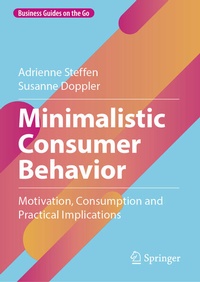
Minimalistic Consumer Behavior
Description
In developed countries people still place great emphasis on materialistic possessions for a happy life; however, many possessions produce tension and lead to burden. As a result, an anti-consumption movement has emerged that embraces the notion of a minimalistic lifestyle. This book combines research, personal insights, and real-world examples to explore the motivations behind minimalist choices and their impact on individuals, communities, and the environment. It examines how consumer behavior is influenced by cultural, economic, and psychological factors, and how adopting minimalist principles can foster well-being and sustainability. The authors also address voluntary simplicity, sustainable marketing, and discuss the implications of minimalistic consumer behavior for achieving SDG 12, Responsible Consumption and Production.
In addition to a theoretical examination for scholars, researchers, and academics, this book provides guidelines for marketing practitioners seeking to engage ethically with increasingly conscious consumers and to design value propositions consistent with minimalist and sustainable principles.
More details
Other editions
Additional editions
Persons
Adrienne Steffen
is Professor of Business Administration at the IU International University of Applied Sciences, Erfurt, Germany. She earned her PhD in Marketing from the University of Strathclyde, Scotland, after completing a Bachelor's degree in International Management with study terms in the United States and France. Her research explores sustainable consumption, minimalism, and customer experience management, focusing on how consumption patterns relate to well-being and ethical values. Dr. Steffen has authored several books, articles, and chapters on minimalism, digital detox, and sustainable consumer behavior.
Before academia, she worked in product management, market research, and business development across diverse industries.
Susanne Doppler is Professor of Event Management and Market Research at the Fresenius University of Applied Sciences in Heidelberg, Germany. Her research focuses on sustainable consumption, sustainable events, and the impact of micro countertrends on event planning. She has written several books, articles, and chapters on these topics. She also co-authored the development of the "Storyporting Method" for sustainable corporate communication. Before entering academia, she gained experience in product marketing and business development in the start-up technology sector. is Professor of Event Management and Market Research at the Fresenius University of Applied Sciences in Heidelberg, Germany. Her research focuses on sustainable consumption, sustainable events, and the impact of micro countertrends on event planning. She has written several books, articles, and chapters on these topics. She also co-authored the development of the "Storyporting Method" for sustainable corporate communication. Before entering academia, she gained experience in product marketing and business development in the start-up technology sector.
Content
Chapter 1 : Introduction.- Chapter 2: Background information on minimalistic consumption.- Chapter 3: Sustainable Consumer Behavior.- Chapter 4: Consumer motivation.- Chapter 5: Consumer Compensation for Reduced Consumption.- Chapter 6: Implications for Practicioners.- chapter 7: Macroenvironmental Consequences of Reducing Consumption.- Chapter 8: Conclusion.