

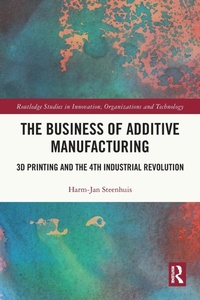
The Business of Additive Manufacturing
3D Printing and the 4th Industrial Revolution
1st Edition
Published on 18. December 2024
Book
Paperback/Softback
178 pages
978-1-032-50573-2 (ISBN)
Description
Although additive manufacturing (AM), also known as 3D printing, has been around for almost 40 years, few people know how it actually works and the huge impact and benefits it offers. This book explains what AM is, using business theories to explain and illustrate why AM is increasingly being used across industries.
The book translates complex engineering technology into relevant managerial terminology, using real-world examples from industries such as apparel, construction and transportation. It provides an introduction into the technical background of AM before expanding on the applications, opportunities and challenges to business models.
Offering a unique managerial perspective, this book is aimed primarily at a scholarly audience and those researching across business disciplines, including technology management, manufacturing, production and operations management. It can also be used in emerging business courses on AM.
The book translates complex engineering technology into relevant managerial terminology, using real-world examples from industries such as apparel, construction and transportation. It provides an introduction into the technical background of AM before expanding on the applications, opportunities and challenges to business models.
Offering a unique managerial perspective, this book is aimed primarily at a scholarly audience and those researching across business disciplines, including technology management, manufacturing, production and operations management. It can also be used in emerging business courses on AM.
More details
Series
Language
English
Place of publication
London
United Kingdom
Publishing group
Taylor & Francis Ltd
Target group
College/higher education
Postgraduate
Illustrations
24 s/w Abbildungen, 14 s/w Photographien bzw. Rasterbilder, 10 s/w Zeichnungen, 12 s/w Tabellen
12 Tables, black and white; 10 Line drawings, black and white; 14 Halftones, black and white; 24 Illustrations, black and white
Dimensions
Height: 234 mm
Width: 156 mm
Thickness: 10 mm
Weight
295 gr
ISBN-13
978-1-032-50573-2 (9781032505732)
Copyright in bibliographic data and cover images is held by Nielsen Book Services Limited or by the publishers or by their respective licensors: all rights reserved.
Schweitzer Classification
Other editions
Additional editions
Harm-Jan Steenhuis
The Business of Additive Manufacturing
3D Printing and the 4th Industrial Revolution
E-Book
09/2023
1st Edition
Routledge
€55.49
Available for download
Harm-Jan Steenhuis
The Business of Additive Manufacturing
3D Printing and the 4th Industrial Revolution
E-Book
09/2023
1st Edition
Routledge
€55.49
Available for download
Harm-Jan Steenhuis
The Business of Additive Manufacturing
3D Printing and the 4th Industrial Revolution
Book
09/2023
1st Edition
Routledge
€206.00
Shipment within 10-20 days
Person
Harm-Jan Steenhuis is Professor of Management, International Business in the College of Business at Hawai'i Pacific University. He previously worked at Eastern Washington University, North Carolina State University, and the University of Twente in Enschede, The Netherlands. He received his MSc in Industrial Engineering and Management and his PhD in International Technology Transfer from the University of Twente.
His main research areas connect with technological development and economic development-related issues such as clusters, technology transfer and diffusion, and innovative technologies. In recent years, he has focused on additive manufacturing (AM) such as the diffusion of industrial AM, adoption of desktop 3D printers, and AM in different industries.
His main research areas connect with technological development and economic development-related issues such as clusters, technology transfer and diffusion, and innovative technologies. In recent years, he has focused on additive manufacturing (AM) such as the diffusion of industrial AM, adoption of desktop 3D printers, and AM in different industries.
Content
CHAPTER 1: Manufacturing in the 21st century
Shift to services
Rise of developing countries
Reality of manufacturing
Industry 4.0
Additive manufacturing
Structure of the book
CHAPTER 2: Additive Manufacturing or 3D Printing: seven types
Comparing 'traditional' and AM
Material extrusion (MEX)
VAT Photopolymerization (VPP)
Powder bed fusion (PBF)
Material jetting (MJT) and binder jetting (BJT)
Directed energy deposition (DED) and sheet lamination (SHL)
Combination
Concluding remarks on AM technology
CHAPTER 3: The AM Business Case I: Comparing AM and TM Characteristics
Process choice
Technical capabilities - molds
Capabilities and performance objectives
Cost
Quality
Time
Flexibility
Innovation
Sustainability
The case for desktop 3D printers
CHAPTER 4: The spread of AM Technology
Technology and the economy
Adoption and diffusion
Adoption of the high technology: AM
CHAPTER 5: The AM Business Case II: Across the Value Chain
Delivering value
The client order decoupling point and service
Illustrative example
CHAPTER 6: Apparel
What is being 3D printed in apparel
Performance: why AM printing is used for apparel
How apparel is 3D printed: use of AM technology
Where apparel is 3D printed: AM in the apparel value chain
Diffusion and challenges of AM in apparel
CHAPTER 7: Construction
What is being 3D printed in construction
Performance: why AM printing is used for construction
How: AM technologies used in construction
Where AM is used in the construction value chain
Diffusion and challenges of AM in construction
CHAPTER 8: Food
What is being 3D printed in the food industry
Performance: why AM printing is used for food
How food is 3D printed: use of AM technology
Where AM is used in the food value chain
Diffusion and challenges of AM in the food industry
CHAPTER 9: Medical
What is being 3D printed in the medical field
Performance: why AM is used in the medical field
AM methods that are used for medical applications
Where in the medical value chain
Diffusion and challenges of medical AM
CHAPTER 10: Transport
What is being 3D printed related to transport
Performance: why AM printing is used in transportation
AM methods that are used for transportation applications
Where in the transportation value chain
Diffusion and challenges of AM in transportation
CHAPTER 11: Technological developments
Hardware
Software and digital files
Materials
Product quality
Delivery time
CHAPTER 12: Sustainability developments
Renewable resources
Minimization of resource usage
Source reduction
Recycling, reuse and repair
Regeneration, recovery, remanufacturing
Purification, end-of-pipe and degradation
Relationships between natural eco systems
AM and sustainability
CHAPTER 13: Legal developments
Legal issues with products
Legality of processes
Safety
Scams involving AM
CHAPTER 14: Conclusion
REFERENCES
INDEX
Shift to services
Rise of developing countries
Reality of manufacturing
Industry 4.0
Additive manufacturing
Structure of the book
CHAPTER 2: Additive Manufacturing or 3D Printing: seven types
Comparing 'traditional' and AM
Material extrusion (MEX)
VAT Photopolymerization (VPP)
Powder bed fusion (PBF)
Material jetting (MJT) and binder jetting (BJT)
Directed energy deposition (DED) and sheet lamination (SHL)
Combination
Concluding remarks on AM technology
CHAPTER 3: The AM Business Case I: Comparing AM and TM Characteristics
Process choice
Technical capabilities - molds
Capabilities and performance objectives
Cost
Quality
Time
Flexibility
Innovation
Sustainability
The case for desktop 3D printers
CHAPTER 4: The spread of AM Technology
Technology and the economy
Adoption and diffusion
Adoption of the high technology: AM
CHAPTER 5: The AM Business Case II: Across the Value Chain
Delivering value
The client order decoupling point and service
Illustrative example
CHAPTER 6: Apparel
What is being 3D printed in apparel
Performance: why AM printing is used for apparel
How apparel is 3D printed: use of AM technology
Where apparel is 3D printed: AM in the apparel value chain
Diffusion and challenges of AM in apparel
CHAPTER 7: Construction
What is being 3D printed in construction
Performance: why AM printing is used for construction
How: AM technologies used in construction
Where AM is used in the construction value chain
Diffusion and challenges of AM in construction
CHAPTER 8: Food
What is being 3D printed in the food industry
Performance: why AM printing is used for food
How food is 3D printed: use of AM technology
Where AM is used in the food value chain
Diffusion and challenges of AM in the food industry
CHAPTER 9: Medical
What is being 3D printed in the medical field
Performance: why AM is used in the medical field
AM methods that are used for medical applications
Where in the medical value chain
Diffusion and challenges of medical AM
CHAPTER 10: Transport
What is being 3D printed related to transport
Performance: why AM printing is used in transportation
AM methods that are used for transportation applications
Where in the transportation value chain
Diffusion and challenges of AM in transportation
CHAPTER 11: Technological developments
Hardware
Software and digital files
Materials
Product quality
Delivery time
CHAPTER 12: Sustainability developments
Renewable resources
Minimization of resource usage
Source reduction
Recycling, reuse and repair
Regeneration, recovery, remanufacturing
Purification, end-of-pipe and degradation
Relationships between natural eco systems
AM and sustainability
CHAPTER 13: Legal developments
Legal issues with products
Legality of processes
Safety
Scams involving AM
CHAPTER 14: Conclusion
REFERENCES
INDEX