

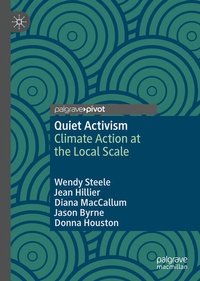
Quiet Activism
Description
This book focuses on the potential and possibilities for socially innovative responses to the climate emergency at the local scale. Climate change has intensified the need for communities to find creative and meaningful ways to address the sustainability of their environments. The authors focus on the creative and collaborative ways local- scale climate action reflects the extra-ordinary measures taken by ordinary people. This includes critical engagement with the ways in which novel social practices and partnerships emerge between people, organisations, institutions, governance arrangements and eco-systems.
The book successfully highlights the transformative power of socially innovative activities and initiatives in response to the climate crisis; and critically explores how different individuals and groups undertake climate action as 'quiet activism' - the embodied acts of collective disruption, subversion, creativity and care at the local scale.
Reviews / Votes
"Alongside the depressing reports of climate breakdown, Quiet Activism is a book you must read. It is an essential reminder that we need to approach each other with compassion, use local knowledge and build an ethics of care if we are to build meaningful and transformative climate action in these troubling times." -Paul Chatterton, Professor of Urban Futures, School of Geography, University of Leeds, UK"At last, a book that carefully explores everyday practices and the local as spaces of transformative potential in climate activism. The focus on quiet forms of change, creative disruption, generative acts, small scale collectivity and attention to care is inspiring and yet also pragmatic. This book is full of hopeful possibilities and examples of people responding to the climate emergency." -Jenny Pickerill, Professor of Environmental Geography, Department of Geography, University of Sheffield, UK
"This is an importantbook with a vital and persuasive argument. It makes the case for the power of collective local action, providing compelling examples of a climate activism that is modest, caring and socially innovative, building enduring commitments and pathways for transformation that transcend the individual. Quiet activism is not enough on its own, but this book makes absolutely clear why it should not be dismissed or undervalued." -Gordon Walker, Lancaster University, Lancaster , UK
More details
Other editions
Additional editions
Persons
Wendy Steele is the co-convenor of the Critical Urban Governance research program in the Centre for Urban Research at RMIT University, Melbourne. Her research focuses on wild cities in climate change with a particular emphasis on human-nature relationships and sustainability-led change.
Jean Hillier is an Emeritus Professor at RMIT University whose research interests include post-structural planning theory and methodology for strategic practice in conditions of uncertainty, political and cultural aspects of governance activity and more-than-human planning theory and practice.
Diana MacCallum is an Adjunct Academic in Urban and Regional Planning at Curtin University. Her research focuses broadly on social aspects of planning and development. She has co-authored or edited six books, including The International Handbook on Social Innovation and Advanced Introduction to Social Innovation .
Jason Byrne is a Professor of Human Geography and Planning at the University of Tasmania. He researches urban political ecologies of green-space, climate change adaptation, and environmental justice. Jason has previously been awarded the Planning Institute Australia's national award for cutting edge research and teaching.
Donna Houston is an urban and cultural geographer at Macquarie University. Her research explores the intersections of urban political ecology and environmental justice in the Anthropocene; cultural dimensions of climate change; spaces of extinction, and planning in the 'more-than-human' city.