

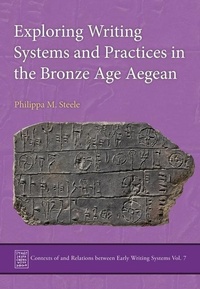
Exploring Writing Systems and Practices in the Bronze Age Aegean
Published on 10. October 2023
Book
Hardback
192 pages
978-1-78925-901-8 (ISBN)
Description
Writing does not begin and end with the encoding of an idea into a group of symbols. It is practised by people who have learnt its principles and acquired the tools and skills for doing it, in a particular context that affects what they do and how they do it. Nor are these practices static, as those involved exploit opportunities to adapt old features and develop new ones. The act of writing then has tangible and visible consequences not only for the writers but also for those encountering what has been produced, whether they can read its content or not - with potential for a wider social visibility that can in turn affect the success and longevity of the writing system itself.
With a focus on the syllabic systems of the Bronze Age Aegean, this book attempts to bring together different perspectives to create an innovative interdisciplinary outlook on what is involved in writing: from structuralist views of writing as systems of signs with their linguistic values, to archaeological and anthropological approaches to writing as a socially grounded practice. The main chapters focus on the concepts of script adoption and adaptation; different methods of logographic writing; and the vitality of writing traditions, with repercussions for the modern world.
Contexts of and Relations between Early Writing Systems (CREWS) is a project funded by the European Research Council under the European Union's Horizon 2020 research and innovation programme (grant agreement No. 677758), and based in the Faculty of Classics, University of Cambridge.
With a focus on the syllabic systems of the Bronze Age Aegean, this book attempts to bring together different perspectives to create an innovative interdisciplinary outlook on what is involved in writing: from structuralist views of writing as systems of signs with their linguistic values, to archaeological and anthropological approaches to writing as a socially grounded practice. The main chapters focus on the concepts of script adoption and adaptation; different methods of logographic writing; and the vitality of writing traditions, with repercussions for the modern world.
Contexts of and Relations between Early Writing Systems (CREWS) is a project funded by the European Research Council under the European Union's Horizon 2020 research and innovation programme (grant agreement No. 677758), and based in the Faculty of Classics, University of Cambridge.
More details
Language
English
Place of publication
Oxford
United Kingdom
Target group
Professional and scholarly
Product notice
sewn/stitched
Cloth over boards
Illustrations
B/W
Dimensions
Height: 245 mm
Width: 171 mm
Thickness: 17 mm
Weight
628 gr
ISBN-13
978-1-78925-901-8 (9781789259018)
Copyright in bibliographic data and cover images is held by Nielsen Book Services Limited or by the publishers or by their respective licensors: all rights reserved.
Schweitzer Classification
Other editions
Additional editions
Steele Philippa M. Steele
Exploring Writing Systems and Practices in the Bronze Age Aegean
E-Book
11/2023
Oxbow Books
€36.99
Available for download
Person
Philippa M. Steele is the Director of the CREWS Project, a Senior Research Associate at the Faculty of Classics, University of Cambridge, and a Senior Research Fellow of Magdalene College. She has previously been awarded a British Academy Postdoctoral Fellowship and the Evans Pritchard Lectureship at All Souls College, Oxford, followed by a European Research Council grant to run the CREWS Project, and has published widely on ancient languages and writing systems with a particular focus on Cyprus and the Aegean.
Content
Acknowledgements
List of Tables and Figures
Introduction
Cretan Hieroglyphic, Linear A and Linear B (and their Cypriot cousins)
Chronology
Theoretical perspectives and terminology
1: Exploring script adoption
How do we know that Linear B adopted Linear A syllabographic sign values with little change?
Can we use Linear B sign values or structural features to reconstruct Minoan phonology or other linguistic features?
How should we understand the nature of the transition from Linear A to B?
2: Exploring logography
Classifying signs in writing systems
Linear B
Linear A
Cretan Hieroglyphic
Understanding logography in the Bronze Age Aegean
3: Exploring vitality
Cretan Hieroglyphic
Linear A
Linear B
Syllabic writing in Cyprus
Relationships between writing and language vitality
The vitality of writing traditions
Epilogue: writing for the future
Bibliography
List of Tables and Figures
Introduction
Cretan Hieroglyphic, Linear A and Linear B (and their Cypriot cousins)
Chronology
Theoretical perspectives and terminology
1: Exploring script adoption
How do we know that Linear B adopted Linear A syllabographic sign values with little change?
Can we use Linear B sign values or structural features to reconstruct Minoan phonology or other linguistic features?
How should we understand the nature of the transition from Linear A to B?
2: Exploring logography
Classifying signs in writing systems
Linear B
Linear A
Cretan Hieroglyphic
Understanding logography in the Bronze Age Aegean
3: Exploring vitality
Cretan Hieroglyphic
Linear A
Linear B
Syllabic writing in Cyprus
Relationships between writing and language vitality
The vitality of writing traditions
Epilogue: writing for the future
Bibliography