

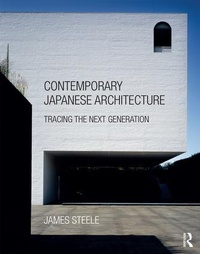
Contemporary Japanese Architecture
Tracing the Next Generation
1st Edition
Published on 18. May 2017
Book
Hardback
302 pages
978-1-138-94124-3 (ISBN)
Description
Contemporary Japanese Architecture presents a clear and comprehensive overview of the historical and cultural framework that informs the work of all Japanese architects, as an introduction to an in-depth investigation of the challenges now occupying the contemporary designers who will be the leaders of the next generation. It separates out the young generation of Japanese architects from the crowded, distinguished, multi-generational field they seek to join, and investigates the topics that absorb them, and the critical issues they face within the new economic reality of Japan and a shifting global order. Salient points in the text are illustrated by beautiful, descriptive images provided by the architects and from the extensive collection of the author. By combining illustrations with timelines and graphics to explain complex ideas, the book is accessible to any student seeking to understand contemporary Japanese architecture.
Reviews / Votes
'James Steele has written an immensely well researched, insightful and scholarly work on the genealogy of contemporary Japanese architecture and in the process of unravelling this, he demystifies the architecture and explains in depth the 'whys', the 'hows' and the 'whats' of modern Japanese architecture since the Second World War. The book is not just invaluable for architects seeking to understand Japanese architecture, it is sine qua non for those in the humanities seeking to understand the Japanese mind and culture through the medium of architectural studies.' - Ken Yeang (Dr.), Principal, T.R.Hamzah & Yeang Sdn. Bhd. (Malaysia)More details
Language
English
Place of publication
London
United Kingdom
Publishing group
Taylor & Francis Ltd
Target group
College/higher education
Illustrations
209 Farbfotos bzw. farbige Rasterbilder, 8 farbige Zeichnungen
8 Line drawings, color; 209 Halftones, color
Dimensions
Height: 276 mm
Width: 219 mm
Weight
1060 gr
ISBN-13
978-1-138-94124-3 (9781138941243)
Copyright in bibliographic data and cover images is held by Nielsen Book Services Limited or by the publishers or by their respective licensors: all rights reserved.
Schweitzer Classification
Other editions
Additional editions
Book
05/2017
1st Edition
Routledge
€83.22
Shipment within 10-20 days
E-Book
03/2017
Routledge
€67.49
Available for download
E-Book
03/2017
Routledge
€67.49
Available for download
Person
James Steele is an architect who received both his bachelor's and master's degrees from the University of Pennsylvania, and practiced in the Philadelphia region before accepting a position at Dammam University in Saudi Arabia where he taught for eight years. He then served as Senior Editor at Academy Editions, and taught at the Prince of Wales's Institute of Architecture in London before relocating to the University of Southern California School of Architecture in 1991, receiving a PhD in Urban Planning and Development at USC in 2002. Professor Steele has taught history and theory as well as design studio, and also organized the first Foreign Studies Program for architecture students in Malaysia in 1998. He administered it up through its fifteenth and final session in 2013 and then founded and became the director of a new undergraduate program in South America, based in Sao Paulo, Brazil. He has written extensively on contemporary architecture and has been a guest critic and speaker at numerous universities in the United States and internationally.
Content
Acknowledgements. Introduction: The (Dis) Continuities of Japanese Architecture. Part 1: An Enduring Cultural Framework. 1. The Land and its People. 2. History and Religion. 3: Paroxysm and Change. Part 2: From Modernity to Modernism: 1869-1940. 4. The Search for Knowledge and its Consequences. 5. Modernism Sidetracked on the Road to War. Part 3: From Re-birth to Economic Collapse. 6. Post-War Reconstruction, From Survival to Recovery: 1945- 1950. 7. The Le Corbusier Syndrome. 8. Metabolism Revisited. 9.Expo '70: A Joyful Vision of a New World. 10. The Shinohara School. 11. Post-Modernism: Apostasy or Prophesy? 12. A Decade of Excess: Life Inside the Bubble. Part 4: Transitional Figures. 13: Witness to War. 14: Conflicting Identities. 15: Relief and Rebuilding. Part 5: The Next Generation. 16. Doing More With Less. 17. On the Surface. 18. Intersticial Space: The New Engawa. 19. Reinventing Modernism. 20. Technology As Nature. 21. Searching for the Sublime. Notes. Bibliography. Glossary. Index.