

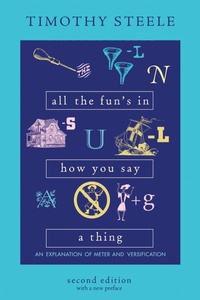
All the Fun's in How You Say a Thing
An Explanation of Meter and Versification
2nd Edition
Published on 17. September 2024
Book
Paperback/Softback
384 pages
978-0-8214-2572-5 (ISBN)
Description
25th Annniversary Edition, with a new preface by the author
Perfect for the general reader of poetry, students and teachers of literature, and aspiring poets, All the Fun's in How You Say a Thing is a lively and comprehensive study of versification by one of our best contemporary practitioners of traditional poetic forms. Emphasizing both the coherence and the diversity of English metrical practice from Chaucer's time to ours, Timothy Steele explains how poets harmonize the fixed units of meter with the variable flow of idiomatic speech, and examines the ways in which poets have used meter, rhyme, and stanza to communicate and enhance meaning. Steele illuminates as well many practical, theoretical, and historical issues in English prosody, without ever losing sight of the fundamental pleasures, beauties, and insights that fine poems offer us.
Written lucidly, with a generous selection of helpful scansions and explanations of the metrical effects of the great poets of the English language, All the Fun's in How You Say a Thing is not only a valuable handbook on technique; it is also a wide-ranging study of English verse and a mine of entertaining information for anyone wishing more fully to write, enjoy, understand, or teach poetry.
Perfect for the general reader of poetry, students and teachers of literature, and aspiring poets, All the Fun's in How You Say a Thing is a lively and comprehensive study of versification by one of our best contemporary practitioners of traditional poetic forms. Emphasizing both the coherence and the diversity of English metrical practice from Chaucer's time to ours, Timothy Steele explains how poets harmonize the fixed units of meter with the variable flow of idiomatic speech, and examines the ways in which poets have used meter, rhyme, and stanza to communicate and enhance meaning. Steele illuminates as well many practical, theoretical, and historical issues in English prosody, without ever losing sight of the fundamental pleasures, beauties, and insights that fine poems offer us.
Written lucidly, with a generous selection of helpful scansions and explanations of the metrical effects of the great poets of the English language, All the Fun's in How You Say a Thing is not only a valuable handbook on technique; it is also a wide-ranging study of English verse and a mine of entertaining information for anyone wishing more fully to write, enjoy, understand, or teach poetry.
Reviews / Votes
Praise for the second editionBefore you go to meet your maker, go to make your meter. And you couldn't be in better hands than those of Timothy Steele. His friendly but deeply knowledgeable guide to versification marks a quarter century of informing, yes, but most importantly inspiring generations to feel confident and excited about poetic forms. He takes technique out of the lecture hall and blows away the dust of the school room.
- Stephen Fry Praise for the second edition
Timothy Steele is one of the finest poets writing in English. He is also, to my mind, the most enlightening analyst of the art of poetry. All the Fun's in How You Say a Thing is a book that ranges over the history and skills of poetry in a manner that is lively, lucid, and profound. It is by far the best book on the subject of how that wondrous thing, poetry, is "said"-a view from both the outside and the inside.
- Vikram Seth Praise for the second edition
Timothy Steele's All the Fun's in How You Say a Thing is an essential book. It has taught me as much about poetry as any book I've read, and whenever I teach a class on meter-which is often-it's the textbook I assign. You must read this book.
- Shane McCrae Praise for the second edition
On its release in 1999, All the Fun's in How You Say a Thing was an instant classic for anyone interested in using or understanding poetic technique-poets at all levels, from beginners to major awards winners, students, teachers, scholars, and critics. Since its publication, it has continued to serve as the principal guide to the theory and practice of English-language versification. No doubt, it's just getting started. But, for these first twenty-five years, I and many other teachers have been telling students and fellow poets that if they want to learn verse technique, they should start with this book. I can also say, without reservation, that, in the 450 years since people first began writing down the principles of English-language versification, this is the best, and the essential, book of its kind. It combines deep scholarly and theoretical knowledge with the technical knowhow of a virtuosic practitioner and poet. Steele demystifies and with unexpected elegance elaborates the subtle relationships among meter, line, stanza, and syntax. I have often been present when students and even established poets, with the help of Steele's book, finally grasp how versification works, and what it is for. Suddenly you see a world of expressive power open up before them.
- Joshua Mehigan Praise for the second edition
If the craft of verse is one of the pillars of artistic civilization, Timothy Steele's All the Fun's in How You Say a Thing has proven itself to be the modern base of that pillar. It is the greatest and most authoritative book on versification that we have, full stop. I cannot overstate how formative Steele's book has been to me both as a poet and an analyst of poetry. Steele has a superhuman gift for explaining complex concepts in the clearest language possible, and his pioneering work in the theory of rhythmic modulation elevates this book far above the rest of the herd. This masterful tome will teach you how to appreciate the music of language as no one else can. Don't read poetry without it.
- Elijah Perseus Blumov, Versecraft podcast host Praise for the second edition
Rewarding and extremely readable.
(Times Literary Supplement) Praise for the first edition
Steele's elegantly written book, as entertaining and readable as it is erudite and taxonomically precise . . . successfully explains-in so far as it is possible to do so-how metre, in being predictable, allows for what is wholly unpredictable.
(Times Literary Supplement) Praise for the first edition
Steele places the many styles of poetry in historical context and clearly explains such elements as rhyme, rhythm, elision, and the use of stanzas. Students of poetry as well as practicing poets who wish to hone their craft will find this new book immensely helpful.
(Library Journal) Praise for the first edition
All the Fun's in How You Say a Thing takes its title from a line by Frost, a poet whose commitment to clarity of expression Steele clearly shares in this modest, neatly organized, and lucidly written explanation of English meter. Steele incorporates into his graceful study a wealth of linguistic insight. Steele's sharp and witty book is the perfect Poetry Month selection: an expert guide that speaks to all levels of readers.
(Kirkus) Praise for the first edition
Though sufficiently specialized to inform scholars, the book will not bewilder uninitiated readers. Steele is an adroit writer, imaginative, vibrant, alluring. . . . Strongly recommended as a textbook in metrics and for all libraries supporting study of language at the upper-division undergraduate level and above.
(Choice) Praise for the first edition
Throughout, Steele's choice of examples, drawn from the entire range of English-language poetry since Chaucer, indicates an impressive breadth of learning and a lively catholicity of taste. . . . This book defines a notably high standard for future writers in the field to emulate.
(Poetry Magazine) Praise for the first edition
Steele himself says that a formally experienced poet would not require a book on meter to learn his trade. That is surely true; yet I can testify, as one who has been writing in meter for over fifty years, that Steele's book has been delightful and instructive reading for me.
- Richard Wilbur Praise for the first edition
Thoughtful, just, and convincing, All the Fun's in How You Say a Thing is written with clarity and a wide range of reference. The formality, music, and good sense Timothy Steele espouses need to be reaffirmed from time to time; and he has done this with grace and intelligence.
- Anthony Hecht
More details
Edition
2nd New edition
Language
English
Place of publication
Athens
United States
Target group
College/higher education
Professional and scholarly
Edition type
New edition
Product notice
Paperback (trade)
Dimensions
Height: 226 mm
Width: 150 mm
Thickness: 25 mm
Weight
532 gr
ISBN-13
978-0-8214-2572-5 (9780821425725)
Copyright in bibliographic data and cover images is held by Nielsen Book Services Limited or by the publishers or by their respective licensors: all rights reserved.
Schweitzer Classification
Other editions
Previous edition
Book
04/1999
Ohio University Press
€27.50
Article exhausted; check for reprint
Person
Timothy Steele's books include Toward the Winter Solstice, a collection of poems published by Ohio University Press. Among Steele's honors are a Wallace Stegner Fellowship in Creative Writing from Stanford University; a Peter I. B. Lavan Younger Poets Award from the Academy of American Poets; and a Guggenheim Fellowship. He is a professor emeritus at California State University, Los Angeles, where he taught literature and writing for twenty-five years.
Content
Preface to the Second Edition xiii
Acknowledgments xvii
Introduction
Part One: Iambic Verse
1
Metrical Norm and Rhythmical Modulation
2
Scansion and Metrical Variation
. Principles of Scansion
. The Principal Iambic Meters
. The Three Common Metrical Variations in Iambic Verse: The Trochaic Substitution
in the First Foot, the Mid-line Trochaic Substitution, and the Feminine Ending
. Less Common Trochaic Substitutions and Trochees That Maybe Are Not Trochees
. Loose Iambic-Iambic Verse with Anapestic Substitutions
. Other Variants: Divided Lines, Clipped Lines, Broken-Backed Lines,
and Feminine Caesuras
3
Additional Sources of Rhythmical Modulation, Including Enjambment,
Caesural Pause, and Word Length
4
The Story of Elision, Including the Famous Rise, Troublesome Reign,
and Tragical Fall of the Metrical Apostrophe
. The Practice and Conventions of Elision
. Elision and Changing Views about Syllable Count
. How Real Is Elision? And What Are We, Finally, to Think of It?
5
Boundless Wealth from a Finite Store:Meter and Grammar
Part Two: Other Matters, Other Meters
6
Rhyme
. The Background and History of Rhyme
. The Two Common Types of Rhyme in English-
Full and Partial-and Some of Their Varieties
. The Use of Rhyme
Seven
Stanzas
8
Trochaic and Trisyllabic Meters
9
Alternative Modes of Versification in English
. Accentual Verse
. Syllabic Verse
. Free Verse
. Imitation-Classical Verse
Notes
Glossary
Bibliography
Permissions and Copyrights
Index
Acknowledgments xvii
Introduction
Part One: Iambic Verse
1
Metrical Norm and Rhythmical Modulation
2
Scansion and Metrical Variation
. Principles of Scansion
. The Principal Iambic Meters
. The Three Common Metrical Variations in Iambic Verse: The Trochaic Substitution
in the First Foot, the Mid-line Trochaic Substitution, and the Feminine Ending
. Less Common Trochaic Substitutions and Trochees That Maybe Are Not Trochees
. Loose Iambic-Iambic Verse with Anapestic Substitutions
. Other Variants: Divided Lines, Clipped Lines, Broken-Backed Lines,
and Feminine Caesuras
3
Additional Sources of Rhythmical Modulation, Including Enjambment,
Caesural Pause, and Word Length
4
The Story of Elision, Including the Famous Rise, Troublesome Reign,
and Tragical Fall of the Metrical Apostrophe
. The Practice and Conventions of Elision
. Elision and Changing Views about Syllable Count
. How Real Is Elision? And What Are We, Finally, to Think of It?
5
Boundless Wealth from a Finite Store:Meter and Grammar
Part Two: Other Matters, Other Meters
6
Rhyme
. The Background and History of Rhyme
. The Two Common Types of Rhyme in English-
Full and Partial-and Some of Their Varieties
. The Use of Rhyme
Seven
Stanzas
8
Trochaic and Trisyllabic Meters
9
Alternative Modes of Versification in English
. Accentual Verse
. Syllabic Verse
. Free Verse
. Imitation-Classical Verse
Notes
Glossary
Bibliography
Permissions and Copyrights
Index