

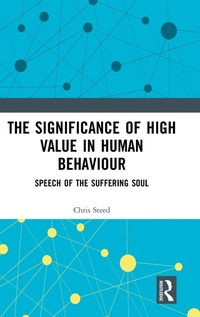
The Significance of High Value in Human Behaviour
Speech of the Suffering Soul
1st Edition
Published on 1. March 2019
Book
Hardback
200 pages
978-1-138-54167-2 (ISBN)
Description
The Significance of High Value in Human Behaviour is an innovative conceptualisation of how the quest for a high self-worth works as a psychosocial dynamic, presenting the idea that feelings of impotence and low self-esteem induce a powerful impetus on negative human action. This book gives an account of what it means to base a whole psychological perspective on high value, which has been an understudied aspect of human action.
Employing an ethnographical approach, the book uses client observations and social research to promote original solutions in an empathetic and engaging manner for psychological support services aiding isolated individuals. It considers the concept of a valuable self and examines the negative effects within the personality which can be generated when this drive for a valuable self is blocked through human devaluation or violence.
The Significance of High Value in Human Behaviour will appeal to academics and post-graduate students in the fields of psychology and psychotherapy, psychotherapists with specialist interests in loneliness and self-worth, and sociologists concerned with the psychology of the self.
Employing an ethnographical approach, the book uses client observations and social research to promote original solutions in an empathetic and engaging manner for psychological support services aiding isolated individuals. It considers the concept of a valuable self and examines the negative effects within the personality which can be generated when this drive for a valuable self is blocked through human devaluation or violence.
The Significance of High Value in Human Behaviour will appeal to academics and post-graduate students in the fields of psychology and psychotherapy, psychotherapists with specialist interests in loneliness and self-worth, and sociologists concerned with the psychology of the self.
More details
Language
English
Place of publication
London
United Kingdom
Publishing group
Taylor & Francis Ltd
Target group
Professional and scholarly
College/higher education
Dimensions
Height: 240 mm
Width: 161 mm
Thickness: 16 mm
Weight
482 gr
ISBN-13
978-1-138-54167-2 (9781138541672)
Copyright in bibliographic data and cover images is held by Nielsen Book Services Limited or by the publishers or by their respective licensors: all rights reserved.
Schweitzer Classification
Other editions
Additional editions

Book
09/2020
1st Edition
Routledge
€49.51
Shipment within 15-20 days
E-Book
03/2019
1st Edition
Routledge
€55.49
Available for download
E-Book
03/2019
1st Edition
Routledge
€55.49
Available for download
Person
Chris Steed is a trained counsellor and Anglican priest who combines the experience of counselling psychotherapist practice and post-doctoral research where he developed the distinctive approach in this book. He is a member of the British Association of Psychotherapy and Counselling and the American Psychological Association, and is the author of Smart Leadership - Wise Leadership: Environments of Value in an Emerging Future (2017) and We Count, We Matter: Voice, Choice and the Death of Distance (2018).
Content
Setting the scene - the psychopathology of everyday life
Part 1: Arenas of anxiety
Chapter 1: Companion
Chapter 2: Comparison: "go compare": social media and social toxins
Chapter 3: Competition: tales of humiliation
Chapter 4: Compensation: violence, transfer and scapegoats
Part 2: Notes on a theory of value
Chapter 5: A discourse on method and the dog that didn't bark
Chapter 6: Re-setting the personality drivers
Chapter 7: Markers of devaluation: difference and Indifference
Chapter 8: Dignity, indignity and the anger of a valuable self
Chapter 9: The relational turn: self-esteem and self-actualisation
Chapter 10: Like a sailboat in the harbour: collision and collusion
Chapter 1: Through the life course
Part 3: A positive psychology
Chapter 12: Transformative change and positive places
Postscript: what is it that Protests?
Part 1: Arenas of anxiety
Chapter 1: Companion
Chapter 2: Comparison: "go compare": social media and social toxins
Chapter 3: Competition: tales of humiliation
Chapter 4: Compensation: violence, transfer and scapegoats
Part 2: Notes on a theory of value
Chapter 5: A discourse on method and the dog that didn't bark
Chapter 6: Re-setting the personality drivers
Chapter 7: Markers of devaluation: difference and Indifference
Chapter 8: Dignity, indignity and the anger of a valuable self
Chapter 9: The relational turn: self-esteem and self-actualisation
Chapter 10: Like a sailboat in the harbour: collision and collusion
Chapter 1: Through the life course
Part 3: A positive psychology
Chapter 12: Transformative change and positive places
Postscript: what is it that Protests?