

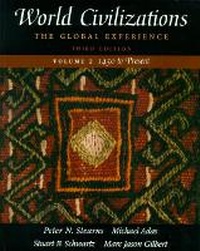
World Civilizations
The Global Experience, Volume II - 1450 To Present
3rd Edition
Published on 8. September 2000
Book
Paperback/Softback
96 pages
978-0-321-03813-5 (ISBN)
Description
The primary goal of World Civilizations is to present a TRULY GLOBAL HISTORY-one that both discusses the development of the world's leading civilizations and also emphasizes the major stages in the interactions among different peoples and societies. World Civilizations examines all the world's civilizations, including those in the Western tradition but also those civilizations sometimes neglected in world history texts-for example, the nomadic societies of Asia, Latin America, and the nations and states of the Pacific Rim. World Civilizations balances this discussion of independent developments in all the world's major civilizations with comparative analysis of the results of international contact.
World Civilizations organizes its presentation of global history into SIX COHERENT TIME PERIODS, with each period defined by the new and parallel patterns that evolved among all or most civilizations during the particular era. The six periods correspond to the six parts of the book. Within each part, the authors identify specific themes that characterize common experiences or common forces in individual societies as well as the new kinds and patterns of global contacts that emerged during the era. Thus, for example, Part I of the book discusses the developmental stage of world history, including the rise of agriculture and the development of civilization. Part II examines the classical era in global history, an era marked by the integration of large regions and diverse groups of people through overarching cultural and political systems. Subsequent parts of the book continue the emphasis on geographic shifts and the intensification of contact among civilizations.
World Civilizations organizes its presentation of global history into SIX COHERENT TIME PERIODS, with each period defined by the new and parallel patterns that evolved among all or most civilizations during the particular era. The six periods correspond to the six parts of the book. Within each part, the authors identify specific themes that characterize common experiences or common forces in individual societies as well as the new kinds and patterns of global contacts that emerged during the era. Thus, for example, Part I of the book discusses the developmental stage of world history, including the rise of agriculture and the development of civilization. Part II examines the classical era in global history, an era marked by the integration of large regions and diverse groups of people through overarching cultural and political systems. Subsequent parts of the book continue the emphasis on geographic shifts and the intensification of contact among civilizations.
More details
Edition
3rd edition
Language
English
Place of publication
United States
Publishing group
Pearson Education (US)
Target group
Professional and scholarly
Dimensions
Height: 254 mm
Width: 203 mm
Thickness: 18 mm
Weight
1094 gr
ISBN-13
978-0-321-03813-5 (9780321038135)
Copyright in bibliographic data and cover images is held by Nielsen Book Services Limited or by the publishers or by their respective licensors: all rights reserved.
Schweitzer Classification
Other editions
New editions
Peter N. Stearns | Michael B. Adas | Stuart B. Schwartz
World Civilizations
The Global Experience, Volume II - 1450 To Present (Chapters 21-40)
Book
02/2004
4th Edition
Pearson
€61.99
Article exhausted; check for reprint
Previous edition

Peter N. Stearns | Michael B. Adas | Stuart B. Schwartz
World Civilizations
The Global Experience - Volume II
Book
02/1998
2nd Edition
Pearson
€47.11
Article exhausted; check for reprint
Content
List of Maps.
Preface.
Supplements.
Acknowledgments.
Prologue.
IV. THE WORLD SHRINKS, 1450-1750.
22. The Transformation of the West, 1450-1750.
The First Big Changes: Culture and Commerce.
Science and Politics: The Next Phase of Change.
Visualizing the Past: Versailles.
In Depth: Elites and Masses.
The West by 1750.
Document: Controversies About Women.
Conclusion: Innovation and Instability.
23. The West and the World.
The West's First Outreach: Maritime Power.
In Depth: Causation and the West's Expansion.
Toward a World Economy.
Visualizing the Past: West Indian Slaveholding.
Colonial Expansion.
Document: Western Conquerors: Tactics and Motives.
Conclusion: The Impact of a New World Order.
24. The Rise of Russia.
Russia's Expansionist Politics Under the Tsars.
Document: The Nature of Westernization.
Russia's First Westernization, 1690-1790.
Themes in Early Modern Russian History.
Visualizing the Past: Oppressed Peasants.
In Depth: Multinational Empires.
Conclusion: Russia and Eastern Europe.
25. Early Latin America.
Spaniards and Portuguese: From Reconquest to Conquest.
The Destruction and Transformation of Indian Societies.
In Depth: The Great Exchange.
Colonial Economies and Governments.
Document: A Vision from the Vanquished.
Brazil: The First Plantation Colony.
Visualizing the Past: Race or Culture? A Changing Society.
Multiracial Societies.
The Eighteenth-Century Reforms.
Conclusion: The Diverse Ingredients of Latin American Civilization.
26. The Muslim Empires.
The Ottomans: From Frontier Warriors to Empire Builders.
The Shi'ite Challenge of the Safvids.
Document: An Islamic Traveler Laments the Muslims' Indifference to Europe.
In Depth: The Gunpowder Empires and the Shifting Balance of Global Power.
The Mughals and the Apex of Muslim Civilization in India.
Visualizing the Past: The Basis of Imperial Power in the Rival Muslim Empires.
Conclusion: The Rise of Europe and the Eclipse of Islamic Civilization as the Pivot of the World Order.
27. Africa and the Africans in the Age of the Atlantic Slave Trade.
The Atlantic Slave Trade.
African Societies, Slavery, and the Slave Trade.
Visualizing the Past: Symboly of African Kinship.
White Settlers and Africans in Southern Africa.
In Depth: Slavery and Human Society.
The African Diaspora.
Document: An African's Description of the Middle Passage.
Conclusion: The Impact of Slavery on Africa.
28. Asian Transitions in an Age of Global Change.
The Asian Trading World and the Coming of the Europeans.
Visualizing the Past: Intruders-The Pattern of Early European Expansion in Asia.
Ming China: A Global Mission Refused.
Document: Exam Questions as a Mirror of Chinese Values.
In Depth: Means and Motives for Overseas Expansion: Europe and China Compared.
Fending Off the West: Japan's Reunification and the First Challenge.
Conclusion: Asia and the First Phase of Europe's Global Expansion.
V. INDUSTRIALIZATION AND WESTERN GLOBAL HEGEMONY, 1750-1914.
29. The Industrialization of the West, 1760-1914.
Forces of Change.
Visualizing: The French Revolution in Cartoon.
The Industrial Revolution.
Document: Women in the Industrial Revolution.
The Consolidation of the Industrial Order, 1850-1914.
Cultural Transformations.
Western Settler Societies.
The Extensions of Western Society.
In Depth: The United States in World History.
Diplomatic Tensions and World War I.
Conclusion: Diplomacy and Society.
30. Industrialization and Imperialism: The Making of the European Global Order.
The Shift to Land Empires in Asia.
In Depth: Western Education and the Rise of an African and Asian Middle Class.
Industrial Rivalries and the partition of the World, 1870-1914.
Patterns of Dominance: Continuity and Change.
Visualizing the Past: Capitalism and Colonialism.
Document: Contrary Images: The Colonizer vs. the Colonized on the "Civilizing Mission".
Conclusion: The Pattern of the Age of Imperialism.
31. The Consolidation of Latin America, 1830-1920.
From Colonies to Nations.
New Nations Confront Old and New Problems.
Document: Confronting the Hispanic Heritage: From Independence to Consolidation.
Latin American Economies and World Markets, 1820-1870.
Societies in Search of Themselves.
In Depth: Explaining Underdevelopment.
Cultural Expression After Independence.
The Great Boom, 1880-1920.
Conclusion: New Nations, Old Problems.
32. Civilizations in Crisis: The Ottoman Empire, the Islamic Heartlands, and Qing China.
In Depth: Western Dominance and the Decline of Civilizations.
From Empire to Nation: Ottoman Retreat and the Birth of Turkey.
Western Intrusions and the Crisis in the Arab Islamic Heartlands.
The Last Dynasty: The Rise and Fall of the Qing Empire in China.
Document: Building a New China.
Conclusion: Islamic and Chinese Responses to the Challenge of the West Compared.
33. Russia and Japan: Industrialization Outside the West.
Russia's Reforms and Industrial Advance.
Document: Conditions for Factory Workers in Russia's Industrialization.
Protest and Revolution in Russia.
Japan: Transformation Without Revolution.
In Depth: The Separate Paths of Japan and China.
Visualizing the Past: Two Faces of Western Influence.
Conclusion: Growing International Rivalries.
VI. THE TWENTIETH CENTURY IN WORLD HISTORY.
34. International Contacts and Conflicts, 1914-1999.
World War I.
Visualizing the Past: Trench Warfare.
The Great Depression.
World War II.
Document: The Leader of the Soviet Union Evaluates the Depression.
In Depth: Total War.
The Cold War, 1945-1989.
Conclusion: A Legacy of Uncertainty.
35. The West in the Twentieth Century.
The Disarray in the West, 1914-1945.
After World War II: International Setting for the West.
Document: The Resistance Spirit.
Society and Culture in the West.
Visualizing the Past: Women at Work: The Female Labor Force in France and the United States..
In Depth: The Decline of the West?
Conclusion: Will the Real West Please Stand Up?
36. Russia and Eastern Europe.
The Russian Revolution.
In Depth: Twentieth-Century Revolutions.
Building Soviet Society.
Document: Socialist Reform.
Visualizing the Past: Socialist Realism.
The Soviet Union as a Superpower.
The Explosion of the 1980s and 1990s.
Conclusion: What Next?
37. Japan and the Pacific Rim.
Decades of Turmoil: The World Wars and Their Consequences.
East Asia in the Postwar Settlements.
Document: Japan and the Loss in World War II.
Japan, Incorporated.
The Pacific Rim: New Japans?
Visualizing the Past: Pacific Rim Growth.
In Depth: The Pacific Rim as a United States Policy Issue.
Conclusion: Pacific Rim as Exception or as Model.
38. Latin America: Revolution and Reaction in the Twentieth Century.
The Mexican Revolution and the Great War.
Economic Change and New Political Actors.
Promises of Social Reform.
Radical Options in the 1950s.
The Search for Reform and the Military Option.
Visualizing the Past: Murals and Posters: Art and Revolution in a "Flash".
Document: The People Speak.
In Depth: Human Rights in the Twentieth Century.
Societies in Search of Change.
Conclusion: Struggling Toward the Future.
39. Decolonization and the Decline of the European World Order.
Prototypes for the Independence Struggles: The First Phase of Decolonization in India and Egypt.
World War I and the Postwar Crisis of the European Empires.
Document: Lessons for the Colonized from the Slaughter in the Trenches.
In Depth: Women in Asian and African Nationalist Movements.
Another Global War and the Collapse of the European World Order.
Visualizing the Past: Nationalist Leaders: Different Styles, Different Images.
Conclusion: The Limits of Decolonization.
40. Africa and Asia in the Era of Independence.
The Challenges of Independence.
In Depth: Artificial Nations and the Rising Tide of Communal Strife.
Document: Cultural Creativity in the Emerging Nations: Some Literary Samples.
Paths to Economic Growth and Social Justice.
Visualizing the Past: Globalization and Post-Colonial Societies..
Conclusion: The Postcolonial Experience in Historical Perspective.
41. War and Revolution in China and Vietnam.
The Struggle for China.
Document: Women in the Revolutionary Struggle.
Mao's China and Beyond.
Visualizing the Past: Art and Revolutionary Propaganda.
Colonialism and Revolution in Vietnam.
In Depth: Decolonization with and Without Social Revolution.
Conclusion: Revolutions and Civilization in China and Vietnam.
42. A Twenty-first-Century World: Trends and Prospects.
Optimism or Pessimism.
A New Period in World History.
Extrapolating Trends in World Societies.
In Depth: Evaluating the Conditions of Women.
Forecasting by a Single Causal Factor.
World History Themes.
Regions, Civilizations, and World Forces.
Conclusion: Asking Questions.
Glossary.
Credits.
Index.
Preface.
Supplements.
Acknowledgments.
Prologue.
IV. THE WORLD SHRINKS, 1450-1750.
22. The Transformation of the West, 1450-1750.
The First Big Changes: Culture and Commerce.
Science and Politics: The Next Phase of Change.
Visualizing the Past: Versailles.
In Depth: Elites and Masses.
The West by 1750.
Document: Controversies About Women.
Conclusion: Innovation and Instability.
23. The West and the World.
The West's First Outreach: Maritime Power.
In Depth: Causation and the West's Expansion.
Toward a World Economy.
Visualizing the Past: West Indian Slaveholding.
Colonial Expansion.
Document: Western Conquerors: Tactics and Motives.
Conclusion: The Impact of a New World Order.
24. The Rise of Russia.
Russia's Expansionist Politics Under the Tsars.
Document: The Nature of Westernization.
Russia's First Westernization, 1690-1790.
Themes in Early Modern Russian History.
Visualizing the Past: Oppressed Peasants.
In Depth: Multinational Empires.
Conclusion: Russia and Eastern Europe.
25. Early Latin America.
Spaniards and Portuguese: From Reconquest to Conquest.
The Destruction and Transformation of Indian Societies.
In Depth: The Great Exchange.
Colonial Economies and Governments.
Document: A Vision from the Vanquished.
Brazil: The First Plantation Colony.
Visualizing the Past: Race or Culture? A Changing Society.
Multiracial Societies.
The Eighteenth-Century Reforms.
Conclusion: The Diverse Ingredients of Latin American Civilization.
26. The Muslim Empires.
The Ottomans: From Frontier Warriors to Empire Builders.
The Shi'ite Challenge of the Safvids.
Document: An Islamic Traveler Laments the Muslims' Indifference to Europe.
In Depth: The Gunpowder Empires and the Shifting Balance of Global Power.
The Mughals and the Apex of Muslim Civilization in India.
Visualizing the Past: The Basis of Imperial Power in the Rival Muslim Empires.
Conclusion: The Rise of Europe and the Eclipse of Islamic Civilization as the Pivot of the World Order.
27. Africa and the Africans in the Age of the Atlantic Slave Trade.
The Atlantic Slave Trade.
African Societies, Slavery, and the Slave Trade.
Visualizing the Past: Symboly of African Kinship.
White Settlers and Africans in Southern Africa.
In Depth: Slavery and Human Society.
The African Diaspora.
Document: An African's Description of the Middle Passage.
Conclusion: The Impact of Slavery on Africa.
28. Asian Transitions in an Age of Global Change.
The Asian Trading World and the Coming of the Europeans.
Visualizing the Past: Intruders-The Pattern of Early European Expansion in Asia.
Ming China: A Global Mission Refused.
Document: Exam Questions as a Mirror of Chinese Values.
In Depth: Means and Motives for Overseas Expansion: Europe and China Compared.
Fending Off the West: Japan's Reunification and the First Challenge.
Conclusion: Asia and the First Phase of Europe's Global Expansion.
V. INDUSTRIALIZATION AND WESTERN GLOBAL HEGEMONY, 1750-1914.
29. The Industrialization of the West, 1760-1914.
Forces of Change.
Visualizing: The French Revolution in Cartoon.
The Industrial Revolution.
Document: Women in the Industrial Revolution.
The Consolidation of the Industrial Order, 1850-1914.
Cultural Transformations.
Western Settler Societies.
The Extensions of Western Society.
In Depth: The United States in World History.
Diplomatic Tensions and World War I.
Conclusion: Diplomacy and Society.
30. Industrialization and Imperialism: The Making of the European Global Order.
The Shift to Land Empires in Asia.
In Depth: Western Education and the Rise of an African and Asian Middle Class.
Industrial Rivalries and the partition of the World, 1870-1914.
Patterns of Dominance: Continuity and Change.
Visualizing the Past: Capitalism and Colonialism.
Document: Contrary Images: The Colonizer vs. the Colonized on the "Civilizing Mission".
Conclusion: The Pattern of the Age of Imperialism.
31. The Consolidation of Latin America, 1830-1920.
From Colonies to Nations.
New Nations Confront Old and New Problems.
Document: Confronting the Hispanic Heritage: From Independence to Consolidation.
Latin American Economies and World Markets, 1820-1870.
Societies in Search of Themselves.
In Depth: Explaining Underdevelopment.
Cultural Expression After Independence.
The Great Boom, 1880-1920.
Conclusion: New Nations, Old Problems.
32. Civilizations in Crisis: The Ottoman Empire, the Islamic Heartlands, and Qing China.
In Depth: Western Dominance and the Decline of Civilizations.
From Empire to Nation: Ottoman Retreat and the Birth of Turkey.
Western Intrusions and the Crisis in the Arab Islamic Heartlands.
The Last Dynasty: The Rise and Fall of the Qing Empire in China.
Document: Building a New China.
Conclusion: Islamic and Chinese Responses to the Challenge of the West Compared.
33. Russia and Japan: Industrialization Outside the West.
Russia's Reforms and Industrial Advance.
Document: Conditions for Factory Workers in Russia's Industrialization.
Protest and Revolution in Russia.
Japan: Transformation Without Revolution.
In Depth: The Separate Paths of Japan and China.
Visualizing the Past: Two Faces of Western Influence.
Conclusion: Growing International Rivalries.
VI. THE TWENTIETH CENTURY IN WORLD HISTORY.
34. International Contacts and Conflicts, 1914-1999.
World War I.
Visualizing the Past: Trench Warfare.
The Great Depression.
World War II.
Document: The Leader of the Soviet Union Evaluates the Depression.
In Depth: Total War.
The Cold War, 1945-1989.
Conclusion: A Legacy of Uncertainty.
35. The West in the Twentieth Century.
The Disarray in the West, 1914-1945.
After World War II: International Setting for the West.
Document: The Resistance Spirit.
Society and Culture in the West.
Visualizing the Past: Women at Work: The Female Labor Force in France and the United States..
In Depth: The Decline of the West?
Conclusion: Will the Real West Please Stand Up?
36. Russia and Eastern Europe.
The Russian Revolution.
In Depth: Twentieth-Century Revolutions.
Building Soviet Society.
Document: Socialist Reform.
Visualizing the Past: Socialist Realism.
The Soviet Union as a Superpower.
The Explosion of the 1980s and 1990s.
Conclusion: What Next?
37. Japan and the Pacific Rim.
Decades of Turmoil: The World Wars and Their Consequences.
East Asia in the Postwar Settlements.
Document: Japan and the Loss in World War II.
Japan, Incorporated.
The Pacific Rim: New Japans?
Visualizing the Past: Pacific Rim Growth.
In Depth: The Pacific Rim as a United States Policy Issue.
Conclusion: Pacific Rim as Exception or as Model.
38. Latin America: Revolution and Reaction in the Twentieth Century.
The Mexican Revolution and the Great War.
Economic Change and New Political Actors.
Promises of Social Reform.
Radical Options in the 1950s.
The Search for Reform and the Military Option.
Visualizing the Past: Murals and Posters: Art and Revolution in a "Flash".
Document: The People Speak.
In Depth: Human Rights in the Twentieth Century.
Societies in Search of Change.
Conclusion: Struggling Toward the Future.
39. Decolonization and the Decline of the European World Order.
Prototypes for the Independence Struggles: The First Phase of Decolonization in India and Egypt.
World War I and the Postwar Crisis of the European Empires.
Document: Lessons for the Colonized from the Slaughter in the Trenches.
In Depth: Women in Asian and African Nationalist Movements.
Another Global War and the Collapse of the European World Order.
Visualizing the Past: Nationalist Leaders: Different Styles, Different Images.
Conclusion: The Limits of Decolonization.
40. Africa and Asia in the Era of Independence.
The Challenges of Independence.
In Depth: Artificial Nations and the Rising Tide of Communal Strife.
Document: Cultural Creativity in the Emerging Nations: Some Literary Samples.
Paths to Economic Growth and Social Justice.
Visualizing the Past: Globalization and Post-Colonial Societies..
Conclusion: The Postcolonial Experience in Historical Perspective.
41. War and Revolution in China and Vietnam.
The Struggle for China.
Document: Women in the Revolutionary Struggle.
Mao's China and Beyond.
Visualizing the Past: Art and Revolutionary Propaganda.
Colonialism and Revolution in Vietnam.
In Depth: Decolonization with and Without Social Revolution.
Conclusion: Revolutions and Civilization in China and Vietnam.
42. A Twenty-first-Century World: Trends and Prospects.
Optimism or Pessimism.
A New Period in World History.
Extrapolating Trends in World Societies.
In Depth: Evaluating the Conditions of Women.
Forecasting by a Single Causal Factor.
World History Themes.
Regions, Civilizations, and World Forces.
Conclusion: Asking Questions.
Glossary.
Credits.
Index.