

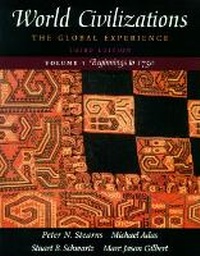
World Civilizations
The Global Experience, Volume I - Beginnings to 1750
3rd Edition
Published on 8. September 2000
Book
Paperback/Softback
80 pages
978-0-321-03812-8 (ISBN)
Description
The primary goal of World Civilizations is to present a TRULY GLOBAL HISTORY-one that both discusses the development of the world's leading civilizations and also emphasizes the major stages in the interactions among different peoples and societies. World Civilizations examines all the world's civilizations, including those in the Western tradition but also those civilizations sometimes neglected in world history texts-for example, the nomadic societies of Asia, Latin America, and the nations and states of the Pacific Rim. World Civilizations balances this discussion of independent developments in all the world's major civilizations with comparative analysis of the results of international contact.
World Civilizations organizes its presentation of global history into SIX COHERENT TIME PERIODS, with each period defined by the new and parallel patterns that evolved among all or most civilizations during the particular era. The six periods correspond to the six parts of the book. Within each part, the authors identify specific themes that characterize common experiences or common forces in individual societies as well as the new kinds and patterns of global contacts that emerged during the era. Thus, for example, Part I of the book discusses the developmental stage of world history, including the rise of agriculture and the development of civilization. Part II examines the classical era in global history, an era marked by the integration of large regions and diverse groups of people through overarching cultural and political systems. Subsequent parts of the book continue the emphasis on geographic shifts and the intensification of contact among civilizations.
World Civilizations organizes its presentation of global history into SIX COHERENT TIME PERIODS, with each period defined by the new and parallel patterns that evolved among all or most civilizations during the particular era. The six periods correspond to the six parts of the book. Within each part, the authors identify specific themes that characterize common experiences or common forces in individual societies as well as the new kinds and patterns of global contacts that emerged during the era. Thus, for example, Part I of the book discusses the developmental stage of world history, including the rise of agriculture and the development of civilization. Part II examines the classical era in global history, an era marked by the integration of large regions and diverse groups of people through overarching cultural and political systems. Subsequent parts of the book continue the emphasis on geographic shifts and the intensification of contact among civilizations.
More details
Edition
3rd edition
Language
English
Place of publication
United States
Publishing group
Pearson Education (US)
Target group
Professional and scholarly
Dimensions
Height: 254 mm
Width: 204 mm
Thickness: 19 mm
Weight
1109 gr
ISBN-13
978-0-321-03812-8 (9780321038128)
Copyright in bibliographic data and cover images is held by Nielsen Book Services Limited or by the publishers or by their respective licensors: all rights reserved.
Schweitzer Classification
Other editions
New editions
Peter N. Stearns | Michael B. Adas | Stuart B. Schwartz
World Civilizations
The Global Experience, Volume I - Beginnings to 1750 (Chapters 1-22)
Book
02/2004
4th Edition
Pearson
€60.65
Article exhausted; check for reprint
Previous edition

Peter N. Stearns | Michael B. Adas | Stuart B. Schwartz
World Civilizations, The Global Experience
Volume I - Beginnings to 1750
Book
02/1998
2nd Edition
Pearson
€47.03
Article exhausted; check for reprint
Content
Contents.
List of Maps.
Preface.
Supplements.
Acknowledgments.
Prologue.
I. THE ORIGINS OF CIVILIZATIONS.
1. The Neolithic Revolution and the Birth of Civilization.
Human Life in the Era of Hunters and Gatherers.
Document: Tales of the Hunt: Paleolithic Cave Paintings as History.
Agriculture and the Origins of Civilization: The Neolithic Revolution.
Visualizing the Past: Representation of Women in Early Art.
In Depth: The Idea of Civilization in World Historical Perspective.
The First Towns: Seedbeds of Civilization.
Conclusion: The Watershed of the 4th Millennium B.C.E.
2. The Rise of Civilization in the Middle East and Africa.
Setting the Scene: The Middle East by 4000 B.C.E.
Civilization in Mesopotamia.
Visualizing the Past: Mesopotamia in Maps.
Document: Hammurabi's Law Code.
Ancient Egypt.
Egypt and Mesopotamia Compared.
In Depth: Women in Patriarchal Societies.
Civilization Centers in Africa and The Eastern Mediterranean.
The End of the Early Civilization Period.
Conclusion: The Issue of Heritage.
3. Asia's First Civilizations: India and China.
The Indus Valley and the Genesis of South Asian Civilization.
The Aryan Invasions and Early Aryan Society in India.
Document: Aryan Poetry in Praise of a War-Horse.
A Bend in the River and the Beginnings of China.
Visualizing the Past: Mapping the Rise of Civilizations.
The Decline of the Shang and the Era of Zhou Dominance.
In Depth: The Legacy of Asia's First Civilizations.
Conclusion: Beginnings and Transitions.
II. THE CLASSICAL PERIOD IN WORLD HISTORY.
4. Nomadic Challenges and Sedentary Responses.
The Rise and Spread of Pastoral Nomadism.
Visualizing the Past: Varieties of Human Adaptation and the Potential for Civilization.
Nomadic Society and Culture.
Document: Nomadic Verse and Nomadic Values.
Nomads and Civilization.
In Depth: Nomads and Cross-Civilizational Contacts and Exchanges.
Conclusion: Nomads and the Pattern of Global History.
5. Unification and the Consolidation of Civilization in China.
Philosophical Solutions to the Long Crisis of the Later Zhou.
Document: Teachings of the Rival Chinese Schools.
The Triumph of the Qin and the Establishment of Imperial Unity.
In Depth: Sunzi and the Shift from Ritual Combat to "Real" War.
The Han Dynasty and the Foundations of China's Classical Age.
Visualizing the Past: Capital Designs and Patterns of Political Power.
Conclusion: An Era of Accomplishment and Affluence.
6. Classical Greece and the Hellenistic World.
Greece as a Classical Civilization.
The Persian Empire: Parallel Power in the Middle East.
The Political Character of Classical Greece.
The Hellenistic Period.
Creativity in Greek and Hellenistic Culture.
Document: The Power of Greek Drama.
In Depth: Defining Social History.
Patterns of Greek and Hellenistic Society.
Visualizing the Past: Commerce and Society.
Conclusion: A Complex Legacy.
7. Rome and Its Empire.
Introduction.
The Development of Rome's Republic.
Roman Culture.
Document: Rome and A Values Crisis.
The Institutions of Empire.
Visualizing the Past: Religions in Rome.
The Evolution of Rome's Economic and Social Structure.
In Depth: The Classical Mediterranean in Comparative Perspective.
The Origins of Christianity.
Conclusion: Decline.
8. Religious Rivalries and India's Golden Age.
The Age of Brahman Dominance.
In Depth: Inequality as the Social Norm.
Religious Ferment and the Rise of Buddhism.
Visualizing the Past: The Pattern of Trade in the Ancient Eurasian World.
Brahmanical Recovery and the Splendors of the Gupta Age.
Document: A Guardian's Farewell Speech to a Young Woman About to Be Married.
Conclusion: The Legacy of the Classical Age in India.
9. The Peoples and Civilizations of the Americas.
Origins of American Societies.
Spread of Civilization in Mesoamerica.
Document: Deciphering the Maya Glyphs.
The Peoples to the North.
In Depth: Different Times for Different Peoples.
The Andean World.
Conclusion: American Civilizations.
10. The Spread of Peoples and Civilizations.
The Spread of Civilization in Africa.
Document: Myths of Origin.
In Depth: Language as a Historical Source.
The Slavs and the Germans on the Northern Rim.
The Spread of Chinese Civilization to Japan.
The Scattered Societies of Polynesia.
Conclusion: The Emerging Cultures.
11. The End of the Classical Era: World History in Transition, 200-700 C.E.
The Decline of Civilization and the Rise of Religions.
Upheavals in Eastern and Southern Asia.
Document: The Popularization of Buddhism.
The Decline and Fall of the Roman Empire.
In Depth: The Problem of Decline and Fall.
The Development and Spread of World Religions.
Visualizing : Religious Geography.
Conclusion: In the Wake of Decline and Fall.
III. THE POSTCLASSICAL ERA.
12. The First Global Civilization: The Rise and Spread of Islam.
Desert and Town: The Arabian World and the Birth of Islam.
The Life of Muhammad and the Genesis of Islam.
The Arab Empire of the Umayyads.
In Depth: Civilization and Gender.
From Arab to Islamic Empire: The Early Abbasid Era.
Document: The Thousand and One Nights as a Mirror of Elite Society in the Abbasid Era.
Visualizing the Past: The Mosque as a Symbol of Islamic Civilization.
Conclusion: The Measure of Islamic Achievement.
13. Abbasid Decline and the Spread of Islamic Civilization to South and Southeast Asia.
The Islamic Heartlands in the Mid- and Late-Abbasid Era.
Document: Ibn Khaldun on the Rise and Decline of Empires.
An Age of Learning and Artistic Refinement.
Visualizing the Past: Patterns of Islam's Global Expansion.
The Coming of Islam to South Asia.
The Spread of Islam to Southeast Asia.
In Depth: Conversion and Accommodation in the Spread of World Religions.
Conclusion: The Legacy of the Abbasid Age.
14. African Civilization and the Spread of Islam.
African Societies: Diversity and Similarities.
Kingdoms of the Grasslands.
Document: The Great Oral Tradition and the Epic of Sundiata.
The Swahili Coast of East Africa.
In Depth: Two Transitions in the History of World Population.
Peoples of the Forest and Plains.
Conclusion: Internal Development and External Contacts.
15. Civilization in Eastern Europe: Byzantium and Orthodox Europe.
The Byzantine Empire.
Visualizing the Past: Women and Power in Byzantium.
The Spread of Civilization in Eastern Europe.
Document: Russia Turns to Christianity.
In Depth: Eastern and Western Europe: The Problem of Boundaries.
Conclusion: The End of an Era in Eastern Europe.
16. A New Civilization Emerges in Western Europe.
The Flavor of the Middle Ages: Inferiority and Vitality.
Stages of Postclassical Development.
In Depth: The Sources of Vitality in the Postclassical West.
Western Culture in the Postclassical Era.
Changing Economic and Social Forms in the Postclassical Centuries.
Visualizing the Past: Peasant Labor.
Document: Changing Roles for Women.
The Decline of the Medieval Synthesis.
Conclusion: The Postclassical West and Its Heritage: A Balance Sheet.
17. The Americas on the Eve of Invasion.
Postclassic Mesoamerica, 1000-1500 C.E.
Aztec Society in Transition.
Document: Aztec Women and Men.
In Depth: The "Troubling" Civilizations of the Americas.
Twantinsuyu: World of the Incas.
Visualizing the Past: Archaeological Evidence of Political Practice.
The Other Indians.
Conclusion: American Indian Diversity in World Context.
18. Reunification and Renaissance in Chinese Civilization: The Era of the Tang and Song Dynasties.
Introduction.
Rebuilding the Imperial Edifice in the Sui-Tang Era.
Document: Ties That Bind: Paths to Power.
Tang Decline and the Rise of the Song.
Tang and Song Prosperity: The Basis of a Golden Age.
In Depth: Artistic Expression and Social Values.
Conclusion: The End of the Song: The Legacy of Two Great Dynasties.
19. The Spread of Chinese Civilization: Korea, Japan, and Vietnam.
Japan: The Imperial Age.
The Era of Warrior Dominance.
In Depth: Comparing Feudalisms.
Korea: Between China and Japan.
Between China and Southeast Asia: The Making of Vietnam.
Visualizing the Past: What Their Portraits Tell Us: "Gatekeeper" Elites and the Persistence of Civilizations.
Document: Literature as a Mirror of the Exchanges Between Civilized Centers.
Conclusion: Divergent Paths in East Asian Development.
20. The Last Great Nomadic Challenges: From Chinggis Khan to Timur.
The Mongol Empire of Chinggis Khan.
Document: A European Assessment of the Virtues and Vices of the Mongols.
Visualizing the Past: The Mongol Empire as a Bridge Between Civilizations.
The Mongol Drive to the West.
The Mongol Interlude in Chinese History.
In Depth: The Eclipse of the Nomadic War Machine.
Conclusion: The Mongol Legacy and an Aftershock: The Brief Ride of Timur.
21. The West and the Changing World Balance.
The Decline of the Old World Order.
The Rise of the West.
Visualizing the Past: Population Trends.
Document: Italian Renaissance Culture.
Western Expansion: The Experimental Phase.
In Depth: The Problem of Ethnocentrism.
Outside the World Network.
Conclusion: Adding Up the Changes.
IV. THE WORLD SHRINKS, 1450-1750.
22. The Transformation of the West, 1450-1750.
The First Big Changes: Culture and Commerce.
Science and Politics: The Next Phase of Change.
Visualizing the Past: Versailles.
In Depth: Elites and Masses.
The West by 1750.
Document: Controversies About Women.
Conclusion: Innovation and Instability.
23. The West and the World.
The West's First Outreach: Maritime Power.
In Depth: Causation and the West's Expansion.
Toward a World Economy.
Visualizing the Past: Analysis: West Indian Slaveholding.
Colonial Expansion.
Document: Western Conquerors: Tactics and Motives.
Conclusion: The Impact of a New World Order.
Glossary.
Credits.
Index.
List of Maps.
Preface.
Supplements.
Acknowledgments.
Prologue.
I. THE ORIGINS OF CIVILIZATIONS.
1. The Neolithic Revolution and the Birth of Civilization.
Human Life in the Era of Hunters and Gatherers.
Document: Tales of the Hunt: Paleolithic Cave Paintings as History.
Agriculture and the Origins of Civilization: The Neolithic Revolution.
Visualizing the Past: Representation of Women in Early Art.
In Depth: The Idea of Civilization in World Historical Perspective.
The First Towns: Seedbeds of Civilization.
Conclusion: The Watershed of the 4th Millennium B.C.E.
2. The Rise of Civilization in the Middle East and Africa.
Setting the Scene: The Middle East by 4000 B.C.E.
Civilization in Mesopotamia.
Visualizing the Past: Mesopotamia in Maps.
Document: Hammurabi's Law Code.
Ancient Egypt.
Egypt and Mesopotamia Compared.
In Depth: Women in Patriarchal Societies.
Civilization Centers in Africa and The Eastern Mediterranean.
The End of the Early Civilization Period.
Conclusion: The Issue of Heritage.
3. Asia's First Civilizations: India and China.
The Indus Valley and the Genesis of South Asian Civilization.
The Aryan Invasions and Early Aryan Society in India.
Document: Aryan Poetry in Praise of a War-Horse.
A Bend in the River and the Beginnings of China.
Visualizing the Past: Mapping the Rise of Civilizations.
The Decline of the Shang and the Era of Zhou Dominance.
In Depth: The Legacy of Asia's First Civilizations.
Conclusion: Beginnings and Transitions.
II. THE CLASSICAL PERIOD IN WORLD HISTORY.
4. Nomadic Challenges and Sedentary Responses.
The Rise and Spread of Pastoral Nomadism.
Visualizing the Past: Varieties of Human Adaptation and the Potential for Civilization.
Nomadic Society and Culture.
Document: Nomadic Verse and Nomadic Values.
Nomads and Civilization.
In Depth: Nomads and Cross-Civilizational Contacts and Exchanges.
Conclusion: Nomads and the Pattern of Global History.
5. Unification and the Consolidation of Civilization in China.
Philosophical Solutions to the Long Crisis of the Later Zhou.
Document: Teachings of the Rival Chinese Schools.
The Triumph of the Qin and the Establishment of Imperial Unity.
In Depth: Sunzi and the Shift from Ritual Combat to "Real" War.
The Han Dynasty and the Foundations of China's Classical Age.
Visualizing the Past: Capital Designs and Patterns of Political Power.
Conclusion: An Era of Accomplishment and Affluence.
6. Classical Greece and the Hellenistic World.
Greece as a Classical Civilization.
The Persian Empire: Parallel Power in the Middle East.
The Political Character of Classical Greece.
The Hellenistic Period.
Creativity in Greek and Hellenistic Culture.
Document: The Power of Greek Drama.
In Depth: Defining Social History.
Patterns of Greek and Hellenistic Society.
Visualizing the Past: Commerce and Society.
Conclusion: A Complex Legacy.
7. Rome and Its Empire.
Introduction.
The Development of Rome's Republic.
Roman Culture.
Document: Rome and A Values Crisis.
The Institutions of Empire.
Visualizing the Past: Religions in Rome.
The Evolution of Rome's Economic and Social Structure.
In Depth: The Classical Mediterranean in Comparative Perspective.
The Origins of Christianity.
Conclusion: Decline.
8. Religious Rivalries and India's Golden Age.
The Age of Brahman Dominance.
In Depth: Inequality as the Social Norm.
Religious Ferment and the Rise of Buddhism.
Visualizing the Past: The Pattern of Trade in the Ancient Eurasian World.
Brahmanical Recovery and the Splendors of the Gupta Age.
Document: A Guardian's Farewell Speech to a Young Woman About to Be Married.
Conclusion: The Legacy of the Classical Age in India.
9. The Peoples and Civilizations of the Americas.
Origins of American Societies.
Spread of Civilization in Mesoamerica.
Document: Deciphering the Maya Glyphs.
The Peoples to the North.
In Depth: Different Times for Different Peoples.
The Andean World.
Conclusion: American Civilizations.
10. The Spread of Peoples and Civilizations.
The Spread of Civilization in Africa.
Document: Myths of Origin.
In Depth: Language as a Historical Source.
The Slavs and the Germans on the Northern Rim.
The Spread of Chinese Civilization to Japan.
The Scattered Societies of Polynesia.
Conclusion: The Emerging Cultures.
11. The End of the Classical Era: World History in Transition, 200-700 C.E.
The Decline of Civilization and the Rise of Religions.
Upheavals in Eastern and Southern Asia.
Document: The Popularization of Buddhism.
The Decline and Fall of the Roman Empire.
In Depth: The Problem of Decline and Fall.
The Development and Spread of World Religions.
Visualizing : Religious Geography.
Conclusion: In the Wake of Decline and Fall.
III. THE POSTCLASSICAL ERA.
12. The First Global Civilization: The Rise and Spread of Islam.
Desert and Town: The Arabian World and the Birth of Islam.
The Life of Muhammad and the Genesis of Islam.
The Arab Empire of the Umayyads.
In Depth: Civilization and Gender.
From Arab to Islamic Empire: The Early Abbasid Era.
Document: The Thousand and One Nights as a Mirror of Elite Society in the Abbasid Era.
Visualizing the Past: The Mosque as a Symbol of Islamic Civilization.
Conclusion: The Measure of Islamic Achievement.
13. Abbasid Decline and the Spread of Islamic Civilization to South and Southeast Asia.
The Islamic Heartlands in the Mid- and Late-Abbasid Era.
Document: Ibn Khaldun on the Rise and Decline of Empires.
An Age of Learning and Artistic Refinement.
Visualizing the Past: Patterns of Islam's Global Expansion.
The Coming of Islam to South Asia.
The Spread of Islam to Southeast Asia.
In Depth: Conversion and Accommodation in the Spread of World Religions.
Conclusion: The Legacy of the Abbasid Age.
14. African Civilization and the Spread of Islam.
African Societies: Diversity and Similarities.
Kingdoms of the Grasslands.
Document: The Great Oral Tradition and the Epic of Sundiata.
The Swahili Coast of East Africa.
In Depth: Two Transitions in the History of World Population.
Peoples of the Forest and Plains.
Conclusion: Internal Development and External Contacts.
15. Civilization in Eastern Europe: Byzantium and Orthodox Europe.
The Byzantine Empire.
Visualizing the Past: Women and Power in Byzantium.
The Spread of Civilization in Eastern Europe.
Document: Russia Turns to Christianity.
In Depth: Eastern and Western Europe: The Problem of Boundaries.
Conclusion: The End of an Era in Eastern Europe.
16. A New Civilization Emerges in Western Europe.
The Flavor of the Middle Ages: Inferiority and Vitality.
Stages of Postclassical Development.
In Depth: The Sources of Vitality in the Postclassical West.
Western Culture in the Postclassical Era.
Changing Economic and Social Forms in the Postclassical Centuries.
Visualizing the Past: Peasant Labor.
Document: Changing Roles for Women.
The Decline of the Medieval Synthesis.
Conclusion: The Postclassical West and Its Heritage: A Balance Sheet.
17. The Americas on the Eve of Invasion.
Postclassic Mesoamerica, 1000-1500 C.E.
Aztec Society in Transition.
Document: Aztec Women and Men.
In Depth: The "Troubling" Civilizations of the Americas.
Twantinsuyu: World of the Incas.
Visualizing the Past: Archaeological Evidence of Political Practice.
The Other Indians.
Conclusion: American Indian Diversity in World Context.
18. Reunification and Renaissance in Chinese Civilization: The Era of the Tang and Song Dynasties.
Introduction.
Rebuilding the Imperial Edifice in the Sui-Tang Era.
Document: Ties That Bind: Paths to Power.
Tang Decline and the Rise of the Song.
Tang and Song Prosperity: The Basis of a Golden Age.
In Depth: Artistic Expression and Social Values.
Conclusion: The End of the Song: The Legacy of Two Great Dynasties.
19. The Spread of Chinese Civilization: Korea, Japan, and Vietnam.
Japan: The Imperial Age.
The Era of Warrior Dominance.
In Depth: Comparing Feudalisms.
Korea: Between China and Japan.
Between China and Southeast Asia: The Making of Vietnam.
Visualizing the Past: What Their Portraits Tell Us: "Gatekeeper" Elites and the Persistence of Civilizations.
Document: Literature as a Mirror of the Exchanges Between Civilized Centers.
Conclusion: Divergent Paths in East Asian Development.
20. The Last Great Nomadic Challenges: From Chinggis Khan to Timur.
The Mongol Empire of Chinggis Khan.
Document: A European Assessment of the Virtues and Vices of the Mongols.
Visualizing the Past: The Mongol Empire as a Bridge Between Civilizations.
The Mongol Drive to the West.
The Mongol Interlude in Chinese History.
In Depth: The Eclipse of the Nomadic War Machine.
Conclusion: The Mongol Legacy and an Aftershock: The Brief Ride of Timur.
21. The West and the Changing World Balance.
The Decline of the Old World Order.
The Rise of the West.
Visualizing the Past: Population Trends.
Document: Italian Renaissance Culture.
Western Expansion: The Experimental Phase.
In Depth: The Problem of Ethnocentrism.
Outside the World Network.
Conclusion: Adding Up the Changes.
IV. THE WORLD SHRINKS, 1450-1750.
22. The Transformation of the West, 1450-1750.
The First Big Changes: Culture and Commerce.
Science and Politics: The Next Phase of Change.
Visualizing the Past: Versailles.
In Depth: Elites and Masses.
The West by 1750.
Document: Controversies About Women.
Conclusion: Innovation and Instability.
23. The West and the World.
The West's First Outreach: Maritime Power.
In Depth: Causation and the West's Expansion.
Toward a World Economy.
Visualizing the Past: Analysis: West Indian Slaveholding.
Colonial Expansion.
Document: Western Conquerors: Tactics and Motives.
Conclusion: The Impact of a New World Order.
Glossary.
Credits.
Index.