

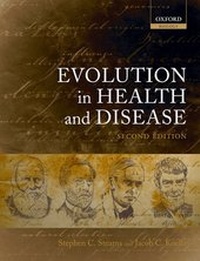
Evolution in Health and Disease
2nd Edition
Published on 22. November 2007
Book
Hardback
398 pages
978-0-19-920745-9 (ISBN)
Description
In this fully revised and updated edition, the editors have integrated a completely new set of contributions from the leading researchers in the field to describe the latest research in evolutionary medicine, providing a fresh summary of this rapidly expanding field 10 years after its predecessor was first compiled. It continues to adopt a broad approach to the subject, drawing on medically relevant research from evolutionary genetics, human behavioural ecology,
evolutionary microbiology (especially experimental evolution of virulence and resistance), the evolution of aging and degenerative disease, and other aspects of biology or medicine where evolutionary approaches make important contributions.
Evolution in Health and Disease describes how evolutionary thinking gives valuable insights and fresh perspectives into human health and disease, establishing evolutionary biology as an essential complementary science for medicine. Integrating evolutionary thought into medical research and practice helps to explain the origins of many medical conditions, including diabetes, obesity, cardiovascular disease, asthma, allergies, other autoimmune diseases, and aging. It also provides
life-saving insights into the evolutionary responses of pathogens to antibiotics, vaccinations, and other human interventions. Why do we grow old? How can we stay healthy as we age? The book discusses these and many other fascinating questions, as well as suggesting exciting possibilities for future treatment and
research.
This research level text is suitable for graduate level students and researchers in the fields of evolutionary (Darwinian) medicine, evolutionary biology, anthropology, developmental biology and genetics. It will also be of relevance and use to medical researchers and doctors.
evolutionary microbiology (especially experimental evolution of virulence and resistance), the evolution of aging and degenerative disease, and other aspects of biology or medicine where evolutionary approaches make important contributions.
Evolution in Health and Disease describes how evolutionary thinking gives valuable insights and fresh perspectives into human health and disease, establishing evolutionary biology as an essential complementary science for medicine. Integrating evolutionary thought into medical research and practice helps to explain the origins of many medical conditions, including diabetes, obesity, cardiovascular disease, asthma, allergies, other autoimmune diseases, and aging. It also provides
life-saving insights into the evolutionary responses of pathogens to antibiotics, vaccinations, and other human interventions. Why do we grow old? How can we stay healthy as we age? The book discusses these and many other fascinating questions, as well as suggesting exciting possibilities for future treatment and
research.
This research level text is suitable for graduate level students and researchers in the fields of evolutionary (Darwinian) medicine, evolutionary biology, anthropology, developmental biology and genetics. It will also be of relevance and use to medical researchers and doctors.
Reviews / Votes
This book is a veritable treasure trove...The book is written in an extremely clear, mostly nontechnical style. * Lab Times * The book should be a welcome addition to the shelves of academics and students in the biological sciences, as well as medical practitioners for whom it was primarily intended. * Jerzy M. Behnke Parasites & Vectors * ...this book will stimulate fresh thinking and new approaches to traditional medical problems * The New England Journal of Medicine * The chapters are well-organized and refreshingly free of jargon, with good flow across the diverse range of topics. * American Journal of Human Biology * This splendid book, will not only delight biologists (both established and apprentice) but also help medical students to appreciate biological issues underlying their future craft. * Biologist magazine *More details
Edition
2nd Revised edition
Language
English
Place of publication
Oxford
United Kingdom
Target group
Professional and scholarly
Edition type
Revised edition
Illustrations
56 b&w line; 1 halftone illustrations
Dimensions
Height: 252 mm
Width: 195 mm
Thickness: 26 mm
Weight
1020 gr
ISBN-13
978-0-19-920745-9 (9780199207459)
Copyright in bibliographic data and cover images is held by Nielsen Book Services Limited or by the publishers or by their respective licensors: all rights reserved.
Schweitzer Classification
Other editions
Additional editions
Stephen C. Stearns | Jacob C. Koella
Evolution in Health and Disease
Book
11/2007
2nd Edition
Oxford University Press
€107.30
Shipment within 15-20 days
Previous edition

Stephen C. Stearns
Evolution in Health and Disease
Book
10/1998
Oxford University Press
€68.09
Article exhausted; check for reprint
Persons
Professor Stearns specializes in life history evolution, which links the fields of ecology and evolutionary biology, in evolutionary medicine, and in evolutionary functional genomics. He came to Yale in 2000 from the University of Basel, Switzerland, where he had been professor of zoology since 1983 and held several administrative posts. Prior to moving to Basel he was an assistant professor in the Biology Department at Reed College in Oregon. Born in Hawaii
and a 1967 graduate of Yale College, Stearns earned a M.S. from the University of Wisconsin and a Ph.D. from the University of British Columbia.
Professor Koella's interests lie in the coevolution of parasites and hosts. He specializes in the evolutionary epidemiology of malaria and in the application of evolutionary ideas to the control of malaria. After obtaining a Masters' in mechanical engineering at the ETH Zurich and a PhD in evolutionary biology at the University of Basel he worked for several years at the Swiss Tropical Institute Basel as a malaria epidemiologist before moving on to positions in Switzerland, Denmark and
France. He arrived at Imperial College in 2005 as a Chair in Epidemiology.
and a 1967 graduate of Yale College, Stearns earned a M.S. from the University of Wisconsin and a Ph.D. from the University of British Columbia.
Professor Koella's interests lie in the coevolution of parasites and hosts. He specializes in the evolutionary epidemiology of malaria and in the application of evolutionary ideas to the control of malaria. After obtaining a Masters' in mechanical engineering at the ETH Zurich and a PhD in evolutionary biology at the University of Basel he worked for several years at the Swiss Tropical Institute Basel as a malaria epidemiologist before moving on to positions in Switzerland, Denmark and
France. He arrived at Imperial College in 2005 as a Chair in Epidemiology.
Content
PART I. INTRODUCTION ; PART II. THE HISTORY AND VARIATION OF HUMAN GENES ; PART III. NATURAL SELECTION AND EVOLUTIONARY CONFLICTS ; PART IV. PATHOGENS: RESISTANCE, VIRULENCE, VARIATION, AND EMERGENCE ; PART V. NONINFECTIOUS AND DEGENERATIVE DISEASE