

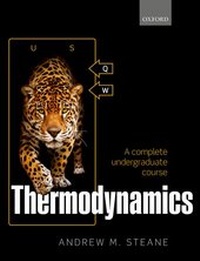
Thermodynamics
A complete undergraduate course
Published on 29. September 2016
Book
Paperback/Softback
464 pages
978-0-19-878857-7 (ISBN)
Description
The role of thermodynamics in modern physics is not just to provide an approximate treatment of large thermal systems, but, more importantly, to provide an organising set of ideas. Thermodynamics: A complete undergraduate course presents thermodynamics as a self-contained and elegant set of ideas and methods. It unfolds thermodynamics for undergraduate students of physics, chemistry or engineering, beginning at first year level. The book introduces the necessary mathematical methods, assuming almost no prior knowledge, and explains concepts such as entropy and free energy at length, with many examples. This book aims to convey the style and power of thermodynamic reasoning, along with applications such as Joule-Kelvin expansion, the gas turbine, magnetic cooling, solids at high pressure, chemical equilibrium, radiative heat exchange and global warming, to name a few. It mentions but does not pursue statistical mechanics, in order to keep the logic clear.
Reviews / Votes
Reading this textbook from the beginning till the end will be easy, enjoyable and enlightening. * M. P. Gururajan, Contemporary Physics *More details
Language
English
Place of publication
Oxford
United Kingdom
Target group
College/higher education
Illustrations
163
Dimensions
Height: 246 mm
Width: 194 mm
Thickness: 22 mm
Weight
976 gr
ISBN-13
978-0-19-878857-7 (9780198788577)
Copyright in bibliographic data and cover images is held by Nielsen Book Services Limited or by the publishers or by their respective licensors: all rights reserved.
Schweitzer Classification
Other editions
Additional editions
Book
10/2016
Oxford University Press
€131.50
Shipment within 15-20 days
Person
Andrew M. Steane was born in Bath, England (1965) and educated at Christ's Hospital school and Oxford University. He has been Professor of Physics at the University of Oxford since 2002. His scientific research concerns quantum computing and fundamental physics. Steane was awarded the Maxwell Medal and Prize of the Institute of Physics in 2000 for his work on quantum error correction. He has given numerous public lectures and school demonstrations in physics. He is the author of "The Wonderful World of Relativity" (OUP, 2011), "Relativity Made Relatively Easy" (OUP, 2012) and "Faithful to Science" (OUP, 2014).
Content
1: How to use this book
2: Introducing thermodynamics
3: A survey of thermodynamic ideas
4: Some general knowledge
5: Mathematical tools
6: Zeroth law, equation of state
7: First Law, internal energy
8: The Second Law and entropy
9: Understanding entropy
10: Heat flow and thermal relaxation
11: Practical heat engines
12: Introducing chemical potential
13: Functions and methods
14: Elastic bands, rods, bubbles, magnets
15: Modelling real gases
16: Expansion and flow processes
17: Stability and free energy
18: Reinventing the subject
19: Thermal radiation
20: Radiative heat transfer
21: Chemical reactions
22: Phase change
23: The Third Law
24: Phase change, nucleation and solutes
25: Continuous phase transitions
26: Self-gravitation and negative heat capacity
27: Fluctuations
28: Thermoelectricity and entropy flow
2: Introducing thermodynamics
3: A survey of thermodynamic ideas
4: Some general knowledge
5: Mathematical tools
6: Zeroth law, equation of state
7: First Law, internal energy
8: The Second Law and entropy
9: Understanding entropy
10: Heat flow and thermal relaxation
11: Practical heat engines
12: Introducing chemical potential
13: Functions and methods
14: Elastic bands, rods, bubbles, magnets
15: Modelling real gases
16: Expansion and flow processes
17: Stability and free energy
18: Reinventing the subject
19: Thermal radiation
20: Radiative heat transfer
21: Chemical reactions
22: Phase change
23: The Third Law
24: Phase change, nucleation and solutes
25: Continuous phase transitions
26: Self-gravitation and negative heat capacity
27: Fluctuations
28: Thermoelectricity and entropy flow