

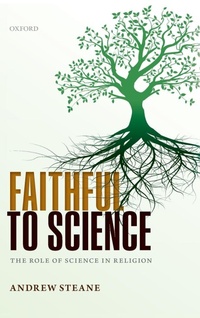
Faithful to Science
The Role of Science in Religion
Published on 24. July 2014
Book
Hardback
272 pages
978-0-19-871604-4 (ISBN)
Description
Science and religious faith are two of the most important and influential forces in human life, yet there is widespread confusion about how, or indeed whether, they link together. This book describes this combination from the perspective of one who finds that they link together productively and creatively. The situation is not one of conflict or uneasy tension, or even a respectful dialogue. Rather, a lively and well-founded faith in God embraces and includes science, and scientific ways of thinking, in their proper role. Science is an activity right in the bloodstream of a reasonable faith.
The book interprets theism broadly, and engages carefully with atheism, while coming from a Christian perspective. The aim is to show what science is, and what it is not, and at the same time give some pointers to what theism is or can be. Philosophy, evolution and the nature of science and human life are discussed in the first part of the book, questions of origins in the second.
It is the very mind-set of scientific thinking that is widely supposed to be antagonistic to religious faith. But such suspicions are too sweeping. They misunderstand both faith and science. Faith can be creative and intellectually courageous; science is not the all-embracing story that it is sometimes made out to be. It is not that science fails to explain some things, but rather, it does not explain anything at all, on its own. It is part of a larger explanation. And even explanation has to take a humble place; it is not the purpose of life.
The book interprets theism broadly, and engages carefully with atheism, while coming from a Christian perspective. The aim is to show what science is, and what it is not, and at the same time give some pointers to what theism is or can be. Philosophy, evolution and the nature of science and human life are discussed in the first part of the book, questions of origins in the second.
It is the very mind-set of scientific thinking that is widely supposed to be antagonistic to religious faith. But such suspicions are too sweeping. They misunderstand both faith and science. Faith can be creative and intellectually courageous; science is not the all-embracing story that it is sometimes made out to be. It is not that science fails to explain some things, but rather, it does not explain anything at all, on its own. It is part of a larger explanation. And even explanation has to take a humble place; it is not the purpose of life.
Reviews / Votes
clearly argued * Church of England Newspaper, Paul Richardson * Steane's book is an absolute 'must'. It is also warmly welcomed for its much-needed clarifications concerning the science-religion 'debate'. * Elizabeth Griffin, The Observatory *More details
Language
English
Place of publication
Oxford
United Kingdom
Illustrations
8 b/w illustrations
Dimensions
Height: 222 mm
Width: 145 mm
Thickness: 18 mm
Weight
467 gr
ISBN-13
978-0-19-871604-4 (9780198716044)
Copyright in bibliographic data and cover images is held by Nielsen Book Services Limited or by the publishers or by their respective licensors: all rights reserved.
Schweitzer Classification
Other editions
Additional editions
E-Book
07/2014
1st Edition
OUP eBook
€28.99
Available for download
E-Book
07/2014
1st Edition
OUP eBook
€28.99
Available for download
Person
Andrew Steane was born in Bath, England (1965) and educated at Christ's Hospital school and the University of Oxford. He has been Professor of Physics at the University of Oxford since 2002 and a Visiting Professor at various institutes. Steane was awarded the Maxwell Medal and Prize of the Institute of Physics in 2000 for his work on quantum error correction. He has given numerous public lectures in physics, and in the interaction of science and Christian faith. He is the author of 'The Wonderful World of Relativity' (OUP, 2011) and 'Relativity Made Relatively Easy' (OUP, 2012).
Content
PART 1: SCIENCE AND NATURE; PART 2: ORIGINS