

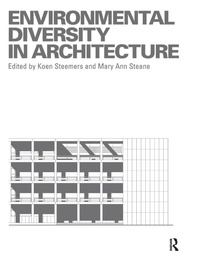
Environmental Diversity in Architecture
Published on 23. September 2004
Book
Hardback
252 pages
978-0-415-31477-0 (ISBN)
Description
This book takes the position that the dynamic of the architectural environment is a key aspect of good design, yet one which is not well anticipated or understood. Environmental variety is a design characteristic closely related to our experience of architecture - an architecture of the senses. Each chapter demonstrates how an understanding of a particular context or environmental characteristic in dynamic terms informs design. The book is an antidote to the misconceptions of 'optimum' environmental performance or fixed criteria, instead embracing the richness of environmental variety.
More details
Language
English
Place of publication
London
United Kingdom
Publishing group
Taylor & Francis Ltd
Target group
College/higher education
Professional and scholarly
Postgraduate, Professional, Professional Practice & Development, and Undergraduate
Illustrations
110 s/w Abbildungen, 30 s/w Zeichnungen
30 Line drawings, black and white; 110 Illustrations, black and white
Dimensions
Height: 260 mm
Width: 208 mm
Thickness: 18 mm
Weight
771 gr
ISBN-13
978-0-415-31477-0 (9780415314770)
Copyright in bibliographic data and cover images is held by Nielsen Book Services Limited or by the publishers or by their respective licensors: all rights reserved.
Schweitzer Classification
Other editions
Additional editions
Mary Ann Steane | Koen Steemers
Environmental Diversity in Architecture
Book
09/2004
Routledge
€93.70
Shipment within 15-20 days
Mary Ann Steane | Koen Steemers
Environmental Diversity in Architecture
E-Book
08/2004
Routledge
€86.99
Available for download
Mary Ann Steane | Koen Steemers
Environmental Diversity in Architecture
E-Book
08/2004
Routledge
€87.49
Available for download
Persons
Koen Steemers is a director of the Martin Centre for Architectural and Urban Studies and a senior lecturer at the University of Cambridge Department of Architecture. He specialises in aspects of environmental design in architecture, has practices as an architect in the UK and Germany, and is a Director of Cambridge Architectural Research Limited. His recent publications include Energy and Environment in Architecture (2000), and Architecture City Environment (2000), The Selective Environment (2002), Daylight Design of Buildings (2002).
Mary Ann Steane is a lecturer in the University of Cambridge Department of Architecture. She lectures on environmental issues and is also a course director of the MPhil in Environmental Design. In the studio courses she delivers the acknowledgement and integration of environmental design issues is always given particular emphasis. Her research marries technical analysis with a more historical perspective. The current focus of her research is on natural lighting strategies, and seeks to enable more precise communication about light quality, and thus to develop a more nuanced appraisal of natural lighting strategies in their broader topographic, climatic and programmatic context.
Mary Ann Steane is a lecturer in the University of Cambridge Department of Architecture. She lectures on environmental issues and is also a course director of the MPhil in Environmental Design. In the studio courses she delivers the acknowledgement and integration of environmental design issues is always given particular emphasis. Her research marries technical analysis with a more historical perspective. The current focus of her research is on natural lighting strategies, and seeks to enable more precise communication about light quality, and thus to develop a more nuanced appraisal of natural lighting strategies in their broader topographic, climatic and programmatic context.
Content
Part 1: Introduction 1. Environmental Diversity in Architecture Part 2 Framework 2. Social, Architectural and Environmental Convergence 3. The Ambiguity of Intentions 4. Human Nature 5. Designing Diverse Lifetimes for Evolving Buildings Part 3: Urban 6. Urban Diversity 7. Outdoor Comfort 8. Intermediate Environments 9. The Reverential Acoustic Part 4: Interior 10. Environmental Diversity and Natural Lighting Strategies 11. Daylight Perception 12. Exploring Thermal Comfort and Spatial Diversity Part 5: Design 13. Experiencing Climate: Architecture and Environmental Diversity