

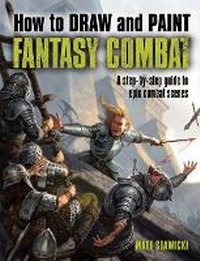
How to Draw & Paint Fantasy Combat
A Step-by-Step Guide to Epic Combat Scenes
Published on 3. February 2014
Book
Paperback/Softback
128 pages
978-1-78221-022-1 (ISBN)
Description
A step-by-step guide to kick-ass combat scenes.
Epic battle scenes beneath thundery skies, hand-to-hand combat between good and evil, the massed forces of darkness lined up against those destined to vanquish them, a lone warrior facing up to a monstrous foe, a slender young heroine wielding a magical sword: this is the stuff of some of the most exciting and dynamic art in the fantasy genre. How to Draw and Paint Fantasy Combat will show you how you can create all these scenes, and more: start the easy way by copying some of the scenes in the book, then work up your skills in the "tutorial" sections until you become great at sketching out dynamic figures from scratch, getting the hang of techniques that will stay with you as long as you keep on drawing.
Epic battle scenes beneath thundery skies, hand-to-hand combat between good and evil, the massed forces of darkness lined up against those destined to vanquish them, a lone warrior facing up to a monstrous foe, a slender young heroine wielding a magical sword: this is the stuff of some of the most exciting and dynamic art in the fantasy genre. How to Draw and Paint Fantasy Combat will show you how you can create all these scenes, and more: start the easy way by copying some of the scenes in the book, then work up your skills in the "tutorial" sections until you become great at sketching out dynamic figures from scratch, getting the hang of techniques that will stay with you as long as you keep on drawing.
Reviews / Votes
Apr 14This book would appeal well to teenagers especially starting out on their path to a career in fantasy drawing. It explains concepts in an easily understood and 'friendly' way which talks 'with' not 'at' the reader. I noticed several things I say to my learners and so this would be a good book linked to college lessons on concept art. This book is laid out especially well and can either be read straight through or delved into for use. The diagrams were extremely helpful and detailed. I found it realistic and energetic and a good 'inspiration' itself (see page 14). The book is about fantasy combat and this is clear from the feel of movement and pace throughout the book. It is definitely one to recommend and the only thing I felt would enhance this is an accompany website or CD as the book could bend very quickly as it is a book to use not just read. This is a book that covers all the key areas and I'll be on the lookout for more from the same authors. * Marian Carr, Bradford College *
More details
Language
English
Place of publication
Tunbridge Wells
United Kingdom
Dimensions
Height: 280 mm
Width: 215 mm
ISBN-13
978-1-78221-022-1 (9781782210221)
Copyright in bibliographic data and cover images is held by Nielsen Book Services Limited or by the publishers or by their respective licensors: all rights reserved.
Schweitzer Classification
Person
Matt Stawicki is an award-winning artist who has been creating dramatic fantasy images for over 20 years. His art has been on the covers of books for many fine authors, including (in no particular order) David Eddings, Margaret Weiss, Larry Nevin, Robert Heinlein, and Issac Asimov. In addition he has created images for a wide range of products, including collector's plates, figurines, collectable card games, and video game covers. His colorful work has been influenced by such notable artists as Howard Pyle, N.C. Wyeth, and Maxfield Parrish. Matt is a classically trained oil painter and did all his work in oils for the first several years of his career. In recent years, Matt has moved to doing much of his art in "digital paint." The first collection of his art, The Art Of Matthew Stawicki is published by Cartouche Press. In addition, Matt's work has also been showcased in The Masters of Dragonlance Art and Dragon Art, published by Flame Tree Publishing.
Content
Prelims (5 pp)
Introduction (2 pp)
A collection of techniques that explain how to draw convincing fantasy figures in combat, covering anatomic composition as well as how anatomy relates to overall composition. In addition, the content features five invaluable "directories" for classic elements of combat art: Attacking Poses, Defensive Poses, Weapons, Clothing and Accessories, and Classic Adversaries: collections of sketches to provide ideas for the beginner artist who wants
to know how, and what, to draw, with plenty of material suitable for copy and practice. The final "Artists at Work" section looks over the shoulders of five leading fantasy artists as they create compelling combat scenes and talk the reader through their planning stages and methodologies for creating great art. There are also "portfolio" examples to back up Matt's explanatory sketches, and drawings that explore the conceptual aspects behind fantasy art.
Section 1: Tools for Drawing and Painting (10 pp)
* Planning your workspace: tables, chairs, boards, lighting.
* Drawing media: pencils and grades, coloured pencil, pastels, pen and ink, brush pens.
* Papers: drawing paper, tracing and layout paper, watercolour papers, and how to prepare it.
* Painting media: a basic overview of media that can be use for colouring.
* More basic art supplies: what you can and can't do, using a wooden mannequin.
* Software programs that won't break the bank and will speed the process.
Section 2: Drawing Techniques (28 pp)
* Keeping a sketch pad: the source of all your fantasy inspiration.
* Core techniques for using pencils-Hatching, crosshatching, details, and outlines.
* Shading-The "sketch" technique that will give your fantasy figures three-dimensions.
* Basic human anatomy-Show us your muscles! This features the basic building blocks of the human anatomy.
With emphasis on the major body parts needed to draw a figure.
* Male figures-From stick figures to action hero: examples of the male figure in action developed from "stick" figure through to a finished drawn figure.
* Female figures-From damsels in distress to female action characters: female anatomy in action poses, starting with stick figures.
* Details: human figure-Male and female heads, faces, and expressions; hands and feet; limbs and foreshortening; masterclass on eyes, nose, and mouth.
* Tonal values-Darks and lights and how they are used to influence where the viewer's eye is directed; Plus how to exaggerate what you see in real life.
* Using photographs, movie clips, and video gaming images to help develop poses-How using these models will give your subjects realism, and how you can go beyond simply copying.
* Clothing-How to draw clothing to develop characters and stories. And to help express movement.
Section 3: Painting Techniques (18 pp)
* The colour wheel: the most useful tool for beginners just learning their craft.
* What you find in the art store, and how to use it: watercolour, gouache, acrylic.
* Colour mixing: a quick guide.
* Essential techniques-Layering; dry brushing; wet-in-wet, and other useful techniques for applying paint.
* Making colour work for you-How colour draws the viewer's eye, creates drama, and makes action sequences more
dynamic. Choosing a "colour scheme" for your piece: how difference palettes will change the mood dramatically.
Section 4: Making your combat scenes real (30 pp)
* Ways to fight, who to fight, why to fight, where to fight, and what to fight with.
* How the human body flexes and bends.
* How to think about posing and positioning.
* Directory 1: Attacking Poses-including kicking, punching, wielding, swordwork.
* Directory 2: Defensive Poses-including parrying a blow, using a shield, wielding a staff, dodging a spear.
* Different viewing angles.
* Foreshortening the figure.
* Exaggerating the human form.
* Energy transfer.
* Choose your weapon: an overview.
* Directory 3: Weapons, and How They Are Used-from axes and arbalests to bows, pikes, and spears.
* Two-handed combat.
* Magic as a weapon and other superior powers.
* Clothing-Making it move: movement, draping, flowing.
* Directory 4: Clothing and Accessories-with all kinds of fighting gear: armour, scabbards, and helmets.
* Special effects: fire, guts, blood, explosions, smoke, and how to render them.
* Choreographing your battle: establishing a connection between or among combatants.
* Directory 5: Classic Combatants-A range of character drawings showing classic adversaries from the fantasy genre.
Section 5: Let Battle Commence: Environments (16 pp)
* Getting inspiration-Getting ideas for your battle scenes: famous paintings of battle scenes to look up and view online; classic films to watch; and books to read by some of the fantasy masters who conjure in words amazing scenes of battle.
* Five classic battle scene environments: the essential elements, and how to draw and render them
Natural environment-forest, trees, or open plains.
Gothic architecture-castle turrets, palace doorways, and dungeons
Cliffs and mountain passes-rockfalls, precipices, and precarious bridges
Cloudscapes and aerial combat-thundery skies, magical powers
Caves and underground worlds-stalactites, mystical lakes, bottomless ravines
Section 6: Artists at Work (16 pp)
Five professional fantasy artists let you look over their shoulders as they create five very different scenes of combat, evoking different fantasy genres.
Index and Credits (3 pp)
Introduction (2 pp)
A collection of techniques that explain how to draw convincing fantasy figures in combat, covering anatomic composition as well as how anatomy relates to overall composition. In addition, the content features five invaluable "directories" for classic elements of combat art: Attacking Poses, Defensive Poses, Weapons, Clothing and Accessories, and Classic Adversaries: collections of sketches to provide ideas for the beginner artist who wants
to know how, and what, to draw, with plenty of material suitable for copy and practice. The final "Artists at Work" section looks over the shoulders of five leading fantasy artists as they create compelling combat scenes and talk the reader through their planning stages and methodologies for creating great art. There are also "portfolio" examples to back up Matt's explanatory sketches, and drawings that explore the conceptual aspects behind fantasy art.
Section 1: Tools for Drawing and Painting (10 pp)
* Planning your workspace: tables, chairs, boards, lighting.
* Drawing media: pencils and grades, coloured pencil, pastels, pen and ink, brush pens.
* Papers: drawing paper, tracing and layout paper, watercolour papers, and how to prepare it.
* Painting media: a basic overview of media that can be use for colouring.
* More basic art supplies: what you can and can't do, using a wooden mannequin.
* Software programs that won't break the bank and will speed the process.
Section 2: Drawing Techniques (28 pp)
* Keeping a sketch pad: the source of all your fantasy inspiration.
* Core techniques for using pencils-Hatching, crosshatching, details, and outlines.
* Shading-The "sketch" technique that will give your fantasy figures three-dimensions.
* Basic human anatomy-Show us your muscles! This features the basic building blocks of the human anatomy.
With emphasis on the major body parts needed to draw a figure.
* Male figures-From stick figures to action hero: examples of the male figure in action developed from "stick" figure through to a finished drawn figure.
* Female figures-From damsels in distress to female action characters: female anatomy in action poses, starting with stick figures.
* Details: human figure-Male and female heads, faces, and expressions; hands and feet; limbs and foreshortening; masterclass on eyes, nose, and mouth.
* Tonal values-Darks and lights and how they are used to influence where the viewer's eye is directed; Plus how to exaggerate what you see in real life.
* Using photographs, movie clips, and video gaming images to help develop poses-How using these models will give your subjects realism, and how you can go beyond simply copying.
* Clothing-How to draw clothing to develop characters and stories. And to help express movement.
Section 3: Painting Techniques (18 pp)
* The colour wheel: the most useful tool for beginners just learning their craft.
* What you find in the art store, and how to use it: watercolour, gouache, acrylic.
* Colour mixing: a quick guide.
* Essential techniques-Layering; dry brushing; wet-in-wet, and other useful techniques for applying paint.
* Making colour work for you-How colour draws the viewer's eye, creates drama, and makes action sequences more
dynamic. Choosing a "colour scheme" for your piece: how difference palettes will change the mood dramatically.
Section 4: Making your combat scenes real (30 pp)
* Ways to fight, who to fight, why to fight, where to fight, and what to fight with.
* How the human body flexes and bends.
* How to think about posing and positioning.
* Directory 1: Attacking Poses-including kicking, punching, wielding, swordwork.
* Directory 2: Defensive Poses-including parrying a blow, using a shield, wielding a staff, dodging a spear.
* Different viewing angles.
* Foreshortening the figure.
* Exaggerating the human form.
* Energy transfer.
* Choose your weapon: an overview.
* Directory 3: Weapons, and How They Are Used-from axes and arbalests to bows, pikes, and spears.
* Two-handed combat.
* Magic as a weapon and other superior powers.
* Clothing-Making it move: movement, draping, flowing.
* Directory 4: Clothing and Accessories-with all kinds of fighting gear: armour, scabbards, and helmets.
* Special effects: fire, guts, blood, explosions, smoke, and how to render them.
* Choreographing your battle: establishing a connection between or among combatants.
* Directory 5: Classic Combatants-A range of character drawings showing classic adversaries from the fantasy genre.
Section 5: Let Battle Commence: Environments (16 pp)
* Getting inspiration-Getting ideas for your battle scenes: famous paintings of battle scenes to look up and view online; classic films to watch; and books to read by some of the fantasy masters who conjure in words amazing scenes of battle.
* Five classic battle scene environments: the essential elements, and how to draw and render them
Natural environment-forest, trees, or open plains.
Gothic architecture-castle turrets, palace doorways, and dungeons
Cliffs and mountain passes-rockfalls, precipices, and precarious bridges
Cloudscapes and aerial combat-thundery skies, magical powers
Caves and underground worlds-stalactites, mystical lakes, bottomless ravines
Section 6: Artists at Work (16 pp)
Five professional fantasy artists let you look over their shoulders as they create five very different scenes of combat, evoking different fantasy genres.
Index and Credits (3 pp)