

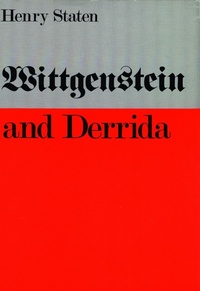
Wittgenstein and Derrida
Published on 1. December 1986
Book
Paperback/Softback
184 pages
978-0-8032-9169-0 (ISBN)
Description
"By linking Wittgenstein with Derrida, Staten suggests that the intellectual relevance of deconstruction is wider than the English-speaking public has recognized."-Studies in the Humanities
"This work is altogether first rate. It is informative, faithful, rigorous and completely original in its problematization. It is an original theoretical advance which I believe will mark an essential step forward in the field."-Jacques Derrida
"Staten has plenty of philosophical acuity and critical sensitivity as well as wide philosophical scholarship, and he writes in a clear, muscular style which illuminates the issues sometimes profoundly without in any way concealing their difficulty and complxity. . . . Wittgenstein and Derrida should be essential reading not only for anyone interested in the current critical debate but also for philosophers."-Bernard Harrison, University of Sussex, England
This book examines Aristotle, Kant, and especially Husserl to bring to light Derrida's development of the classical philosophical concepts of form (eidos), verbal formula (logos), the object-in-general, and time. The later work of Wittgenstein is then examined in detail and Wittgenstein's "zigzag" writing in the Philosophical Investigations is interpreted as deconstructive syntax, directed, like Derrida's work, against the dominance of the philosophical concern with the form of an entity.
Henry Staten is a professor of English and philosophy at the University of Utah.
"This work is altogether first rate. It is informative, faithful, rigorous and completely original in its problematization. It is an original theoretical advance which I believe will mark an essential step forward in the field."-Jacques Derrida
"Staten has plenty of philosophical acuity and critical sensitivity as well as wide philosophical scholarship, and he writes in a clear, muscular style which illuminates the issues sometimes profoundly without in any way concealing their difficulty and complxity. . . . Wittgenstein and Derrida should be essential reading not only for anyone interested in the current critical debate but also for philosophers."-Bernard Harrison, University of Sussex, England
This book examines Aristotle, Kant, and especially Husserl to bring to light Derrida's development of the classical philosophical concepts of form (eidos), verbal formula (logos), the object-in-general, and time. The later work of Wittgenstein is then examined in detail and Wittgenstein's "zigzag" writing in the Philosophical Investigations is interpreted as deconstructive syntax, directed, like Derrida's work, against the dominance of the philosophical concern with the form of an entity.
Henry Staten is a professor of English and philosophy at the University of Utah.
More details
Language
English
Place of publication
Lincoln
United States
Target group
Professional and scholarly
Product notice
Paperback (trade)
Dimensions
Height: 227 mm
Width: 152 mm
Thickness: 13 mm
Weight
286 gr
ISBN-13
978-0-8032-9169-0 (9780803291690)
Copyright in bibliographic data and cover images is held by Nielsen Book Services Limited or by the publishers or by their respective licensors: all rights reserved.
Schweitzer Classification
Person
Henry Staten is a professor of English and philosophy at the University of Utah.