

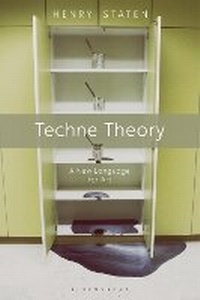
Techne Theory
A New Language for Art
Published on 21. February 2019
Book
Hardback
216 pages
978-1-4725-9289-7 (ISBN)
Description
Only since the Romantic period has art been understood in terms of an ineffable aesthetic quality of things like poems, paintings, and sculptures, and the art-maker as endowed with an inexplicable power of creation. From the Greeks to the 18th century, art was conceived as techne--the skill and know-how by which things and states of affairs are ordered. Techne Theory shows how to use this concept to cut through the Romantic notion of art as a kind of magic by returning to the original sense of art as techne, the standpoint of the person who actually knows how to make a work of art.
Understood as techne, art-making, like all other cultural accomplishments, is a form of work performed by an artisan who has inherited the know-how of previous generations of artisans. Along the way, Techne Theory cuts through the humanist-structuralist impasse over the question of artistic agency and explains what 'form' really means.
Understood as techne, art-making, like all other cultural accomplishments, is a form of work performed by an artisan who has inherited the know-how of previous generations of artisans. Along the way, Techne Theory cuts through the humanist-structuralist impasse over the question of artistic agency and explains what 'form' really means.
Reviews / Votes
Each of the diverse chapters makes for highly interesting (and for an analytic philosopher refreshingly different) reading ... [For] analytic philosophers of aesthetics, who have for the most part neglected the topic of creativity, this book is interesting and creative in both style and content. * Notre Dame Philosophical Reviews * From the standpoint of techne theory, Kant's most radical insight concerned the limitation of the creative power of individual genius, which cannot account for the emergence of the novelty or the formal evolution of the artwork. Building on this critical insight, Staten creates a highly original phenomenological investigation into the technical components of "art-making," remaining grounded in material processes and what art and literary theory can (and cannot) tell us about them. -- Gregg Lambert, Dean's Professor and Director of the Syracuse University Humanities Center, USA In this learned, original, important, and always lively new study, Henry Staten moves today's heated and often sterile debate about aesthetic form to a new place-a place that is also (and in the best sense), an old place, newly inhabited. Staten rethinks Plato's and Aristotle's concepts of eidos and techne in three ways: first, by bringing searching attention of a scholarly and critical kind to tensions and contradictions within the founding works themselves; second, by making those works respond to the very developments that they sponsored in both Romantic and modernist works; and third, by coordinating ancient Greek concepts of art, form, medium, making, and doing, with a posthumanist framework that reunites knowledge and know-how, theory and practice, eidos and hyle, and vates and poietes. Anyone with any interest in the idea of form (and in the formation of ideas) should read this book. It changes the game we've been playing. -- Marjorie Levinson, F.L. Huetwell Professor of English, University of Michigan, USA * 15/01/2019 *More details
Language
English
Place of publication
London
United Kingdom
Publishing group
Bloomsbury Publishing PLC
Target group
College/higher education
Professional and scholarly
Dimensions
Height: 234 mm
Width: 156 mm
Weight
481 gr
ISBN-13
978-1-4725-9289-7 (9781472592897)
Copyright in bibliographic data and cover images is held by Nielsen Book Services Limited or by the publishers or by their respective licensors: all rights reserved.
Schweitzer Classification
Other editions
Additional editions
E-Book
02/2019
1st Edition
Bloomsbury Academic
€28.49
Available for download
Person
Henry Staten is Byron W. and Alice L. Lockwood Professor in the Humanities, University of Washington, USA. His acclaimed first book, Wittgenstein and Derrida (1984) was one of the first philosophical commentaries on deconstruction. Since then his work has ranged widely across literature and philosophy from the Greeks through modernism.
Content
Acknowledgements
Part One: Fundamentals
Chapter 1: Introduction: The Techne Standpoint
Chapter 2: Art and Evolution
Chapter 3: The Artist's Touch
Part Two: Origins in Greek Philosophy
Chapter 4: How Plato (Despite Himself) Invented Techne Theory
Chapter 5: From Aristotle to Extended Mind
Part Three: Where Do Poems Come From?
Chapter 6: A Romantic View: Seamus Heaney
Chapter 7: Excursus on the Nature of Language
Chapter 8: An Anti-Romantic View: Paul Valery
Part Four: Studies in Modernist Techne
Chapter 9: T. J. Clark's Picasso
Chapter 10: What's Radical About Radical Painting?
Chapter 11: The Techne of Kafka's Metamorphosis
Part Five: Techne Metatheory
Chapter 12: Universal Design Space and the Lines of Force
Bibliography
Index
Part One: Fundamentals
Chapter 1: Introduction: The Techne Standpoint
Chapter 2: Art and Evolution
Chapter 3: The Artist's Touch
Part Two: Origins in Greek Philosophy
Chapter 4: How Plato (Despite Himself) Invented Techne Theory
Chapter 5: From Aristotle to Extended Mind
Part Three: Where Do Poems Come From?
Chapter 6: A Romantic View: Seamus Heaney
Chapter 7: Excursus on the Nature of Language
Chapter 8: An Anti-Romantic View: Paul Valery
Part Four: Studies in Modernist Techne
Chapter 9: T. J. Clark's Picasso
Chapter 10: What's Radical About Radical Painting?
Chapter 11: The Techne of Kafka's Metamorphosis
Part Five: Techne Metatheory
Chapter 12: Universal Design Space and the Lines of Force
Bibliography
Index