

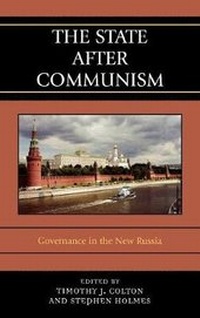
The State after Communism
Governance in the New Russia
Rowman & Littlefield Publishers
Published on 11. August 2006
Book
Hardback
334 pages
978-0-7425-3941-9 (ISBN)
Description
The Soviet dictatorship was a strong state, committed to dominating and transforming society in the name of a utopian ideology. When the communist regime crumbled and the post-Soviet countries committed to democracy, most observers took for granted that their state structures would be effective agents of the popular will. Russia's experience demonstrates that this assumption was overly optimistic. This book, based on a major collaborative research project with American and Russian scholars, shows that state capacity, strength, and coherence were highly problematic after communism, which had major consequences for particular functions of government and for the entire process of regime change. Eleven respected contributors examine governance in post-Soviet Russia in comparative context, investigating the roots, characteristics, and consequences of the crisis as a whole and its manifestations in the specific realms of tax collection, statistics, federalism, social policy, regulation of the banks, currency exchange, energy policy, and parliamentary oversight of the bureaucracy.
Reviews / Votes
An interesting, challenging book. Highly recommended. * CHOICE * The State After Communism is a laudable effort to understand this pehnomenon, aiming to correct the earlier neglect and to "bring the state back in" to scholarly analyses of contemporary Russia....an insightful, useful set of studies on the emerging Russian state. * Canadian Slavonic Papers, March-June 2010 * This book offers a long-awaited and much-needed assessment of the current condition of the Russian state from a distinguished group of leading American scholars of Russian affairs. The volume of essays will be required reading for any serious student of Russia who wants to understand the complexities of how the country is governed today, years after the collapse of the Soviet Union, and to get a sense of the direction of the Russian state in the future. -- Fiona Hill, The Brookings InstitutionMore details
Language
English
Place of publication
United States
Publishing group
Bloomsbury Publishing Plc
Target group
College/higher education
Dimensions
Height: 237 mm
Width: 162 mm
Thickness: 29 mm
Weight
635 gr
ISBN-13
978-0-7425-3941-9 (9780742539419)
Copyright in bibliographic data and cover images is held by Nielsen Book Services Limited or by the publishers or by their respective licensors: all rights reserved.
Schweitzer Classification
Persons
Timothy J. Colton is professor of government and Russian studies and director of the Davis Center for Russian and Eurasian Studies at Harvard University. Stephen Holmes is professor of law at New York University School of Law.
Content
Chapter 1 Introduction: Governance and Postcommunist Politics Chapter 2 Building Fiscal Capacity Chapter 3 The Transformation of State Statistics Chapter 4 Resistance to the Central State in the Periphery Chapter 5 State Capacity and Pension Provision Chapter 6 Governing the Banking Sector Chapter 7 Evaluating Exchange Rate Management Chapter 8 The Paradox of Energy Sector Reform Chapter 9 Democratization, Separation of Powers, and State Capacity Chapter 10 Conclusion: The State of the State in Putin's Russia