

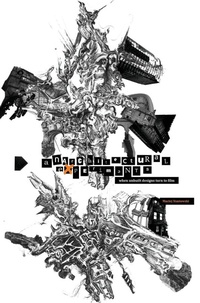
Anarchitectural Experiments
When Unbuilt Designs Turn to Film
Published on 15. May 2023
Book
Hardback
324 pages
978-1-78938-542-7 (ISBN)
Description
The book investigates speculative filmic architectural projects and animations that go beyond representing buildings, touching upon issues concerning medium, act of representation, or conducting criticism on history, culture, society, or urban politics, along with the mediated character of contemporary spatial experience - interpreting it primarily through protocols of architectural imaging.
The book centres on the influence of simulation and cinematic design on visionary or speculative architecture. It outlines the impact of film and animation in architectural representation through key projects. The opening analysis is useful in contextualizing speculative architectural projects, while the later chapters link the theory to the imagery. Stasiowski uses a diverse collection of interesting case studies that are easy to read and well-chosen to support his argument.
This is a well-researched work and comprehensive review of speculative architecture and various media that describe it. Stasiowski makes a thorough argument about the use of cinema and animation as a method of architectural visualization.
Stasiowki's book sets itself apart from other work in the same area by in discussing speculative projects in relation to cinema. and specifically, the effect that modern technologies are having on the subject now and in its potential futures.
The borderline between material environment and spatialized imagery becomes progressively more blurred, while demand for visionary works that would make sense of this merging, has never been greater.
It will appeal primarily to architects and designers, filmmakers and academics. It may also be of interest to artists, set designers, and film production designers.
The book centres on the influence of simulation and cinematic design on visionary or speculative architecture. It outlines the impact of film and animation in architectural representation through key projects. The opening analysis is useful in contextualizing speculative architectural projects, while the later chapters link the theory to the imagery. Stasiowski uses a diverse collection of interesting case studies that are easy to read and well-chosen to support his argument.
This is a well-researched work and comprehensive review of speculative architecture and various media that describe it. Stasiowski makes a thorough argument about the use of cinema and animation as a method of architectural visualization.
Stasiowki's book sets itself apart from other work in the same area by in discussing speculative projects in relation to cinema. and specifically, the effect that modern technologies are having on the subject now and in its potential futures.
The borderline between material environment and spatialized imagery becomes progressively more blurred, while demand for visionary works that would make sense of this merging, has never been greater.
It will appeal primarily to architects and designers, filmmakers and academics. It may also be of interest to artists, set designers, and film production designers.
More details
Language
English
Place of publication
United Kingdom
Publishing group
Intellect
Target group
Professional and scholarly
Illustrations
100 Illustrations, black and white
Dimensions
Height: 250 mm
Width: 175 mm
Thickness: 23 mm
Weight
760 gr
ISBN-13
978-1-78938-542-7 (9781789385427)
Copyright in bibliographic data and cover images is held by Nielsen Book Services Limited or by the publishers or by their respective licensors: all rights reserved.
Schweitzer Classification
Other editions
Additional editions
E-Book
06/2023
Intellect Books
€93.99
Available for download
Person
Dr. Maciej Stasiowski is a graduate in film and media studies from the Institute of Audiovisual Arts, in the Faculty of Management and Social Communication at the Jagiellonian University, Cracow, Poland.
Content
List of Figures
Introduction: Lebbeus Takes Us Outside
1. On Techniques of Architectural Representation
2. Architecture in Filmic Space
3. Leaving Buildings on Paper
4. Inscription Deconstructed by Means of Cinematography
5. Case Studies, Part One: 'Analogue' Projects
6. Digitalia
7. Case Studies, Part Two: Speculating with Architectural Animation
Notes
Acknowledgements
Bibliography
Filmography
Index
Introduction: Lebbeus Takes Us Outside
1. On Techniques of Architectural Representation
2. Architecture in Filmic Space
3. Leaving Buildings on Paper
4. Inscription Deconstructed by Means of Cinematography
5. Case Studies, Part One: 'Analogue' Projects
6. Digitalia
7. Case Studies, Part Two: Speculating with Architectural Animation
Notes
Acknowledgements
Bibliography
Filmography
Index