

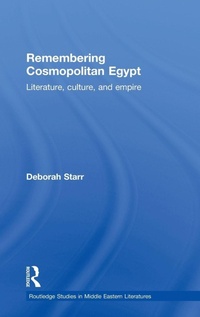
Remembering Cosmopolitan Egypt
Literature, culture, and empire
1st Edition
Published on 8. October 2009
Book
Hardback
212 pages
978-0-415-77511-3 (ISBN)
Description
Remembering Cosmopolitan Egypt examines the link between cosmopolitanism in Egypt, from the nineteenth century through to the mid-twentieth century, and colonialism. While it has been widely noted that such a relationship exists, the nature and impact of this dynamic is often overlooked. Taking a theoretical, literary and historical approach, the author argues that the notion of the cosmopolitan is inseparable from, and indebted to, its foundation in empire.
Since the late 1970s a number of artistic works have appeared that represent the diversity of ethnic, national, and religious communities present in Egypt in the nineteenth and early twentieth centuries. During this period of direct and indirect European domination, the cosmopolitan society evident in these texts thrived. Through detailed analysis of these texts, which include contemporary novels written in Arabic and Hebrew as well as Egyptian films, the implications of the close relationship between colonialism and cosmopolitanism are explored.
This comparative study of the contemporary literary and cultural revival of interest in Egypt's cosmopolitan past will be of interest to students of Middle Eastern Studies, Literary and Cultural Studies and Jewish Studies.
Since the late 1970s a number of artistic works have appeared that represent the diversity of ethnic, national, and religious communities present in Egypt in the nineteenth and early twentieth centuries. During this period of direct and indirect European domination, the cosmopolitan society evident in these texts thrived. Through detailed analysis of these texts, which include contemporary novels written in Arabic and Hebrew as well as Egyptian films, the implications of the close relationship between colonialism and cosmopolitanism are explored.
This comparative study of the contemporary literary and cultural revival of interest in Egypt's cosmopolitan past will be of interest to students of Middle Eastern Studies, Literary and Cultural Studies and Jewish Studies.
Reviews / Votes
"[An] incisive study, which clearly establishes the fact that the phenomenon of cosmopolitanism could be both historical and ahistorical-a binary that is by no means contradictory, and can in fact be deployed to foster harmony in contemporary diversities in which 'adversarial discourse' (p. 149) dominates. All students of history and theorists on political ideas will forever be beholden to this remarkable effort by Starr."- Amidu Olalekan Sanni, Lagos State University, Nigeria; British Journal of Middle Eastern Studies, 39:1More details
Series
Language
English
Place of publication
London
United Kingdom
Publishing group
Taylor & Francis Ltd
Target group
College/higher education
Illustrations
7 s/w Photographien bzw. Rasterbilder
7 Halftones, black and white
Dimensions
Height: 240 mm
Width: 161 mm
Thickness: 17 mm
Weight
505 gr
ISBN-13
978-0-415-77511-3 (9780415775113)
Copyright in bibliographic data and cover images is held by Nielsen Book Services Limited or by the publishers or by their respective licensors: all rights reserved.
Schweitzer Classification
Other editions
Additional editions
Book
02/2013
1st Edition
Routledge
€78.30
Shipment within 15-20 days
E-Book
06/2009
Routledge
€72.49
Available for download
E-Book
06/2009
1st Edition
Routledge
€72.49
Available for download
E-Book
06/2009
1st Edition
Routledge
€110.69
Available for download
Person
Deborah A. Starr is Associate Professor of Modern Arabic and Hebrew Literature at Cornell University. Her research and teaching interests include contemporary literature and film, minorities of the Middle East, cosmopolitanism, postcolonial studies, and urban studies.
Content
Introduction Part 1: Colonial Anxieties and Cosmopolitan Desires 1. Literary Alexandria 2. Poetics of Memory: Edwar al-Kharrat 3. Polis and Cosmos: Ibrahim Abdel Meguid Part 2: Counterpoint New York 4. Why New York?: Youssef Chahine Part 3: A Mobile Levant 5. Gazing Across Sinai 6. A Mediterranean Vigor that Never Wanes: Yitzhaq Gormezano Goren 7. Unmasking Levantine Blindness: Ronit Matalon. Conclusion