

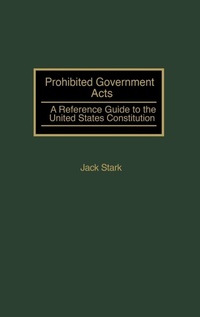
Prohibited Government Acts
A Reference Guide to the United States Constitution
Published on 30. November 2002
Book
Hardback
192 pages
978-0-313-31352-3 (ISBN)
Description
Traces the history of, and analyzes, the current status of the law on a number of prohibited acts forbidden to the federal government as prescribed in Article I, Section 9, of the United States Constitution. Most of these represent constraints on Congress with the exception of the statement that no money may be drawn from the U.S. Treasury except by appropriation, which increases the power of Congress. The provisions include prohibitions against suspending the privilege of the writ of habeas corpus except in cases of emergency and against passing bills of attainder and ex post facto laws. These prohibitions secure important freedoms for the citizens of the United States.
Among the other prohibitions discussed are a delay in stopping the slave trade, forbidding taxes on exports between states, forbidding giving preferences to ports of one state, and forbidding public officers from accepting things of value from foreign countries. Several of these provisions, such as those concerning bills of attainder, ex post facto laws, and the writ of habeas corpus laws are the bedrock of our free society. The provision on the need for appropriations enhances the role of Congress and sets up potential conflicts between it and the other two branches of government, conflicts that might lead to highly significant cases that will help to clarify to doctrine of the separation of powers. A table of cases, bibliographic essay, and an index to enable further pursuit of key topics is included to aid students, legal, and constitutional scholars.
Among the other prohibitions discussed are a delay in stopping the slave trade, forbidding taxes on exports between states, forbidding giving preferences to ports of one state, and forbidding public officers from accepting things of value from foreign countries. Several of these provisions, such as those concerning bills of attainder, ex post facto laws, and the writ of habeas corpus laws are the bedrock of our free society. The provision on the need for appropriations enhances the role of Congress and sets up potential conflicts between it and the other two branches of government, conflicts that might lead to highly significant cases that will help to clarify to doctrine of the separation of powers. A table of cases, bibliographic essay, and an index to enable further pursuit of key topics is included to aid students, legal, and constitutional scholars.
More details
Series
Language
English
Place of publication
United States
Publishing group
Bloomsbury Publishing Plc
Target group
College/higher education
Professional and scholarly
Interest Age: From 7 to 17 years
Dimensions
Height: 240 mm
Width: 161 mm
Thickness: 15 mm
Weight
461 gr
ISBN-13
978-0-313-31352-3 (9780313313523)
Copyright in bibliographic data and cover images is held by Nielsen Book Services Limited or by the publishers or by their respective licensors: all rights reserved.
Schweitzer Classification
Other editions
Additional editions
E-Book
11/2002
1st Edition
Praeger Publishers Inc
€82.99
Available for download
Person
JACK STARK is a legislative attorney. He is the editor of this series, Reference Guides to the United States Constitution. He is the author of The Wisconsin State Consitution (Greenwood, 1997) and The Iowa State Constitution (Greenwood, 1998).
Content
Series Foreword by Jack Stark
Foreword by Tom Barrett
Introduction
A History of Prohibited Government Acts
English Common Law
The Constitutional Convention
The Ratification Debate
Before the Civil War
Between the Civil War and 1950
The Current Era
Prohibited Government Acts and Commentary
Clause 2: Suspending the Privilege of the Writ of Habeas Corpus
Clause 3: Bills of Attainder and Ex Post Facto Laws
Clause 5: Taxes on Exports
Clause 6: Preferences to Ports
Clause 7: No Money to Be Drawn from the Treasury But by Appropriation
Clause 8: Titles and Gifts Prohibited
Conclusion
Bibliographical Essay
Index
Foreword by Tom Barrett
Introduction
A History of Prohibited Government Acts
English Common Law
The Constitutional Convention
The Ratification Debate
Before the Civil War
Between the Civil War and 1950
The Current Era
Prohibited Government Acts and Commentary
Clause 2: Suspending the Privilege of the Writ of Habeas Corpus
Clause 3: Bills of Attainder and Ex Post Facto Laws
Clause 5: Taxes on Exports
Clause 6: Preferences to Ports
Clause 7: No Money to Be Drawn from the Treasury But by Appropriation
Clause 8: Titles and Gifts Prohibited
Conclusion
Bibliographical Essay
Index