

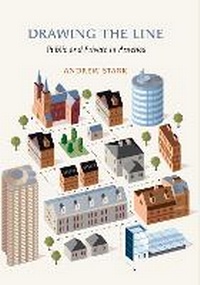
Drawing the Line
Public and Private in America
Published on 18. December 2009
Book
Hardback
245 pages
978-0-8157-0333-4 (ISBN)
Description
"In Drawing the Line, Andrew Stark takes a fresh and provocative look at how Americans debate the border between the public realm and the private. The seemingly eternal struggle to establish the proper division of societal responsibilities-to draw the line-has been joined yet again. Obama administration initiatives, particularly bank bailouts and health care reform, roil anew the debate of just what government should do for its citizens, what exactly is the public sphere, and what should be left to individual responsibility.
Are these arguments specific to isolated policy issues, or do they reveal something bigger about politics and society? The author realizes that the shorthand, ""public vs. private"" dichotomy is overly simplistic. Something more subtle and complex is going on, Stark reveals, and he offers a deeper, more politically helpful way to view these conflicts.
Stark interviewed hundreds of policymakers and advocates, and here he weaves those insights into his own counterintuitive view and innovative approach to explain how citizens at the grass-roots level divide policy debates between public and private responsibilities-specifically on education, land use and ""public space,"" welfare, and health care. In doing so, Drawing the Line provides striking lessons for anyone trying to build new and effective policy coalitions on Main Street.
""All of these debates... are typically portrayed as conflicts between one side championing the values of the public sphere... and the other those of the private realm.... [A] closer look shows that each side asserts and relies coequally on both sets of values... but applies them in inverse or opposing ways."" -From the Introduction
"
Are these arguments specific to isolated policy issues, or do they reveal something bigger about politics and society? The author realizes that the shorthand, ""public vs. private"" dichotomy is overly simplistic. Something more subtle and complex is going on, Stark reveals, and he offers a deeper, more politically helpful way to view these conflicts.
Stark interviewed hundreds of policymakers and advocates, and here he weaves those insights into his own counterintuitive view and innovative approach to explain how citizens at the grass-roots level divide policy debates between public and private responsibilities-specifically on education, land use and ""public space,"" welfare, and health care. In doing so, Drawing the Line provides striking lessons for anyone trying to build new and effective policy coalitions on Main Street.
""All of these debates... are typically portrayed as conflicts between one side championing the values of the public sphere... and the other those of the private realm.... [A] closer look shows that each side asserts and relies coequally on both sets of values... but applies them in inverse or opposing ways."" -From the Introduction
"
Reviews / Votes
"As our political discourse becomes more hysterical and polarized by the day, we're veryfortunate to have this sober and insightful book about American ideology by Andrew Stark. He shows that there is more common ground between conservatives and liberals than either side admits. Written with grace and wit, this book actually says something new about the political debates of our time." ?Mark Lilla, Professor of the Humanities, Columbia University|"Governance in the twenty-first century is a complex mixture of the public and private.Andrew Stark has written an extremely useful book about this new world, in which heexplores the moral and ethical dilemmas that confront practitioners and scholars as theyattempt to define and understand boundaries that were once clear but that are increasingly ambiguous. This is a must-read for scholars and practitioners alike." ?Elaine C. Kamarck, Harvard Kennedy School
|"A meticulous and ironic exploration of American political self-deception. Stark takes thoseall-important ideological captions 'public' and 'private' and capsizes them under a tsunami of mind-bending examples of people using words to mean just what they wish them to mean." ?David Frum, American Enterprise Institute
|"American politics will become less combustible when we realize that we are not dividedbetween conservatives who prefer the private to the public and liberals who insist on theopposite. In this compelling book, Andrew Stark shows us how we can improve our political discourse." ?Alan Wolfe, Boston College
|"An illuminating account of what Americans argue about when they rely on competingconceptions of what's properly private and what's properly public in defending their policypreferences. As Andrew Stark elegantly demonstrates, these largely unexamined differences powerfully inform debates about welfare, health care, education, or the use of space. Anyone interested in rethinking social policy will find this book hard to put down." ?David L. Kirp, author of The Sandbox Investment: The Preschool Movement and Kids-First Politics
More details
Language
English
Place of publication
United States
Publishing group
Bloomsbury Publishing Plc
Target group
Professional and scholarly
Dimensions
Height: 235 mm
Width: 160 mm
Thickness: 24 mm
Weight
531 gr
ISBN-13
978-0-8157-0333-4 (9780815703334)
Copyright in bibliographic data and cover images is held by Nielsen Book Services Limited or by the publishers or by their respective licensors: all rights reserved.
Schweitzer Classification
Other editions
Additional editions
E-Book
03/2010
1st Edition
Brookings Institution
€28.49
Available for download
Person
"Andrew Stark teaches ethics and strategic management at the University of Toronto. He is the author of The Limits of Medicine (Cambridge University Press, 2006) and Conflict of Interest in American Public Life (Harvard University Press, 2000)."
Content
Contents Introduction Part One: Space 1. America the Gated? 2. Arresting Developments 3. Space, Real and Virtual Part Two: Education 4. What's Wrong with Private Funding for Public Schools? 5. What's Wrong with State Aid to Parochial Schools? 6. Commercialism in the Public Schools Part Three: Health Care 7. Thin the Soup or Shorten the Line? 8. Touring the Boundary of Medical Necessity 9. For Richer or For Poorer, but not in Sickness and in Health Part Four: Welfare 10.Moral Economy in America 11.Work and Welfare 12.Charitable Choice: The Hidden Consensus