

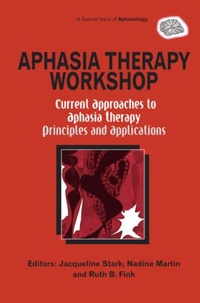
Aphasia Therapy Workshop: Current Approaches to Aphasia Therapy - Principles and Applications
A Special Issue of Aphasiology
Published on 22. December 2005
Book
Hardback
194 pages
978-1-84169-800-7 (ISBN)
Description
The Aphasia Therapy Workshop brings together leading experts in the field of aphasia to address current approaches to aphasia rehabilitation. The topics in this special issue include:
1) Functional communication: Social models and psychosocial approaches
2) Technological advances : Computer - based approaches
3) Aphasia therapy duration: best when intensive and prolonged?
4) Cognitive neuropsychological approaches
5) (Psycho-) Linguistic approaches
6) Beyond language - cognitive aspects of language therapy
The papers reflect the variety of approaches to treatment of aphasia and provide the reader with an update on the most current advances in our theories and practice of aphasia rehabilitation.
1) Functional communication: Social models and psychosocial approaches
2) Technological advances : Computer - based approaches
3) Aphasia therapy duration: best when intensive and prolonged?
4) Cognitive neuropsychological approaches
5) (Psycho-) Linguistic approaches
6) Beyond language - cognitive aspects of language therapy
The papers reflect the variety of approaches to treatment of aphasia and provide the reader with an update on the most current advances in our theories and practice of aphasia rehabilitation.
More details
Series
Language
English
Place of publication
Hove
United Kingdom
Publishing group
Taylor & Francis Ltd
Target group
College/higher education
Professional and scholarly
Dimensions
Height: 246 mm
Width: 167 mm
Weight
520 gr
ISBN-13
978-1-84169-800-7 (9781841698007)
Copyright in bibliographic data and cover images is held by Nielsen Book Services Limited or by the publishers or by their respective licensors: all rights reserved.
Schweitzer Classification
Other editions
Additional editions
Jacqueline Ann Stark | Ruth Fink | Nadine Martin
Aphasia Therapy Workshop: Current Approaches to Aphasia Therapy - Principles and Applications
A Special Issue of Aphasiology
Book
06/2015
1st Edition
Psychology Press Ltd
€38.60
Shipment within 10-20 days
Persons
Jacqueline Ann Stark, Ruth Fink, Nadine Martin
Content
J. Stark, N. Martin, R. Fink, Current Approaches to Aphasia Therapy: Principles and Applications. S. Byng, J.F. Duchan, Social Model Philosophies and Principles: Their Applications to Therapies for Aphasia. L. Worrall, T. Rose, T. Howe, A. Brennan, J. Egan, D. Oxenham, K. McKenna, Access to Written Information for People with Aphasia. M.C. Linebarger, M.F. Schwartz, AAC for Hypothesis Testing and Treatment of Aphasic Language Production: Lessons from a 'Processing Prosthesis'. R. Fink, A. Brecher, P. Sobel, M.F. Schwartz, Computer-assisted Treatment of Word Retrieval Deficits in Aphasia. G.A. Stefanatos, A. Gershkoff, S. Madigan, Computer-mediated Tools for the Investigation and Rehabilitation of Auditory and Phonological Processing in Aphasia. J.J. Hinckley, T.H. Carr, Comparing the Outcomes of Intensive and Non-intensive Context-based Aphasia Treatment. A. Basso, How Intensive-prolonged should an Intensive-prolonged Treatment be? A.E. Hillis, J. Heidler, Contributions and Limitations of "The Cognitive Neuropsychological Approach" to Treatment: Illustrations from Studies of Reading and Spelling Therapy. B. Rapp, The Relationship between Treatment Outcomes and the Underlying Cognitive Deficit: Evidence from the Remediation of Acquired Dysgraphia. J. Marshall, D. Cairns, Therapy for Sentence Processing Problems in Aphasia: Working on Thinking for Speaking. C.K. Thompson, L.P. Shapiro, Treating Agrammatic Aphasia within a Linguistic Framework: Treatment of Underlying Forms. N. Friedmann, Degrees of Severity and Recovery in Agrammatism: Climbing up the Syntactic Tree. M. Nicholas, M.P. Sinotte, N. H-Estabrooks, Using a Computer to Communicate: Effect of Executive Function Impairments in People with Severe Aphasia. G. Ramsburger, Achieving Conversational Success in Aphasia by Focusing on Nonlinguistic Cognitive Skills; a Potentially Promising New Approach. J.A. Stark, Analysing the Language Therapy Process - The Implicit Role of Learning and Memory.