

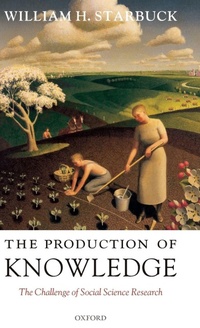
The Production of Knowledge
The Challenge of Social Science Research
Published on 27. April 2006
Book
Hardback
208 pages
978-0-19-928853-3 (ISBN)
Description
Bill Starbuck has been one of the leading management researchers over several decades. In this book he reflects on a number of challenges associated with management and social science research - the search for a 'behavioral science', the limits of rationality, the unreliability of many research findings, the social shaping of research agendas, cultures and judgements. It is an engaging, chronologically structured account in which he discusses some of his own research projects and various methodological debates.
This is a feisty argument from someone who has been fully engaged with all aspects of research - carrying out research programmes, evaluating research, tirelessly questioning the assumptions and claims of social science research, and never avoiding the awkward theoretical or practical challenges that face organizational researchers.
Well written, provocative and unusual, this quasi autobiographical account will inform and entertain, and be a valuable guide to current and future research students.
This is a feisty argument from someone who has been fully engaged with all aspects of research - carrying out research programmes, evaluating research, tirelessly questioning the assumptions and claims of social science research, and never avoiding the awkward theoretical or practical challenges that face organizational researchers.
Well written, provocative and unusual, this quasi autobiographical account will inform and entertain, and be a valuable guide to current and future research students.
Reviews / Votes
In this remarkable book, one of the most original minds in all of social science shows how to make the science better. Bill Starbuck demonstrates that true scholars are defined by their inputs, not just their outputs. Inputs captured in his autobiography are converted into lessons that reshape the tools we use to understand social complexity. This book is a profound illustration of living the craft of scholarship, with equally profound guidelines to improve the craft! * Karl E. Weick, Rensis Likert Distinguished University Professor of Organizational Behavior and Psychology, University of Michigan * In a fascinating account of his 40 years of investigation and learning, Bill Starbuck presents an original, razor-sharp and often devastating critique of our vast body of organizational research. He also plots the route to a better way to create useful, cumulative knowledge of organizations, This book is a must-read for anyone who wishes to study organizations and it will become a classic in our literature. * Danny Miller, Rogers-J.-A.-Bombardier Chair of Entrepreneurship Hautes Etudes Commerciales, Montreal *More details
Language
English
Place of publication
Oxford
United Kingdom
Target group
Professional and scholarly
Academics, researchers, and graduate students in management, organization studies, and the social sciences. Consultants, policymakers and management professionals engaged in research.
Illustrations
6 tables, 19 figures
Dimensions
Height: 222 mm
Width: 145 mm
Thickness: 16 mm
Weight
425 gr
ISBN-13
978-0-19-928853-3 (9780199288533)
Copyright in bibliographic data and cover images is held by Nielsen Book Services Limited or by the publishers or by their respective licensors: all rights reserved.
Schweitzer Classification
Other editions
Additional editions
E-Book
04/2006
OUP eBook
€92.49
Available for download
Person
William H. Starbuck is Professor in Residence, Lundquist College of Business, University of Oregon. Author of numerous articles on a wide-ranging set of issues relating to organizational behavior and strategy, he is also a former editor of Administrative Science Quarterly and co-editor of The Handbook of Organizational Design (with Paul Nystrom, OUP, 1981).
Content
1. Creating Better Social Science ; 2. A Journey into Disillusionment: Discovering Problems ; 3. Pretences of Research ; 4. A Journey into Hope: Discovering Partial Solutions ; 5. The Production of Knowledge