

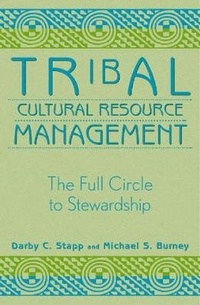
Tribal Cultural Resource Management
The Full Circle to Stewardship
Published on 23. October 2002
Book
Hardback
208 pages
978-0-7591-0104-3 (ISBN)
Description
The entrance of Native Americans into the world of cultural resource management is forcing a change in the traditional paradigms that have guided archaeologists, anthropologists, and other CRM professionals. This book examines these developments from tribal perspectives, and articulates native views on the identification of cultural resources, how they should be handled and by whom, and what their meaning is in contemporary life. Sponsored by the Heritage Resources Management Program, University of Nevada, Reno
Reviews / Votes
Essential reading for archaeologists and others involved in the cultural heritage management of Indigenous sites. -- Claire Smith, President, World Archaeological Congress Stapp and Burney's Tribal Cultural Resource Management is a must for anyone who works in historic preservation and CRM! Each year I meet hundreds of students and countless agencies, and this book is the only one that provides a comprehensive background to anthropology and CRM from a tribal perspective. Understanding historic preservation through a tribal perspective has become a prerequisite for those that intend to work in cultural resource management; this book serves as an invaluable resource-a veritable CRM bible! -- Rhonda Foster, Cultural Resource Director for Squaxin Island Tribe, Tribal Historic Preservation Officer [The authors] provide excellent coverage of the legal aspects of tribal sovereignty over cultural resources and Tribal Historic Preservation Officers...[this book is] a "must read" for archaeologists, but will also be fascinating to others concerned about cultural property rights and changes in Native American sovereignty. -- Larry J. Zimmerman, Indiana University-Purdue University, Indianapolis * Key Reporter, Winter 2004, Vol. 69, No.1 * This book may be one of the most important books ever published on the subject of tribal cultural resources management. Friends like Darby and Michael have assisted us in coming back full-circle to place (sacred sites), to our original responsibilities to take care of the land and our cultural resources. For me, coming full-circle means coming together with the ones who were here before, to be one with the spirit, and the mind. For Indian people, this work feeds the spiritual part of the body. We understand the knowledge of our past generations, and through those who were here before we know our purpose. Our purpose is to make decisions that will bring us (all of us) better water, air, and a better way of life. This book will surely be a guide for cultural resources managers and the future of archaeology. -- Jeff Van Pelt, Cultural Resources Protection Program, Confederated Tribes of the Umatilla Indian ReservationMore details
Series
Language
English
Place of publication
California
United States
Dimensions
Height: 239 mm
Width: 152 mm
Thickness: 23 mm
Weight
531 gr
ISBN-13
978-0-7591-0104-3 (9780759101043)
Copyright in bibliographic data and cover images is held by Nielsen Book Services Limited or by the publishers or by their respective licensors: all rights reserved.
Schweitzer Classification
Other editions
Additional editions
Darby C. Stapp | Michael S. Burney | Robert Whitlam
Tribal Cultural Resource Management
The Full Circle to Stewardship
E-Book
10/2002
1st Edition
AltaMira Press
€43.99
Available for download
Darby C. Stapp | Michael S. Burney
Tribal Cultural Resource Management
The Full Circle to Stewardship
E-Book
10/2002
1st Edition
Bloomsbury eBooks US
€43.99
Available for download
Persons
Darby Stapp is Director of the Hanford Cultural Resources Laboratory, Pacific Northwest National Laboratory. He works with the Confederated Tribes of the Umatilla Indian Reservation, the Nez Perce Tribe, the Wanapum Band, and the Yakama Indian Reservation. Michael Burney, Burney and Associates, was the tribal consulting archaeologist for the Confederated Tribes of the Umatilla Reservation, and from 1996 through 1998 was their Tribal Historic Preservation Officer. Over two decades he has also worked as a consultant for the Oglala Sioux Nation, the Rosebud Lakota Sioux, the Cocopah Indian Tribe, and the Northern Cheyenne Tribe
Content
Part 1 Foreword by Jeff Van Pelt Part 2 Preface Part 3 Part One: Tracing the Roots of Tribal Cultural Resource Management Chapter 4 Chapter 1: Defining Tribal Cultural Resource Management Chapter 5 Chapter 2: The Early Years: Archaeology and American Indians - 1492 to 1960 Chapter 6 Chapter 3: Archaeology, Anthropology and American Indians - 1960 to 1980 Chapter 7 Chapter 4: Archaeology, Anthropology and American Indians - the 1980s and 1990s Chapter 8 Chapter 5: Case Study: The Cultural Resource Protection Program of the Confederated Tribes of the Umatilla Indian Reservation Part 9 Part Two: Implementing a Tribal Cultural Resource Management Agenda Chapter 10 Chapter 6: Developing a Tribal Cultural Resource Protection Program Chapter 11 Chapter 7: Consultation: The Cornerstone of Tribal Cultural Resource Management Chapter 12 Chapter 8: Cultural Landscapes and the Challenge of Protection Chapter 13 Chapter 9: Promoting a Cultural Resource Stewardship Agenda to Address Tribal Interests and Expectations Part 14 Part Three: The Future of Cultural Resource Management Chapter 15 Chapter 10: The Fruits of Synergy Part 16 Afterword by Robert Whitlam