

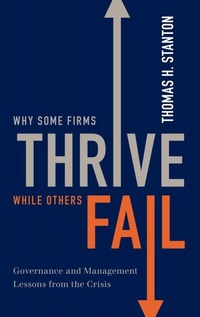
Why Some Firms Thrive While Others Fail
Governance and Management Lessons from the Crisis
Published on 12. July 2012
Book
Hardback
292 pages
978-0-19-991599-6 (ISBN)
Description
Why did some firms weather the financial crisis and others not? This book builds on the author's interviews and access to internal documents from over a dozen major financial companies, investigates their workings, reveals what went wrong and discovers a remedy. A critical difference between successful and unsuccessful firms is a culture that encourages respectful challenge, what the book calls "constructive dialogue. " At successful firms top management engaged in constructive dialogue with the board, a strong management team, and the chief risk officer, among others, in making a decision; firms that failed often featured overbearing (or distracted) CEOs or unit heads, supine boards, incapable management, ineffective risk officers, and poor communications both across silos and up the hierarchy. They often lacked ability to manage the firm as an integrated organization.
Companies need good management, and not only good risk management, to stay out of trouble. Successful companies operated with strong information systems and a culture of good communications that brought issues promptly to top management so the company could adjust its operations accordingly. Successful managers had discipline to ask simple questions and pursue answers until they understood the risk-reward tradeoffs in their activities.
Regulators too made mistakes. They didn't feel empowered to rein in companies that - at least before the crisis - seemed so profitable. Instead of waiting for a company to take losses, the book recommends that they use "constructive dialogue " as a test of good management and that supervisors require evidence that major business decisions result from a robust process rather than merely the will of a powerful CEO or heads of revenue-producing units. Companies in turn should use their regulator as a potential source of useful feedback. The book concludes by looking at major firms in other industries and finds that its conclusions apply to these companies too.
Companies need good management, and not only good risk management, to stay out of trouble. Successful companies operated with strong information systems and a culture of good communications that brought issues promptly to top management so the company could adjust its operations accordingly. Successful managers had discipline to ask simple questions and pursue answers until they understood the risk-reward tradeoffs in their activities.
Regulators too made mistakes. They didn't feel empowered to rein in companies that - at least before the crisis - seemed so profitable. Instead of waiting for a company to take losses, the book recommends that they use "constructive dialogue " as a test of good management and that supervisors require evidence that major business decisions result from a robust process rather than merely the will of a powerful CEO or heads of revenue-producing units. Companies in turn should use their regulator as a potential source of useful feedback. The book concludes by looking at major firms in other industries and finds that its conclusions apply to these companies too.
Reviews / Votes
an informative, worthwhile read. * S. Gove, CHOICE *More details
Language
English
Place of publication
New York
United States
Target group
Professional and scholarly
College/higher education
Illustrations
19 b/w line
Dimensions
Height: 240 mm
Width: 161 mm
Thickness: 22 mm
Weight
658 gr
ISBN-13
978-0-19-991599-6 (9780199915996)
Copyright in bibliographic data and cover images is held by Nielsen Book Services Limited or by the publishers or by their respective licensors: all rights reserved.
Schweitzer Classification
Other editions
Additional editions
Thomas H. Stanton
Why Some Firms Thrive While Others Fail
Governance and Management Lessons from the Crisis
E-Book
07/2012
1st Edition
OUP eBook
€21.99
Available for download
Thomas H. Stanton
Why Some Firms Thrive While Others Fail
Governance and Management Lessons from the Crisis
E-Book
06/2012
1st Edition
OUP eBook
€34.99
Available for download
Person
Thomas H. Stanton is a fellow of the Center for the Study of American Government at the Johns Hopkins University. he is the author of A State of Risk: Will Government Sponsored Enterprises be the Next Financial Crisis? and Making Government Manageable: Executive Organization and Management in the Twenty-First Century.
Content
Preface ; Chapter One Repairing our Public and Private Institutions: A National Imperative ; Chapter Two Dynamics of the Financial Crisis ; Chapter Three Coping With the Crisis ; Chapter Four Company Governance and the Financial Crisis ; Chapter Five Risk Management and the Financial Crisis ; Chapter Six Company Organization, Business Models, and the Crisis ; Chapter Seven Supervision and Regulation of Financial Firms ; Chapter Eight Hyman Minsky: Will it Happen again? ; Chapter Nine Governance and Management: Lessons Learned ; Chapter Ten Governance and Management: Beyond the Financial Crisis ; References ; Index