

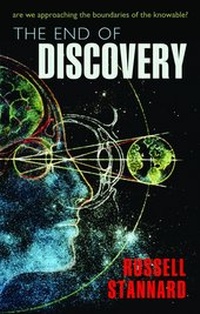
The End of Discovery
Are We Approaching the Boundaries of the Knowable?
Published on 23. September 2010
Book
Hardback
240 pages
978-0-19-958524-3 (ISBN)
Description
It is generally thought that science, by its very nature, must always progress. But this is not so. One day, fundamental science will come to an end. Not when we have discovered everything, but when we have discovered whatever is open to us to understand - which is not the same thing. Limitations as to what the human brain can comprehend, together with practical considerations to do with the need for ever more elaborate and expensive equipment, are likely to ensure that our knowledge will remain for ever incomplete. A further indication that the world will ultimately retain some of its mystery is suggested by evidence that in certain directions, scientific enquiry might already have come up against the boundaries of the knowable. Author and broadcaster Russell Stannard, himself a high-energy physicist and former Head of the Department of Physics and Astronomy at the Open University, introduces the general reader to the deepest questions facing us today - questions to do with consciousness, free will, the nature of space, time, and matter, the existence of extraterrestrial life, and why there should be a world at all.
In doing so, he speculates as to whether some of these questions will never be answered.
In doing so, he speculates as to whether some of these questions will never be answered.
Reviews / Votes
Lucid and provocative, it is a very polite corrective to both superstitions of the layman and the triumphalism of the experts. New Statesman A lucid tour. Simon Mitton, THES Stannard takes readers on a tour of some of the deepest questions facing science. The IndependentMore details
Language
English
Place of publication
Oxford
United Kingdom
Target group
General popular science readers and scientists and philosophers who wish to be brought up-to-date on areas of science outside their particular field
Illustrations
Approx 15 line drawings and 8 halftones
Dimensions
Height: 216 mm
Width: 138 mm
Thickness: 23 mm
Weight
412 gr
ISBN-13
978-0-19-958524-3 (9780199585243)
Copyright in bibliographic data and cover images is held by Nielsen Book Services Limited or by the publishers or by their respective licensors: all rights reserved.
Schweitzer Classification
Person
Russell Stannard is Emeritus Professor of Physics at the Open University where for 21 years he headed the Department of Physics and Astronomy. A high energy nuclear physicist, he has carried out research at CERN in Geneva and at other laboratories in USA and Europe. Among his awards he has the OBE, he received the Bragg Medal from the Institute of Physics, and has been made Fellow of University College London. In 1986 he was awarded the Templeton Project Trust Award for significant contributions to the field of spirtual values; in particular for contributions to greater understanding of science and religion. His triology of Uncle Albert books introduces children of 10+ to relativity and quantum theory and he wrote Relativity: A Very Short Introduction in 2008.
Content
Introduction ; 1. Brain and consciousness ; 2. Creation of the cosmos ; 3. The laws of nature ; 4. The anthropic principle ; 5. The size of the cosmos ; 6. Extraterrestrial life ; 7. The nature of space ; 8. Space in relation to time ; 9. The nature of time ; 10. High energy physics ; 11. The quantum world ; 12. Quantum gravity and string theory ; 13. Concluding remarks