

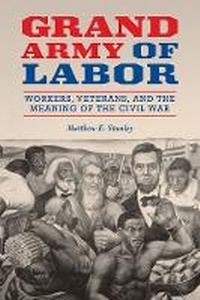
Grand Army of Labor
Workers, Veterans, and the Meaning of the Civil War
Published on 13. April 2021
Book
Hardback
320 pages
978-0-252-04374-1 (ISBN)
Description
Enlisting memory in a new fight for freedom
From the Gilded Age through the Progressive era, labor movements reinterpreted Abraham Lincoln as a liberator of working people while workers equated activism with their own service fighting for freedom during the war. Matthew E. Stanley explores the wide-ranging meanings and diverse imagery used by Civil War veterans within the sprawling radical politics of the time. As he shows, a rich world of rituals, songs, speeches, and newspapers emerged among the many strains of working class cultural politics within the labor movement. Yet tensions arose even among allies. Some people rooted Civil War commemoration in nationalism and reform, and in time, these conservative currents marginalized radical workers who tied their remembering to revolution, internationalism, and socialism. An original consideration of meaning and memory, Grand Army of Labor reveals the complex ways workers drew on themes of emancipation and equality in the long battle for workers' rights.
From the Gilded Age through the Progressive era, labor movements reinterpreted Abraham Lincoln as a liberator of working people while workers equated activism with their own service fighting for freedom during the war. Matthew E. Stanley explores the wide-ranging meanings and diverse imagery used by Civil War veterans within the sprawling radical politics of the time. As he shows, a rich world of rituals, songs, speeches, and newspapers emerged among the many strains of working class cultural politics within the labor movement. Yet tensions arose even among allies. Some people rooted Civil War commemoration in nationalism and reform, and in time, these conservative currents marginalized radical workers who tied their remembering to revolution, internationalism, and socialism. An original consideration of meaning and memory, Grand Army of Labor reveals the complex ways workers drew on themes of emancipation and equality in the long battle for workers' rights.
Reviews / Votes
"This book is a must for those who would strive to replace marble men with stories of people who lived and died fighting against monopoly, white supremacy, inequality, militarism, convict labor, and a growing internal empire." --Journal of American History"As Matthew Stanley shows, the foot-soldiers in Grand Army of Labor lost many of their initial electoral battles. Yet pioneering efforts ultimately succeeded in popularizing the idea that veterans' benefits were a good working model for more expansive social welfare programs, benefiting all U.S. workers and their families." --Against the Current
"Stanley's outstanding study reminds us of the power of symbols--including popular images of antislavery leaders, such as Abraham Lincoln, and abolitionist martyrs, such as John Brown--as well as incomplete and skewed historical representations, such as the Lost Cause." --Journal of the Civil War Era
More details
Edition
New edition
Language
English
Place of publication
Baltimore
United States
Target group
Professional and scholarly
Edition type
New edition
Illustrations
10 black & white photographs
Dimensions
Height: 229 mm
Width: 152 mm
Thickness: 30 mm
Weight
739 gr
ISBN-13
978-0-252-04374-1 (9780252043741)
Copyright in bibliographic data and cover images is held by Nielsen Book Services Limited or by the publishers or by their respective licensors: all rights reserved.
Schweitzer Classification
Person
Matthew E. Stanley is an associate professor of history at Albany State University. He is the author of The Loyal West: Civil War and Reunion in Middle America.
Content
CoverTitle PageCopyrightContentsForewordAcknowledgmentsIntroduction: A Second Great EmancipatorChapter 1. King Labor: Workers Imagine Emancipation beyond EqualityChapter 2. Southern Palm, Northern Pine: Greenbackers and the Reconciliation of ClassChapter 3. Against Masters and Money Power: The Knights of Labor and Wage SlaveryChapter 4. The Red Flag of Emancipation: Socialism and Revolutionary MemoryChapter 5. The Blue-Gray Campaign: Populism and White ReunionChapter 6. Citadel of Labor: The American Federation of Labor and Reformist MemoryChapter 7. The Blue and the Gray and the Red: The Rise and Repression of Proletarian MemoryEpilogue: Resurrecting John Brown's BodyNotesBibliographyIndexBack cover