

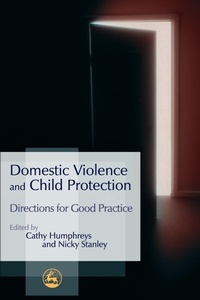
Domestic Violence and Child Protection
Directions for Good Practice
Published on 30. January 2006
Book
Paperback/Softback
224 pages
978-1-84310-276-2 (ISBN)
Description
How do you respond simultaneously to the needs of adults experiencing domestic violence and the specific needs of their children? Domestic Violence and Child Protection explores the challenges of working effectively in this complex field and offers positive models for practice.
Leading practitioners and researchers outline the essential safety considerations for children, adult victims and child protection workers, and stress the importance of children's experiences, using children's own words to describe their diverse needs. The contributors offer examples of good practice in prevention, intervention and recovery, drawn from international settings. They highlight new directions for policy and practice, and consider whether these might be achieved through increased communication and coordination between agencies, or by developing multiprofessional agencies that are able to offer integrated responses. Individual chapters address child abduction, legal issues concerning child contact arrangements, and dealing with abuse in the context of divorce.
Including perspectives from social services, health services and the voluntary sector, this book is a valuable source of information and ideas on how to work safely and sensitively with children living with domestic violence and will be a key reference for social workers, health professionals and policy makers.
Leading practitioners and researchers outline the essential safety considerations for children, adult victims and child protection workers, and stress the importance of children's experiences, using children's own words to describe their diverse needs. The contributors offer examples of good practice in prevention, intervention and recovery, drawn from international settings. They highlight new directions for policy and practice, and consider whether these might be achieved through increased communication and coordination between agencies, or by developing multiprofessional agencies that are able to offer integrated responses. Individual chapters address child abduction, legal issues concerning child contact arrangements, and dealing with abuse in the context of divorce.
Including perspectives from social services, health services and the voluntary sector, this book is a valuable source of information and ideas on how to work safely and sensitively with children living with domestic violence and will be a key reference for social workers, health professionals and policy makers.
Reviews / Votes
This book reminds us of the pervasiveness and complexity 0f the problem of domestic violence and child protection both nationally and internationally. It brings together perspectives from practitioners and researchers and tackles the difficult question of how to respond simultaneously to the needs of adults (primarily women) experiencing domestic violence as well as those of their children... This book makes an important contribution to many areas of professional practice and deserves to be widely read by those working in, or students of, social work, youth work, health and social care, education, the police and other front line services, the family courts and so on. -- Youth & Policy Thirteen contributions from international academics and practitioners offer practical guidance for those working with children living with domestic violence. The first two chapters provide an overview of the relationship between domestic violence and child protection services, primarily in the UK. Other topics include (for example) prevention programs, perpetrator assessment, an the use of research to develop practice in child protection and child care. -- Schi Tech Book News This book provides an excellent overview of the subject and achieves its aims of linking the two discourses into an integrated picture. -- Journal of Social Work Practice Book in general provides an excellent overview of this vital area. -- CAFCASS As someone offering interventions to men who have perpetrated domestic violence, I welcome this book and its commitment to promoting properly resourced, coordinated multi-agency disciplinary work in this complex area. Using international examples, it provides an up-to-date review of the evidence base in relation to how domestic violence impacts on children, the systems needed to protect women and children, plus approaches to working with male perpetrators. A core message from this useful book is that good practice needs to take seriously, and seek to increase, the safety of women (mostly) and children living with domestic violence, respond to their separate needs and also address the perpetrator's violence. Insights are also provided into the wide diversity of violence within families and the importance of careful assessments and interventions.' - Professional Social Work'Humphreys and Stanley have here produced an authoritative multi-faceted and challenging work... It has much to offer both practitioners and managers who grapple with the complex arena of domestic violence and child protection, providing both theoretical grounding and applicable practice advice. The introduction is a must, setting out the contemporary landscape in which these issues are addressed and reminding us that our minimum requirement is not merely to `do no harm' but actively to increase safety and accountability. What follows is a sequence of recommendations from multi-agency practice, adult and child survivor experience and engagement with perpetrators'. -- Community Care Much was familiar, but to read one coherent narrative was immensely powerful. -- Children Now
More details
Language
English
Place of publication
London
United Kingdom
Target group
College/higher education
Professional and scholarly
Product notice
Paperback (UK-trade)
Dimensions
Height: 234 mm
Width: 156 mm
Thickness: 12 mm
Weight
351 gr
ISBN-13
978-1-84310-276-2 (9781843102762)
Copyright in bibliographic data and cover images is held by Nielsen Book Services Limited or by the publishers or by their respective licensors: all rights reserved.
Schweitzer Classification
Other editions
Additional editions
E-Book
01/2006
Jessica Kingsley Publishers
from
€26.09
Available for download
Persons
Lorraine Radford is Head of Research at the NSPCC in London. Kate Iwi is Young People's Services Officer for RESPECT, UK. As well as working with perpetrators of domestic violence both individually and in groups, Kate has facilitated fathering groups, linked women's support groups and undertaken therapeutic work with children. Cathy Humphreys is a senior lecturer in Health and Social Work at the University of Warwick. She has worked as a practitioner, researcher and educator in domestic violence and child abuse. Catherine's other research areas include substance misuse, mental health, outreach and advocacy services for both women and children, and child contact.
Content
Introduction, Cathy Humphreys, University of Warwick and Nicky Stanley, University of Central Lancashire. Part I: Defining the Issues and Setting the Scene. 1. Relevant Evidence for Practice, Cathy Humphreys. 2. Multi-Agency and Multi-Disciplinary Work: Barriers and Opportunities, Cathy Humphreys and Nicky Stanley. Part II: Children's Views and Needs. 3. What Children Tell Us: `He Said He Was Going to Kill Our Mum', Audrey Mullender, University of Oxford. 4. Prevention Programmes for Children and Young People in the UK. Jane Ellis, University of Warwick, Nicky Stanley and Jo Bell, University of Central Lancashire. 5. Listen Louder: Working with Children and Young People, Claire Houghton, Violence Against Women Unit, Scottish Executive. Part III: Protecting Women and Children. 6. Asking about Domestic Violence: Implications for Practice, Marianne Hester, University of Bristol. 7. `Point of Contact' Front-Line Workers Responding to Children Living with Domestic Violence, Jan Breckenridge, University of New South Wales, Australia, and Claire Ralfs, Relationships Australia. 8. Using Research to Develop Practice in Child Protection and Child Care. Elaine Farmer, University of Bristol. 9. Damned If You Do and Damned If You Don't? The Contradictions between Private and Public Law, Christine Harrison, University of Warwick. 10. Child Abuse and Domestic Violence in the Context of Parental Separation and Divorce: New Models of Invention, Thea Brown, Monash University, Melbourne. Part IV: Working with Perpetrators. 11. Domestic Abuse Risk Assessment and Safety Planning in Child Protection - Assessing Perpetrators, Lorraine Radford, Roehampton University, Neil Blacklock and Kate Iwi, Domestic Violence Intervention Project, London. 12. Are Men Who Use Violence Against Their Partners and Children Good Enough Fathers? The Need for an Integrated Child Perspective in Treatment Work with Men, Marius Rakil, Alternative to Violence, Oslo. 13. Confronting the issues of child abduction. Denise Carter, Re-unite, International Child Abduction Centre, UK. 13. Men's Use of Violence and Intimidation Against Family Members and Child Protection Workers, Brian Littlechild and Catherine Bourke, University of Hertfordshire. The Contributors. References. Indexes.