

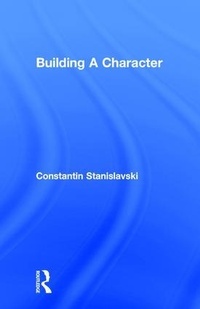
Building A Character
1st Edition
Published on 7. January 1987
Book
Hardback
352 pages
978-0-87830-012-9 (ISBN)
Description
Building a Character is one of the three volumes that make up Stanislavski's The Acting Trilogy.
An Actor Prepares explores the inner preparation an actor must undergo in order to explore a role to the full. In this volume, Sir John Gielgud said, this great director "found time to explain a thousand things that have always troubled actors and fascinated students."
Building a Character discusses the external techniques of acting: the use of the body, movement, diction, singing, expression, and control.
Creating a Role describes the preparation that precedes actual performance, with extensive discussions of Gogol's The Inspector General and Shakespeare's Othello. Sir Paul Scofield called Creating a Role "immeasurably important" for the actor.
These three volumes belong on any actor's short shelf of essential books.
An Actor Prepares explores the inner preparation an actor must undergo in order to explore a role to the full. In this volume, Sir John Gielgud said, this great director "found time to explain a thousand things that have always troubled actors and fascinated students."
Building a Character discusses the external techniques of acting: the use of the body, movement, diction, singing, expression, and control.
Creating a Role describes the preparation that precedes actual performance, with extensive discussions of Gogol's The Inspector General and Shakespeare's Othello. Sir Paul Scofield called Creating a Role "immeasurably important" for the actor.
These three volumes belong on any actor's short shelf of essential books.
Reviews / Votes
"Indispensable for the actor, stimulating for the layman." -- The Nation"Anyone who attempts to train actors or to direct plays will find here a great mine of practical wisdom, all informed by Stanislavski's grasp of the art itself." -- Francis Fergusson, Educational Theatre Journal
"In (this book) Stanislavski, assuming the reader's familiarity with the 'inner technique', proceeds to study costume and the wearing of costume, bodily movement, voice, speech and the use of language, and tempo and rhythm-- the more external but essential techniques whereby the actor learns to use his physical instrument . . . and he expounds them as only a master can; i.e., with the insight and authority of talent plus expeirence. Anyone who attempts to train actors or to direct plays will find here a great mine of practical wisdom." -- Francis Fergusson, Education Theatre Journal
"The chapter on Diction and Singing offers an analysis of basic problems of singing that is unrivaled." -- MusicalAmerica
More details
Language
English
Place of publication
New York
United States
Publishing group
Taylor & Francis Inc
Target group
Professional and scholarly
Professional Practice & Development
Product notice
sewn/stitched
Cloth over boards
Dimensions
Height: 212 mm
Width: 147 mm
Thickness: 25 mm
Weight
531 gr
ISBN-13
978-0-87830-012-9 (9780878300129)
Copyright in bibliographic data and cover images is held by Nielsen Book Services Limited or by the publishers or by their respective licensors: all rights reserved.
Schweitzer Classification
Other editions
Additional editions
Constantin Stanislavski
Building A Character
E-Book
12/2013
1st Edition
Routledge
€44.99
Available for download
Constantin Stanislavski
Building A Character
E-Book
12/2013
1st Edition
Routledge
€44.99
Available for download
Constantin Stanislavski
Building A Character
Book
04/1989
1st Edition
Routledge
€62.11
Shipment within 3-4 weeks
Persons
Constantin Stanislavski (1863-1938), arguably the most influential director in the history of the theater, was the founder of the renowned Moscow Art Theater. A pioneer of psychological realism and improvisation on the stage, he devoted his life to developing the performance techniques now emulated throughout the world.
Content
Chapter 1 Toward a Physical Characterization; Chapter 2 Dressing a Character; Chapter 3 Characters and Types; Chapter 4 Making the Body Expressive; Chapter 5 Plasticity of Motion; Chapter 6 Restraint and Control; Chapter 7 Diction and Singing; Chapter 8 Intonations and Pauses; Chapter 9 Accentuation: The Expressive Word; Chapter 10 Perspective in Character Building; Chapter 11 Tempo-Rhythm in Movement; Chapter 12 Speech Tempo-Rhythm; Chapter 13 Stage Charm; Chapter 14 Toward an Ethics for the Theatre; Chapter 15 Patterns of Accomplishment; Chapter 16 Some Conclusions on Acting;