

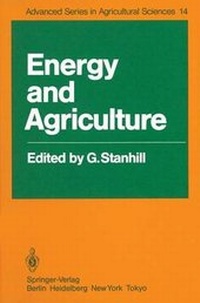
Energy and Agriculture
Meeting : Papers
Published on 1. August 1984
Book
Hardback
XIII, 194 pages
978-3-540-13476-3 (ISBN)
Description
Energy and agriculture are both extremely broad subjects and their interactions - the subject of this book - cover almost the full spectrum of the agricultural sciences. Yet the subject is a relatively new one whose importance first received widespread recognition barely a decade ago, following the dramatic increase in oil prices during 1973. The impact of this increase was such as to promote a world-wide debate on the future direction that agriculture should take. This debate was, and is, of particular concern in countries where agriculture plays a leading role in economic and social development. During the last half century many national agricultural systems have been transformed from almost closed, self-sufficient systems with few locally produced inputs geared to satisfy local requirements, to intensive, open systems, utilizing large quantities of energy-rich inputs such as fossil fuel for manufactured agro-chemicals, water distribution and imported animal feedstuffs to produce a range of sophisticated products, often for export, which in tum require many energy-rich inputs for their marketing. This industrialization of agriculture has proved to be very successful in many respects and indeed was accepted as a general model for agricultural development allowing increased productivity and efficiency per unit land, labor and water, even in areas with limited natural resources.
More details
Other editions
Additional editions
Content
1 Introduction to the Role of Energy in Agriculture.- 1.1 Definition and Scope.- 1.2 Energy Analysis and Agriculture.- 1.3 References.- 1 Principles and Processes.- 2 Economic Impacts of Energy Prices on Agriculture.- 2.1 Introduction.- 2.2 Resource Prices and Technologies of Agriculture.- 2.3 Energy Prices Impact.- 2.3.1 Developed Countries.- 2.3.2 Developing Countries.- 2.4 Increased Energy Prices.- 2.5 Expected Future Impact of Energy Prices.- 2.6 Income Redistribution.- 2.7 Time Flexibility in Food Production.- 2.8 Research Induced by Resource Endowments and Prices.- 2.9 References.- 3 Energy Analysis of the Environmental Role in Agriculture.- 3.1 Introduction.- 3.2 Definitions and Procedures for Calculation.- 3.2.1 Energy Transformation Ratio.- 3.2.2 General Plan of Agroecosystems.- 3.2.3 Solar Embodied Energy.- 3.2.4 Nonadditivity of Byproduct Flows.- 3.2.5 Partitioning Embodied Energy of a Split Flow.- 3.2.6 Summing of Embodied Energy in Storages.- 3.2.7 Energy to Dollar Ratio for Evaluating Human Service.- 3.2.8 Corrections for Double Counting in Service Evaluation.- 3.2.9 Dual Calculation for Purchased Resources.- 3.2.10 Evaluation of a Capital Addition.- 3.2.11 Net Energy Yield Ratio.- 3.2.12 Primitive Energy Transformation Ratios.- 3.2.13 Energy Investment Ratio.- 3.2.14 Calories or Joules.- 3.2.15 Solar Energy Embodied in Fuels.- 3.3 Results.- 3.4 Discussion of Perspectives.- 3.4.1 Embodied Energy Predicting Economic Contribution.- 3.4.2 Effect on Net Energy Estimation of Including Goods and Services.- 3.4.3 Low Intensity Agriculture, with Net Energy.- 3.4.4 Criteria for Economic Success.- 3.4.5 Energetics of Water Application.- 3.4.6 Energetics of Fertilizer Application.- 3.4.7 Foreign Trade Evaluation with Embodied Energy.- 3.4.8 Balancing Embodied Energy Exchange.- 3.4.9 Total Energy Intensity of Agriculture.- 3.4.10 Models of Agricultural Trends with Rising Relative Price of Fuels.- 3.4.11 Appropriate Agroecosystems.- 3.4.12 Discussion of Previous Analyses.- 3.4.13 Other Embodied Energy Approaches.- 3.5 Footnotes for Figures and Tables.- 3.6 References.- 4 Genetic Engineering to Modify Energy Flow in Agriculture.- 4.1 Introduction.- 4.2 Extrinsic Energy Flow.- 4.3 Problems in the Modification of Intrinsic Energy Flow to Crops.- 4.3.1 Photosynthesis and Respiration.- 4.3.2 Transport Processes.- 4.3.3 Growth.- 4.3.4 Control of Flowering.- 4.3.5 Seed Production.- 4.3.6 Energy Flow to Seeds and Storage Organs.- 4.3.7 Specific Chemical Products.- 4.4 Problems in the Modification of Exogenous Energy Flows in an Agroecosystem.- 4.5 Prospects for Genetic Manipulation.- 4.5.1 Sexual Methods.- 4.5.2 Asexual Methods.- 4.5.3 Vectors for Higher Plant Transformation.- 4.6 Conclusion.- 4.7 References.- 2 Energy Sources for Agriculture.- 5 Energy in Different Agricultural Systems: Renewable and Nonrenewable Sources.- 5.1 Introduction.- 5.2 Sources of Energy.- 5.2.1 Categories of Energy.- 5.2.1.1 Photochemically Active Radiation.- 5.2.1.2 Thermal Energy.- 5.2.1.3 Fossil Fuels.- 5.2.1.4 Biomass.- 5.2.2 Global Scale of Fossil Fuel and Biomass Options for Liquid Fuels.- 5.2.2.1 Global Primary Production by Vegetation.- 5.2.2.2 The Petroleum Resource.- 5.2.2.3 Matching Future Demand to the Resources.- 5.3 Energy, Atmospheric Carbon Dioxide, and Agriculture.- 5.4 Support Energy for Agriculture in the Future.- 5.4.1 General Points.- 5.4.2 Options in Industrialized Countries.- 5.4.3 Options in Third World Countries.- 5.5 Conclusions.- 5.6 References.- 6 Agricultural Labour: From Energy Source to Sink.- 6.1 Introduction.- 6.2 Accounting for Agricultural Labour.- 6.3 Substitution of Fossil Fuel Energy for Labour During Agricultural Development.- 6.3.1 Intranational Development.- 6.3.2 International Comparisons.- 6.3.3 Subsystem Development.- 6.4 Indirect Energy Costs of Reducing Farm Labour.- 6.5 Discussion and Conclusions.- 6.6 Notes and References.- 3 Case Studies.- 7 Energy Use in the Food-Producing Sector of the European Economic Community.- 7.1 Introduction.- 7.1.1 Is a High Energy-Intensive Agriculture Inevitable?.- 7.1.2 Importation of Food into EEC.- 7.2 Energy Use in Agriculture.- 7.2.1 Methodology of Energy Analysis.- 7.2.2 Changing Technology of Agricultural Inputs.- 7.2.3 Procedure.- 7.2.4 Data Collection.- 7.3 Results.- 7.3.1 Gross Energy Requirements of Food Production.- 7.3.2 Analysis of Energy Data.- 7.3.2.1 Correlation of Data.- 7.3.3 Energy Efficiency of European Agriculture.- 7.3.3.1 Total Energy Including Transport Energy.- 7.3.3.2 Comparison of Imported Food with Added Transport Energy.- 7.3.3.3 Consequences of Increasing Imports of Food.- 7.4 Conclusion.- 7.5 References.- 8 Energy in Australian Agriculture: Inputs, Outputs, and Policies.- 8.1 Introduction.- 8.2 Review of the Earlier Studies.- 8.3 Major Changes in Australian Agricultural Energetics During the 1970's.- 8.3.1 Agricultural Production.- 8.3.2 Energy Inputs.- 8.3.2.1 Fuel and Power Used Directly on Farms.- 8.3.2.2 Irrigation.- 8.3.2.3 Fertilizer.- 8.3.3 Current Energy I/O Ratio for Australian Agriculture.- 8.4 Agricultural Energy Policy.- 8.5 Conclusions.- 8.6 References.- 9 Energy Use and Management in US Agriculture.- 9.1 Introduction.- 9.2 Current Energy Use in US Agriculture.- 9.2.1 1974: Agricultural Energy Data Base.- 9.2.2 1978: Energy and US Agriculture.- 9.2.3 1981 Update: Energy and US Agriculture.- 9.2.4 State Energy Audits.- 9.2.5 Critical Importance of Liquid Fuels.- 9.3 Energy Management.- 9.4 Agricultural Energy Research, Development and Demonstration (RD & D).- 9.4.1 Appropriations for Agricultural Energy RD & D.- 9.4.2 Organization for Agricultural Energy RD & D.- 9.4.2.1 National Level.- 9.4.2.2 State Level.- 9.4.2.3 Local Level.- 9.4.3 Analysis of Energy Projects Reported in the Current Research Information System (CRIS).- 9.4.3.1 Energy Conservation.- 9.4.3.2 Biomass Production and Conversion to Fuel.- 9.4.3.3 Solar, Wind, Geothermal, and Hydropower.- 9.4.3.4 Home and Family Energy Use.- 9.4.3.5 Systems, Energy Self-sufficiency and Integrated Farms.- 9.4.3.6 Economics, Policy and Social/Environmental Implications.- 9.4.3.7 Miscellaneous Energy Projects.- 9.5 Discussion and Conclusions.- 9.6 References.