

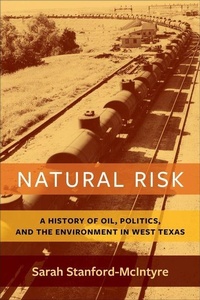
Natural Risk
A History of Oil, Politics, and the Environment in West Texas
Will be published approx. on 20. October 2026
Book
Hardback
288 pages
978-0-231-19736-6 (ISBN)
Description
The longest-running oil-producing region in Texas, the Permian Basin fueled the state's transformation from agricultural backwater to extractive powerhouse in the middle of the twentieth century. During the same period, Texas was also a crucial outlier in a national trend that placed risk management and environmental safety in the hands of state regulators. This book shows how Permian Basin oil production reshaped Texas's environment, economy, and political culture, with major consequences for American understandings of health, wealth, and the social safety net.
Sarah Stanford-McIntyre argues that the energy industry naturalized the risks of extractive capitalism, redefining what sorts and levels of danger were seen as acceptable. She traces how West Texas oil employers and employees-prospectors, bankers, roughnecks, drillers, contractors, and engineers-encountered and assessed the industry's many overlapping risks, demonstrating why different groups prioritized immediate economic concerns over long-term public health or the environment. Energy workers and communities often saw environmental and health hazards as inherent and unavoidable, believing that risk could be managed on economic terms. For the industry, risk became a language for justifying deregulation, contamination, and neglect. Bringing together the political, environmental, and business history of West Texas with the lived experience of workers in the energy industries, Natural Risk reveals how Permian Basin oil transformed American capitalism.
Sarah Stanford-McIntyre argues that the energy industry naturalized the risks of extractive capitalism, redefining what sorts and levels of danger were seen as acceptable. She traces how West Texas oil employers and employees-prospectors, bankers, roughnecks, drillers, contractors, and engineers-encountered and assessed the industry's many overlapping risks, demonstrating why different groups prioritized immediate economic concerns over long-term public health or the environment. Energy workers and communities often saw environmental and health hazards as inherent and unavoidable, believing that risk could be managed on economic terms. For the industry, risk became a language for justifying deregulation, contamination, and neglect. Bringing together the political, environmental, and business history of West Texas with the lived experience of workers in the energy industries, Natural Risk reveals how Permian Basin oil transformed American capitalism.
Reviews / Votes
Natural Risk delivers a rich and eye-opening portrait of the Permian Basin, weaving together the stories of oil workers, ranchers, unions, and industry leaders. Stanford-McIntyre reveals the forces - environmental, economic, and political - that shaped one of the world's most powerful energy regions. -- Paul Sabin, author of <i>Public Citizens: The Attack on Big Government and the Remaking of American Liberalism</i>More details
Series
Language
English
Place of publication
New York
United States
Target group
Professional and scholarly
Product notice
Trade binding
Illustrations
18 b&w illustrations
Dimensions
Height: 229 mm
Width: 152 mm
ISBN-13
978-0-231-19736-6 (9780231197366)
Copyright in bibliographic data and cover images is held by Nielsen Book Services Limited or by the publishers or by their respective licensors: all rights reserved.
Schweitzer Classification
Person
Sarah Stanford-McIntyre is an assistant professor in the Herbst Program for Engineering, Ethics & Society at the University of Colorado Boulder. She is a coeditor of American Energy Cinema (2023).