

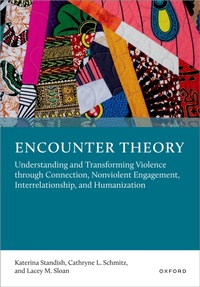
Encounter Theory
Understanding and Transforming Violence through Connection, Nonviolent Engagement, Interrelationship, and Humanization
Will be published approx. on 16. September 2026
Book
Hardback
248 pages
978-0-19-775019-3 (ISBN)
Description
This book presents Encounter Theory; an approach grounded in engagement with difference and the principle of nonviolent conflict transformation. It offers scholars, peacebuilders, and students a comprehensive way to understand and practice violence transformation by drawing on diverse frames, concepts, and pedagogies from multiple disciplines. Schmitz, Standish, and Sloan, who work across personal, interpersonal, community, and international contexts, aim to create a platform for addressing violence in society, culture, and the self in the twenty-first century.
At its core, Encounter Theory calls for meeting others and their deeply held beliefs within a space that is non-dominatory and non-discriminatory, fostering recognition and appreciation. Through such encounters, individuals move toward relationality, building bonds of understanding and re-humanization. The book argues that creating a nonviolent world requires tools that allow us to continually and relentlessly engage with difference, without resorting to violence.
The book begins by introducing the foundations of Encounter Theory and then expands its application through an interdisciplinary lens. It explores the breadth of human harm and offers critical perspectives that enable encounter to become a lived practice. Later chapters examine emancipatory peace frameworks, critique limiting approaches, and synthesize insights to illustrate how encounter can serve as a transformative method for addressing violence. Ultimately, the book positions Encounter Theory not only as a theoretical construct but as a practical pathway toward nonviolence and deeper human connection.
At its core, Encounter Theory calls for meeting others and their deeply held beliefs within a space that is non-dominatory and non-discriminatory, fostering recognition and appreciation. Through such encounters, individuals move toward relationality, building bonds of understanding and re-humanization. The book argues that creating a nonviolent world requires tools that allow us to continually and relentlessly engage with difference, without resorting to violence.
The book begins by introducing the foundations of Encounter Theory and then expands its application through an interdisciplinary lens. It explores the breadth of human harm and offers critical perspectives that enable encounter to become a lived practice. Later chapters examine emancipatory peace frameworks, critique limiting approaches, and synthesize insights to illustrate how encounter can serve as a transformative method for addressing violence. Ultimately, the book positions Encounter Theory not only as a theoretical construct but as a practical pathway toward nonviolence and deeper human connection.
Reviews / Votes
Encounter Theory points out that genuine everyday interactions foster critical experiences and empathetic understanding that ground those experiences in transforming intergroup relationships over the long term to build an adaptable and authentic peace that lasts. The book highlights the importance of people in local peacebuilding initiatives; intersections across disciplines to understand complex problems; the connection, humanization, inter-relationship, and nonviolent engagement peace practices emerging from positive peacebuilding; and a balanced approach to justice and peace. The book is a must read for those interested in critical and emancipatory peacebuilding and nonviolent conflict transformation.- Sean Byrne, Peace and Conflict Studies, University of Manitoba 02/02/2026
More details
Language
English
Place of publication
New York
United States
Target group
College/higher education
Product notice
sewn/stitched
Cloth over boards
Illustrations
8 b&w
Dimensions
Height: 235 mm
Width: 156 mm
ISBN-13
978-0-19-775019-3 (9780197750193)
Copyright in bibliographic data and cover images is held by Nielsen Book Services Limited or by the publishers or by their respective licensors: all rights reserved.
Schweitzer Classification
Persons
Katerina Standish is Professor of Global and International Studies at the University of Northern British Columbia. Standish's teaching and supervision span Western and Indigenous research paradigms. She is the author and editor of books on conflict transformation, education, human rights, community building, gender, genocide, and transformative research. An expert in peace education, graduate pedagogy, and conflict transformation, Standish combines scholarly rigor with practical engagement to advance interdisciplinary approaches to building peace.
Cathryne L. Schmitz is Professor Emerita in the Department of Social Work at the University of North Carolina Greensboro. Across her career, she has been committed to community, collective action, advocacy, and social change. The core areas of her scholarship reflect her overall career development--critical multiculturalism, ecological justice, interdisciplinary education, community building, global engagement, human rights, and peacebuilding. She has been engaged in intercultural global teaching, environmental education, knowledge building, and curriculum development.
Lacey M. Sloan is a Professor at Auburn University at Montgomery. Her three intertwining areas of scholarship are environmental justice; sexual rights and gender-based violence; and, social work education and practice in Islamic contexts. Sloan serves on CSWE's Commission on Education Policy (COEP) and served as a consultant for UNICEF-Somalia and UNICEF-South Sudan supporting the rapid deployment of a child protection workforce.
Cathryne L. Schmitz is Professor Emerita in the Department of Social Work at the University of North Carolina Greensboro. Across her career, she has been committed to community, collective action, advocacy, and social change. The core areas of her scholarship reflect her overall career development--critical multiculturalism, ecological justice, interdisciplinary education, community building, global engagement, human rights, and peacebuilding. She has been engaged in intercultural global teaching, environmental education, knowledge building, and curriculum development.
Lacey M. Sloan is a Professor at Auburn University at Montgomery. Her three intertwining areas of scholarship are environmental justice; sexual rights and gender-based violence; and, social work education and practice in Islamic contexts. Sloan serves on CSWE's Commission on Education Policy (COEP) and served as a consultant for UNICEF-Somalia and UNICEF-South Sudan supporting the rapid deployment of a child protection workforce.
Author
Professor of Global & International StudiesProfessor of Global & International Studies, University of Northern British Columbia
Professor Emerita, Department of Social WorkProfessor Emerita, Department of Social Work, University of North Carolina Greensboro
DrDr, Professor, Department of Social Work & AnthropologyAuburn University at Montgomery
Content
- Introduction: Encounter Theory for the 21st Century
- 1: The Theoretical Ecosystem of Encounter Theory
- 2: Enriching Encounter Theory
- 3: Human Violence
- 4: From Perception to Practice
- 5: Encounter Theory Praxis: Pathways to Change
- 6: Wicked Problems and Encounter Theory
- 7: Horizon Lines, and Stepping Forward