

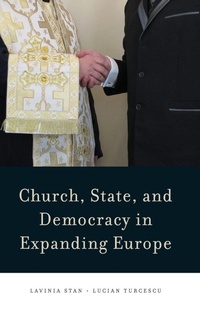
Church, State, and Democracy in Expanding Europe
Published on 22. September 2011
Book
Hardback
304 pages
978-0-19-533710-5 (ISBN)
Description
Lavinia Stan and Lucian Turcescu examine the relationship between religion and politics in ten former communist Eastern European countries. Contrary to widespread theories of increasing secularization, Stan and Turcescu argue that in most of these countries, the populations have shown themselves to remain religious even as they embrace modernization and democratization.
Church-state relations in the new EU member states can be seen in political representation for church leaders, governmental subsidies, registration of religions by the state, and religious instruction in public schools. Stan and Turcescu outline three major models: the Czech church-state separation model, in which religion is private and the government secular; the pluralist model of Hungary, Bulgaria and Latvia, which views society as a group of complementary but autonomous spheres - for example, education, the family, and religion - each of which is worthy of recognition and support from the state; and the dominant religion model that exists in Poland, Romania, Estonia, and Lithuania, in which the government maintains informal ties to the religious majority.
Church, State, and Democracy in Expanding Europe offers critical tools for understanding church-state relations in an increasingly modern and democratic Eastern Europe.
Church-state relations in the new EU member states can be seen in political representation for church leaders, governmental subsidies, registration of religions by the state, and religious instruction in public schools. Stan and Turcescu outline three major models: the Czech church-state separation model, in which religion is private and the government secular; the pluralist model of Hungary, Bulgaria and Latvia, which views society as a group of complementary but autonomous spheres - for example, education, the family, and religion - each of which is worthy of recognition and support from the state; and the dominant religion model that exists in Poland, Romania, Estonia, and Lithuania, in which the government maintains informal ties to the religious majority.
Church, State, and Democracy in Expanding Europe offers critical tools for understanding church-state relations in an increasingly modern and democratic Eastern Europe.
Reviews / Votes
The book is well researched, and the authors appeal to a variety of sources and to a multitude of methods of both data analysis and interpretation The strong point of their analysis is their reading of the interaction of religion and politics at the legislative level Stan and Turcescu both offer a valuable working tool and provide scope for future research on post-communist countries. * Monica Grigore, Religion and Society in Central and Eastern Europe * a welcome addition to the growing literature in this field, shedding light on the ten newest members of the EU and examining how interactions between law and religion have changed following the fall of Communism. * Russell Sandberg, Journal of Church and State * Stan and Turcescu are to be commended for making available, in a highly readable work, the contents of this critical debate inside the EU. The book will appeal to anyone interested in the intersection of religion, statehood, nationalism and civil society among the newer members of the EU. It may also be beneficial to those interested in the legacy of repressive governments during World War II and subsequent communist regimes on a countryas culture of civil and religious intolerance. * Ovidiu Creanga, Europe-Asia Studies *More details
Series
Language
English
Place of publication
New York
United States
Target group
Professional and scholarly
Dimensions
Height: 240 mm
Width: 161 mm
Thickness: 22 mm
Weight
675 gr
ISBN-13
978-0-19-533710-5 (9780195337105)
Copyright in bibliographic data and cover images is held by Nielsen Book Services Limited or by the publishers or by their respective licensors: all rights reserved.
Schweitzer Classification
Persons
Stan: Assistant Professor of Political Science, Concordia University and Director of the Center for Post-Communist Studies, St. Francis Xavier University
Author
Assistant Professor of Political Science and Director of the Center for Post-Communist StudiesAssistant Professor of Political Science and Director of the Center for Post-Communist Studies, St. Francis Xavier University
Graduate Program Director and Professor of Historical TheologyGraduate Program Director and Professor of Historical Theology, Concordia University, Montreal
Content
Acknowledgements ; Chapter 1: Introduction ; Chapter 2: Bulgaria ; Chapter 3: Czech Republic ; Chapter 4: Estonia ; Chapter 5: Hungary ; Chapter 6: Latvia ; Chapter 7: Lithuania ; Chapter 8: Poland ; Chapter 9: Romania ; Chapter 10: Slovakia ; Chapter 11: Slovenia ; Conclusions ; Notes ; Bibliography ; Index