

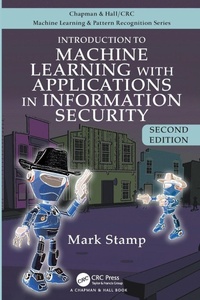
Introduction to Machine Learning with Applications in Information Security
2nd Edition
Published on 19. December 2024
Book
Paperback/Softback
534 pages
978-1-032-20717-9 (ISBN)
Description
Introduction to Machine Learning with Applications in Information Security, Second Edition provides a classroom-tested introduction to a wide variety of machine learning and deep learning algorithms and techniques, reinforced via realistic applications. The book is accessible and doesn't prove theorems, or dwell on mathematical theory. The goal is to present topics at an intuitive level, with just enough detail to clarify the underlying concepts.
The book covers core classic machine learning topics in depth, including Hidden Markov Models (HMM), Support Vector Machines (SVM), and clustering. Additional machine learning topics include k-Nearest Neighbor (k-NN), boosting, Random Forests, and Linear Discriminant Analysis (LDA). The fundamental deep learning topics of backpropagation, Convolutional Neural Networks (CNN), Multilayer Perceptrons (MLP), and Recurrent Neural Networks (RNN) are covered in depth. A broad range of advanced deep learning architectures are also presented, including Long Short-Term Memory (LSTM), Generative Adversarial Networks (GAN), Extreme Learning Machines (ELM), Residual Networks (ResNet), Deep Belief Networks (DBN), Bidirectional Encoder Representations from Transformers (BERT), and Word2Vec. Finally, several cutting-edge deep learning topics are discussed, including dropout regularization, attention, explainability, and adversarial attacks.
Most of the examples in the book are drawn from the field of information security, with many of the machine learning and deep learning applications focused on malware. The applications presented serve to demystify the topics by illustrating the use of various learning techniques in straightforward scenarios. Some of the exercises in this book require programming, and elementary computing concepts are assumed in a few of the application sections. However, anyone with a modest amount of computing experience should have no trouble with this aspect of the book.
Instructor resources, including PowerPoint slides, lecture videos, and other relevant material are provided on an accompanying website: http://www.cs.sjsu.edu/~stamp/ML/.
The book covers core classic machine learning topics in depth, including Hidden Markov Models (HMM), Support Vector Machines (SVM), and clustering. Additional machine learning topics include k-Nearest Neighbor (k-NN), boosting, Random Forests, and Linear Discriminant Analysis (LDA). The fundamental deep learning topics of backpropagation, Convolutional Neural Networks (CNN), Multilayer Perceptrons (MLP), and Recurrent Neural Networks (RNN) are covered in depth. A broad range of advanced deep learning architectures are also presented, including Long Short-Term Memory (LSTM), Generative Adversarial Networks (GAN), Extreme Learning Machines (ELM), Residual Networks (ResNet), Deep Belief Networks (DBN), Bidirectional Encoder Representations from Transformers (BERT), and Word2Vec. Finally, several cutting-edge deep learning topics are discussed, including dropout regularization, attention, explainability, and adversarial attacks.
Most of the examples in the book are drawn from the field of information security, with many of the machine learning and deep learning applications focused on malware. The applications presented serve to demystify the topics by illustrating the use of various learning techniques in straightforward scenarios. Some of the exercises in this book require programming, and elementary computing concepts are assumed in a few of the application sections. However, anyone with a modest amount of computing experience should have no trouble with this aspect of the book.
Instructor resources, including PowerPoint slides, lecture videos, and other relevant material are provided on an accompanying website: http://www.cs.sjsu.edu/~stamp/ML/.
More details
Series
Edition
2nd edition
Language
English
Place of publication
United Kingdom
Publishing group
Taylor & Francis Ltd
Illustrations
19 s/w Abbildungen, 164 farbige Abbildungen, 9 Farbfotos bzw. farbige Rasterbilder, 19 s/w Zeichnungen, 155 farbige Zeichnungen, 22 s/w Tabellen
22 Tables, black and white; 155 Line drawings, color; 19 Line drawings, black and white; 9 Halftones, color; 164 Illustrations, color; 19 Illustrations, black and white
Dimensions
Height: 234 mm
Width: 156 mm
Thickness: 27 mm
Weight
749 gr
ISBN-13
978-1-032-20717-9 (9781032207179)
Copyright in bibliographic data and cover images is held by Nielsen Book Services Limited or by the publishers or by their respective licensors: all rights reserved.
Schweitzer Classification
Other editions
Additional editions
E-Book
09/2022
2nd Edition
Chapman & Hall/CRC
€63.49
Available for download
E-Book
09/2022
2nd Edition
Chapman & Hall/CRC
€63.49
Available for download
Book
09/2022
2nd Edition
Chapman & Hall/CRC
€101.80
Shipment within 10-20 days
Previous edition
Book
06/2020
1st Edition
Chapman & Hall/CRC
€53.22
Article exhausted; check for reprint
Person
Mark Stamp is a Professor at San Jose State University, and the author of two textbooks, Information Security: Principles and Practice and Applied Cryptanalysis: Breaking Ciphers in the Real World. He previously worked at the National Security Agency (NSA) for seven years, which was followed by two years at a small Silicon Valley startup company.
Content
Preface
About the Author
What is Machine Learning?
A Revealing Introduction to Hidden Markov Models
Principles of Principal Component Analysis
A Reassuring Introduction to Support Vector Machines
A Comprehensible Collection of Clustering Concepts
Many Mini Topics
Deep Thoughts on Deep Learning
Onward to Backpropagation
A Deeper Diver into Deep Learning
Alphabet Soup of Deep Learning Topics
HMMs for Classic Cryptanalysis
Image Spam Detection
Image-Based Malware Analysis
Malware Evolution Detection
Experimental Design and Analysis
Epilogue
References
Index
About the Author
What is Machine Learning?
A Revealing Introduction to Hidden Markov Models
Principles of Principal Component Analysis
A Reassuring Introduction to Support Vector Machines
A Comprehensible Collection of Clustering Concepts
Many Mini Topics
Deep Thoughts on Deep Learning
Onward to Backpropagation
A Deeper Diver into Deep Learning
Alphabet Soup of Deep Learning Topics
HMMs for Classic Cryptanalysis
Image Spam Detection
Image-Based Malware Analysis
Malware Evolution Detection
Experimental Design and Analysis
Epilogue
References
Index