

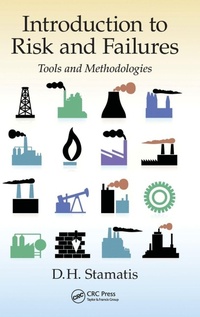
Introduction to Risk and Failures
Tools and Methodologies
1st Edition
Published on 2. May 2014
Book
Hardback
274 pages
978-1-4822-3479-4 (ISBN)
Description
Risk is everywhere, in everything we do. Realizing this fact, we all must try to understand this "risk" and if possible to minimize it. This book expands the conversation beyond failure mode and effects analysis (FMEA) techniques. While FMEA is indeed a powerful tool to forecast failures for both design and processes, it is missing methods for considering safety issues, catastrophic events, and their consequences. Focusing on risk, safety, and HAZOP as they relate to major catastrophic events, Introduction to Risk and Failures: Tools and Methodologies addresses the process and implementation as well as understanding the fundamentals of using a risk methodology in a given organization for evaluating major safety and/or catastrophic problems.
The book identifies and evaluates five perspectives through which risk and uncertainty can be viewed and analyzed: individual and societal concerns, complexity in government regulations, patterns of employment, and polarization of approaches between large and small organizations. In addition to explaining what risk is and exploring how it should be understood, the author makes a distinction between risk and uncertainty. He elucidates more than 20 specific methodologies and/or tools to evaluate risk in a manner that is practical and proactive but not heavy on theory. He also includes samples of checklists and demonstrates the flow of analysis for any type of hazard.
Written by an expert with more than 30 years of experience, the book provides from-the-trenches examples that demonstrate the theory in action. It introduces methodologies such as ETA, FTA, and others which traditionally have been used specifically in reliability endeavors and details how they can be used in risk assessment. Highly practical, it shows you how to minimize or eliminate risks and failures for any given project or in any given work environment.
The book identifies and evaluates five perspectives through which risk and uncertainty can be viewed and analyzed: individual and societal concerns, complexity in government regulations, patterns of employment, and polarization of approaches between large and small organizations. In addition to explaining what risk is and exploring how it should be understood, the author makes a distinction between risk and uncertainty. He elucidates more than 20 specific methodologies and/or tools to evaluate risk in a manner that is practical and proactive but not heavy on theory. He also includes samples of checklists and demonstrates the flow of analysis for any type of hazard.
Written by an expert with more than 30 years of experience, the book provides from-the-trenches examples that demonstrate the theory in action. It introduces methodologies such as ETA, FTA, and others which traditionally have been used specifically in reliability endeavors and details how they can be used in risk assessment. Highly practical, it shows you how to minimize or eliminate risks and failures for any given project or in any given work environment.
More details
Language
English
Place of publication
Bosa Roca
United States
Publishing group
Taylor & Francis Inc
Target group
College/higher education
Product notice
sewn/stitched
Cloth over boards
Illustrations
35 s/w Abbildungen, 38 s/w Tabellen
38 Tables, black and white; 35 Illustrations, black and white
Dimensions
Height: 234 mm
Width: 156 mm
Thickness: 16 mm
Weight
558 gr
ISBN-13
978-1-4822-3479-4 (9781482234794)
Copyright in bibliographic data and cover images is held by Nielsen Book Services Limited or by the publishers or by their respective licensors: all rights reserved.
Schweitzer Classification
Other editions
Additional editions
Book
03/2017
1st Edition
CRC Press
€96.50
Shipment within 10-20 days
E-Book
05/2014
1st Edition
CRC Press
€88.49
Available for download
E-Book
05/2014
1st Edition
CRC Press
€88.49
Available for download
Person
Content
Risk. Approaches to Risk. Types of Risk Methodologies. Preliminary Hazard Analysis. HAZOP. Fault Tree Analysis (FTA). Other Methodologies Used in Risk Analysis. Teams and Team Mechanics. OSHA - Job Hazard analysis. Hazard Communication Based on Standard (CFR 910.1200). Appendix A. Checklists. Appendix B. HAZOP Example.