

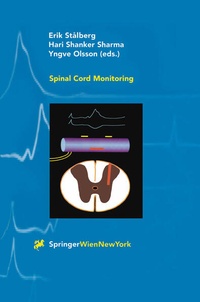
Spinal Cord Monitoring
Basic Principles, Regeneration, Pathophysiology, and Clinical Aspects
Published on 16. November 1998
Book
Hardback
XV, 531 pages
978-3-211-82923-3 (ISBN)
Description
During the last decades, research on spinal cord has attracted a great deal of attention because of problems such as sensory-motor and autonomic dysfunctions associated with traumatic and other injuries. Recording of spinal cord evoked potentials is one of the most promising approaches to understand the spinal cord function. However, the details of the evoked potentials and their significance in various pathological conditions are not yet fully characterized.
This book summarizes new findings in the field of electrophysiology and relates this knowledge to pathology and regeneration research. It is the first one which deals in great detail with various ways to monitor spinal cord function in experimental and clinical situations. It provides an up-to-date knowledge regarding spinal cord bioelectrical activity and its modification with pharmacological agents and covers new aspects of regeneration studies, particularly the role of myelin associated inhibitory molecules. A section is devoted to clinical studies dealing with electrical activity, pathology, and current therapeutic measures.
This volume will be useful both to basic and clinical neuroscientists engaged in the field of neurology, neurophysiology, neurochemistry, neurosurgery, neuropathology, and related disciplines in order to understand basic functions of the spinal cord and to stimulate further research in this rapidly advancing field.
Reviews / Votes
"... Das Konzept des Buches, Grundlagenforschung und klinische Bedeutung zusammenzubringen, ist durchwegs gegluckt ... bietet detaillierte umfassende Information ... ein wertvolles Werk fur neurophysiologisch orientierte Neurologen, Rehabilitationsmediziner und Physiologen." Der Nervenarzt 10/2000More details
Edition
1998 ed.
Language
English
Place of publication
Vienna
Austria
Publishing group
Springer Wien
Target group
Professional and scholarly
Research
Illustrations
XV, 531 p.
Dimensions
Height: 241 mm
Width: 160 mm
Thickness: 39 mm
Weight
1087 gr
ISBN-13
978-3-211-82923-3 (9783211829233)
DOI
10.1007/978-3-7091-6464-8
Schweitzer Classification
Other editions
Additional editions
Eric Stalberg | Hari S. Sharma | Yngve Olsson
Spinal Cord Monitoring
Basic Principles, Regeneration, Pathophysiology, and Clinical Aspects
E-Book
12/2012
Springer
€149.79
Available for download
Eric Stalberg | Hari S. Sharma | Yngve Olsson
Spinal Cord Monitoring
Basic Principles, Regeneration, Pathophysiology, and Clinical Aspects
Book
12/2012
Springer
€160.49
Shipment within 10-15 days
Content
Section I: Spinal cord blood flow, neurochemistry and sensory function.- 1.Spinal cord blood flow and metabolism in transient spinal ischemia.- 2.Calcium binding proteins in the spinal cord: physiological significance.- 3.Substance P Transmitter or regulator in spinal sensory mechanisms?.- 4.The role of glycine in pain and spasticity.- 5.Prostaglandin system in the pathophysiology of the spinal cord. A neuroanatomical study.- Section II: Spinal cord regeneration and repair.- 6.Neurotrophic factors and CNS regeneration.- 7.Regeneration in the axotomised cord: influence of cyclosporin A and neonatal immune desensitization in mammals.- 8.Neurotrophic factors attenuate neuronal nitric oxide synthase upregulation, microvascular permeability disturbances, edema formation and cell injury in the spinal cord following trauma.- Section III: Spinal cord electrophysiology: methods and various techniques.- 9.A Cerebellar evoked potential for spinal cord monitoring.- 10.Generation of magnetic evoked spinal cord potentials.- 11.Magnetic stimulation of spinal nerve roots and cortical somatosensory evoked potentials.- 12.A combination of microdialysis, electrophysiology and histology for exploring secondary damage upon spinal cord injury.- Section IV: Spinal cord evoked potentials: pathophysioiogy and pharmacological aspects.- 13.Spinal cord bioelectrical activity, edema and cell injury following a focal trauma to the rat spinal cord.- 14.Spinal cord blood flow and evoked potentials as outcome measures for experimental spinal cord injury.- Section V: Spinal cord monitoring in clinic: pathology and diseases processes.- 15.White matter changes in human spinal cord injury.- 16.Motor control in human spinal cord injury.- 17.Intraoperative neurophysiology of the corticospinal tract.- 18.Corticospinal volleys evoked by transcranial electrical and magnetic stimulation.- Section VI: Spinal cord monitoring in clinic: pharmacology, therapy and outcome measures.- 19.Novel approaches to the treatment of post compressive spinal cord injury.- 20.The multicentre outcome survey of spinal cord monitoring: monitoring reduces neurologic deficits.- 21.Effect of anaesthetics on somatosensory and motor evoked potentials in humans.- 22.Intraoperative spinal cord monitoring: clinical overview.- Author index.