

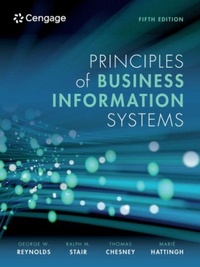
Principles of Business Information Systems
5th Edition
Published on 21. February 2025
Book
Paperback/Softback
608 pages
978-1-4737-9129-9 (ISBN)
Description
The new fifth edition of Principles of Business Information Systems features new cases, new questions and assignments and the latest technologies, whilst retaining its comprehensive coverage of Information Systems issues. It also boasts a wealth of real-world examples from a broad range of countries and updated coverage of IT and technological issues, making it perfect for courses that prepare students for the modern corporate world.
More details
Edition
5th edition
Language
English
Place of publication
London
United Kingdom
Target group
College/higher education
Dimensions
Height: 259 mm
Width: 196 mm
Thickness: 27 mm
Weight
1088 gr
ISBN-13
978-1-4737-9129-9 (9781473791299)
Copyright in bibliographic data and cover images is held by Nielsen Book Services Limited or by the publishers or by their respective licensors: all rights reserved.
Schweitzer Classification
Persons
Ralph Stair has taught information systems at many universities throughout his academic career, including Florida State University, the University of New Orleans, the University of Washington and the University of Oregon. He earned a B.S. in chemical engineering from Purdue University, an M.B.A. from Tulane University, and a Ph.D. from the University of Oregon. A well-respected author, esteemed researcher and leading educator, he has published numerous articles and popular textbooks, including Succeeding with Technology, Programming in Basic, and more. George Reynolds taught information systems at the University of Cincinnati, Xavier University (Ohio), Miami University (Ohio), the College of Mount St. Joseph, and Strayer University. Professor Reynolds authored more than two dozen popular textbooks addressing various aspects of today's information technology and business. Thomas Chesney is Professor of Computational Social Science at Nottingham University Business School, UK where he studies the behaviour of networked individuals. His work has appeared in the Information Systems Journal and Decision Support Systems. Marie Hattingh is an Associate Professor of Informatics at the University of Pretoria where she coordinates the capstone project and lectures on research methodologies at postgraduate level. She has published several papers on systems analysis and design pedagogy and community informatics. Marie has a PhD in Informatics from the University of Pretoria, a MMil in Technology, BMil Hons in Technology and BMil (BSc) from Stellenbosch University. She was the joint winner of the Teaching Excellence award of the University of Pretoria in 2020. Marie is the Vice-President of the South African Institute for Computer Scientists and Information Technologists (SAICSIT).
Content
Part 1: Information Systems in Business and Society
1. Information Systems: People, Technology, Processes and Structure
2. Secure Information Systems
3.Corporate and Individual Accountability: Ethical, Legal and Social Issues
Part 2: Technology Infrastructure
4. Hardware and Software
5. Database Systems and Management
6. Business Intelligence: Big Data and Analytics
7. Networks: An Interconnected World
8. Cloud Computing and the Internet of Things
Part 3: Business Information Systems
9. eCommerce
10. Enterprise Systems
11. Artificial Intelligence (AI) and Automation
Part 4: Planning, Implementing, and Managing Information Systems
12. Strategic Planning and Project Management
13. System Acquisition and Development
1. Information Systems: People, Technology, Processes and Structure
2. Secure Information Systems
3.Corporate and Individual Accountability: Ethical, Legal and Social Issues
Part 2: Technology Infrastructure
4. Hardware and Software
5. Database Systems and Management
6. Business Intelligence: Big Data and Analytics
7. Networks: An Interconnected World
8. Cloud Computing and the Internet of Things
Part 3: Business Information Systems
9. eCommerce
10. Enterprise Systems
11. Artificial Intelligence (AI) and Automation
Part 4: Planning, Implementing, and Managing Information Systems
12. Strategic Planning and Project Management
13. System Acquisition and Development