

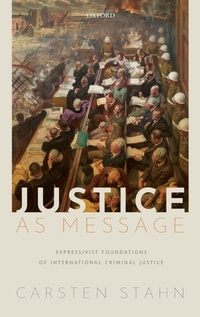
Justice as Message
Expressivist Foundations of International Criminal Justice
Published on 28. May 2020
Book
Hardback
470 pages
978-0-19-886418-9 (ISBN)
Description
International criminal justice relies on messages, speech acts, and performative practices in order to convey social meaning. Major criminal proceedings, such as Nuremberg, Tokyo, and other post-World War II trials have been branded as 'spectacles of didactic legality'. However, the expressive and communicative functions of law are often side-lined in institutional discourse and legal practice. This innovative work brings these functions centre-stage, developing the idea of justice as message and outlining the expressivist foundations of international criminal justice in a systematic way.
Professor Carsten Stahn examines the origins of the expressivist theory in the sociology of law and the justification of punishment, its articulation in practice, and its broader role as method of international law. He shows that expression and communication is not only an inherent part of the punitive functions of international criminal justice, but is represented in a whole spectrum of practices: norm expression and diffusion, institutional actions, performative aspects of criminal procedures, and repair of harm. He argues that expressivism is not a classical justification of justice or punishment on its own, but rather a means to understand its aspirations and limitations, to explain how justice is produced and to ground punishment rationales. This book is an invitation to think beyond the confines of the legal discipline, and to engage with the multidisciplinary foundations and possibilities of the international criminal justice project.
Professor Carsten Stahn examines the origins of the expressivist theory in the sociology of law and the justification of punishment, its articulation in practice, and its broader role as method of international law. He shows that expression and communication is not only an inherent part of the punitive functions of international criminal justice, but is represented in a whole spectrum of practices: norm expression and diffusion, institutional actions, performative aspects of criminal procedures, and repair of harm. He argues that expressivism is not a classical justification of justice or punishment on its own, but rather a means to understand its aspirations and limitations, to explain how justice is produced and to ground punishment rationales. This book is an invitation to think beyond the confines of the legal discipline, and to engage with the multidisciplinary foundations and possibilities of the international criminal justice project.
Reviews / Votes
Stahn has succeeded in producing an impressive work by constructing a new expressive typology in international criminal law ... and aligning the comprehensive range of expressivist literature in international criminal law with it. In particular, the new typology is suitable for the analysis of other areas of law, which is why it is also recommended reading for interested readers outside the field of international criminal law. * Philipp Guenther, Zeitschrift fuer Rechtssoziologie, Zeitschrift fuer Rechtssoziologie *More details
Language
English
Place of publication
Oxford
United Kingdom
Target group
College/higher education
Dimensions
Height: 240 mm
Width: 161 mm
Thickness: 30 mm
Weight
866 gr
ISBN-13
978-0-19-886418-9 (9780198864189)
Copyright in bibliographic data and cover images is held by Nielsen Book Services Limited or by the publishers or by their respective licensors: all rights reserved.
Schweitzer Classification
Other editions
Additional editions
E-Book
05/2020
1st Edition
OUP eBook
€71.99
Available for download
E-Book
05/2020
1st Edition
OUP eBook
€82.99
Available for download
Person
Carsten Stahn is Professor of International Criminal Law and Global Justice at Leiden University and is Professor of Public International Law and International Criminal Justice at Queen's University Belfast School of Law. He has previously worked as Legal Officer in Chambers of the International Criminal Court (2003-2007) and as Research Fellow at the Max Planck Institute for Comparative Public Law and International Law (2000-2003). He has published 13 books and over 70 articles/essays in different fields of international law and international justice. He obtained his PhD degree (summa cum laude) from Humboldt University Berlin after completing his First and Second State Exam in Law in Germany. He holds LL.M. degrees from New York University and Cologne/Paris I (Pantheon-Sorbonne).
Author
Professor of International Criminal Law and Global Justice, Leiden Law School and Professor of Public International Law and International Criminal JusticeProfessor of International Criminal Law and Global Justice, Leiden Law School and Professor of Public International Law and International Criminal Justice, Queen's University Belfast School of Law
Content
Introduction
1: International Criminal Justice and Expressivist Theory
2: Norm Expression: Norm Affirmation, Norm Projection, and Storytelling
3: Institutional Expression: The Medium as Message
4: Procedural Expression: Judicial Theater, Legal Performance, and Discursive Justice
5: Remedial Expression: Expressive Punishment and Repair of Harm
6: International Criminal Law as Expressivist Justice: Meanings, Implications, and Critiques
1: International Criminal Justice and Expressivist Theory
2: Norm Expression: Norm Affirmation, Norm Projection, and Storytelling
3: Institutional Expression: The Medium as Message
4: Procedural Expression: Judicial Theater, Legal Performance, and Discursive Justice
5: Remedial Expression: Expressive Punishment and Repair of Harm
6: International Criminal Law as Expressivist Justice: Meanings, Implications, and Critiques