

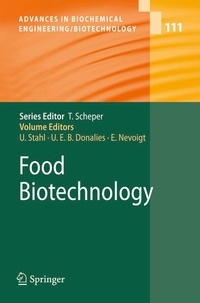
Food Biotechnology
Published on 28. August 2008
Book
Hardback
XII, 269 pages
978-3-540-70535-2 (ISBN)
Description
The use of fermentation in food processing was originally developed as amethodforpreserving foodandhasprobablybeen practisedsince mankind has been living in settlements. Nowadays food biotechnology involves a lot more than simply preventing spoilage and ranges from improving salub- ousness, improving texture to enriching foodstuffs with substances that are favourable to health and well-being and the prevention of illness. The basic principle of fermentation is mostly to exploit the metabolism of a speci?c microorganism.The activityofthese microorganismstakes place inthe fo- stuff itself or in the intestine (probiotica), whereby they produce primary or secondary metabolites via the fermentation process. Naturally, probiotica or metabolites in particular can be produced as pure cultures or as pure s- stances and can then be administered as pharma productsor foodadditives. The foodbiotechnology?eldis extremely broadandis developing rapidly. An important factor is that the average age of humans is increasing, but the age of well-being, that is how long one feels ?t and healthy, is stagnating. It has been shown that this so-called age of well-being can be in?uenced by individual nutrition habits and, complemented by genetic predisposition, can even be increased.
In addition, common diseases and illnesses such as the prevalence of being overweight or diabetes can even be prevented through food, pro- and prebiotica and food additives. One emphasis of this volume is onthis area.
In addition, common diseases and illnesses such as the prevalence of being overweight or diabetes can even be prevented through food, pro- and prebiotica and food additives. One emphasis of this volume is onthis area.
Reviews / Votes
From the reviews:
"This work, with only six chapters, covers a fraction of the vast area of food biotechnology . . the detailed information included in each chapter is meticulously referenced and complete. . the chapters are well written and easy to understand. The many examples used by the authors give the book a very practical feel, making it an easier read than one might expect. Summing Up: Highly recommended. Upper-division undergraduates through professionals in biology, biochemistry, food science, and biological engineering." (I. U. Gruen, Choice, Vol. 46 (11), 2009)
More details
Series
Edition
2008 ed.
Language
English
Place of publication
Berlin
Germany
Publishing group
Springer Berlin
Target group
Professional and scholarly
Research
Illustrations
15 s/w Abbildungen
XII, 269 p. 15 illus.
Dimensions
Height: 23.5 cm
Width: 15.5 cm
Weight
583 gr
ISBN-13
978-3-540-70535-2 (9783540705352)
DOI
10.1007/978-3-540-70536-9
Schweitzer Classification
Other editions
Additional editions
Ulf Stahl | Ute E.B. Donalies | Elke Nevoigt
Food Biotechnology
Book
11/2010
Springer
€320.99
Shipment within 7-9 days
Content
Probiotics, Prebiotics, and Synbiotics.- Improvement of Saccharomyces Yeast Strains Used in Brewing, Wine Making and Baking.- Filamentous Fungi for Production of Food Additives and Processing Aids.- Plant Biotechnology: Transgenic Crops.- Production of Secondary Metabolites Using Plant Cell Cultures.- Food and Agricultural Biotechnology: A Summary and Analysis of Ethical Concerns.